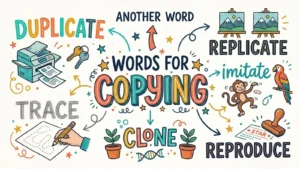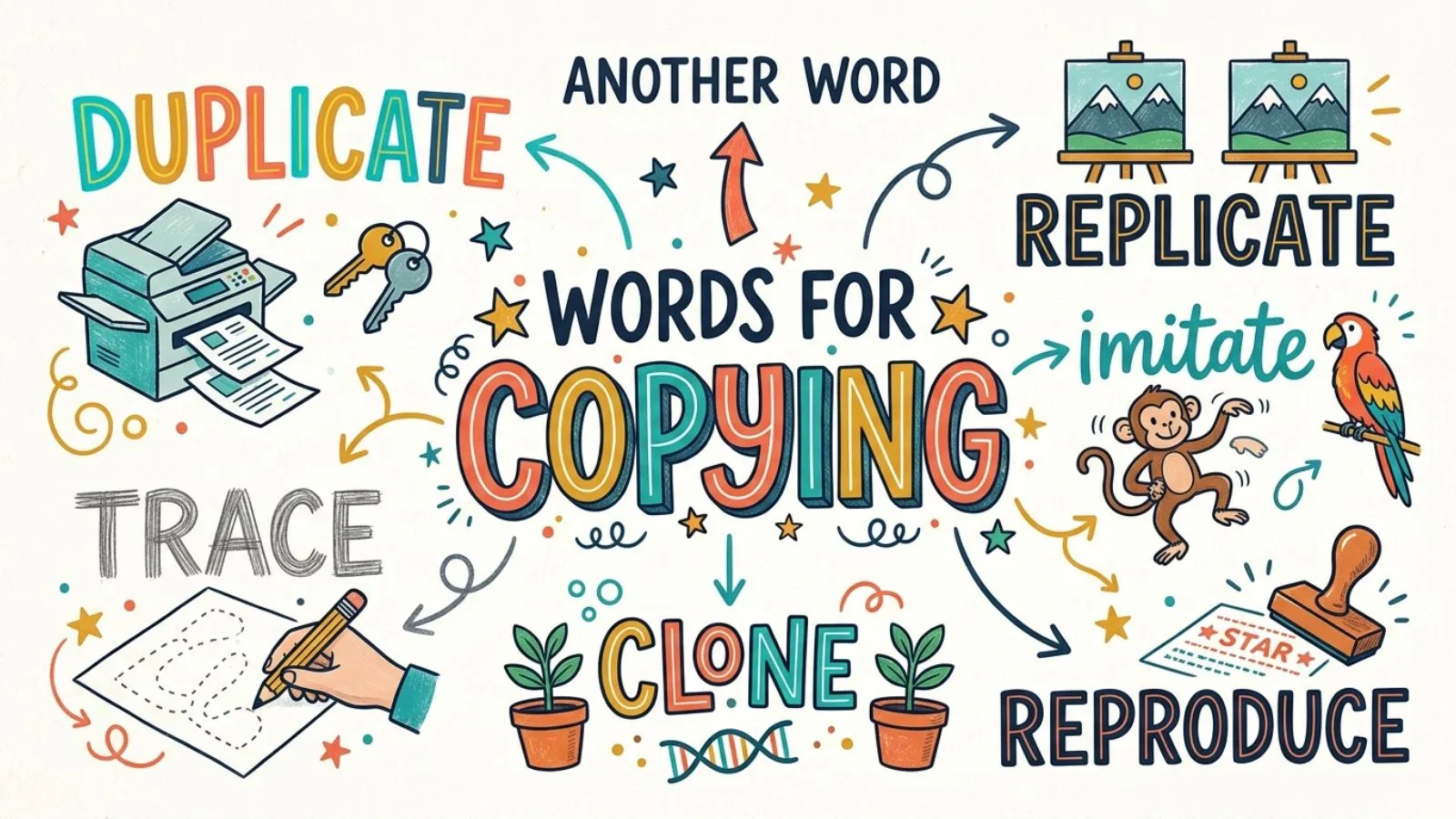
Copying can describe many actions, including repeating information, creating identical files, learning through imitation, borrowing ideas, and reproducing text or images.
Some alternatives are neutral, while others suggest dishonesty or a lack of originality. Understanding these differences helps you choose the right word for schoolwork, business writing, technology, creative work, and everyday conversation.
Quick list: Duplicating, imitating, reproducing, replicating, emulating, repeating, transcribing, paraphrasing, plagiarizing, and mimicking.
This guide explores 50 alternatives to copying, with definitions, pronunciation guides, usage notes, examples, common word partnerships, and practical explanations to help you choose the most accurate word.
At a Glance: Copying Synonyms and Related Alternatives
| Alternative | Part of Speech | Meaning | Register / Tone | Ideal Context |
| Duplicating | Verb | Making another copy | Neutral | Files and documents |
| Imitating | Verb | Following a model or style | Neutral | Behavior and art |
| Reproducing | Verb | Making a copy or likeness | Formal / neutral | Images and records |
| Replicating | Verb | Making a close or exact copy | Technical | Science and technology |
| Mimicking | Verb | Copying actions, sounds, or speech | Informal / neutral | Voices and behavior |
| Emulating | Verb | Trying to match a successful model | Positive / formal | Skills and performance |
| Repeating | Verb | Saying or doing something again | Neutral | Words and actions |
| Transcribing | Verb | Writing down spoken or recorded words | Formal | Interviews and recordings |
| Plagiarizing | Verb | Using another’s work as one’s own | Negative | Academic and creative work |
| Parroting | Verb | Repeating words without much understanding | Critical / informal | Speech and opinions |
These alternatives overlap, but they are not interchangeable in every sentence. Duplicate focuses on making another version, imitate focuses on following a model, and plagiarize specifically concerns presenting another person’s work or ideas as one’s own without proper acknowledgment.
Collins English Dictionary
Which Word Should You Use?
| If you want to… | Use | Why |
| Make another version of a file | Duplicate | Clearly describes creating another copy |
| Copy someone’s behavior | Imitate | Focuses on actions, habits, or manner |
| Create a copy of a picture | Reproduce | Works well for artwork and images |
| Make an exact version of something | Replicate | Emphasizes close or exact matching |
| Copy someone’s voice or gestures | Mimic | Highlights recognizable details |
| Learn from a successful example | Emulate | Suggests a goal of matching or improving performance |
| Write down spoken words | Transcribe | Refers to converting speech into written text |
| Use another person’s work dishonestly | Plagiarize | Identifies an issue of uncredited use |
| Repeat information without understanding it | Parrot | Suggests thoughtless repetition |
| Copy data from one place to another | Transfer | Describes moving data rather than necessarily making a duplicate |
Exploring the Multiple Meanings of “Copying”
1. Making a Duplicate
- Meaning: Creating another version of an existing item.
- Explanation: This sense applies to documents, photographs, files, keys, and other objects. The new version may be identical or very similar to the original.
- Example: I am copying the report before sending it to the team.
2. Following Someone’s Behavior or Style
- Meaning: Doing something in a way that resembles another person or model.
- Explanation: Copying can involve speech, clothing, gestures, habits, artistic styles, or methods. It does not always mean dishonesty; people often learn through imitation.
- Example: The young musician is copying the rhythm of her teacher.
3. Repeating Words or Information
- Meaning: Reproducing information that has already been spoken or written.
- Explanation: This can mean writing text from a source, repeating an instruction, or recording spoken words. Transcribing is more specific when speech is turned into writing.
- Example: The student copied the definition into her notebook.
4. Reusing Someone’s Work Without Credit
- Meaning: Using another person’s words, ideas, or creative work without proper acknowledgment.
- Explanation: Plagiarism is a particular form of copying. Not every act of copying is plagiarism; the context, permission, attribution, and applicable rules matter.
- Example: The editor rejected the article because it contained plagiarized passages.
5. Learning by Example
- Meaning: Adopting a method or pattern after observing someone else.
- Explanation: Words such as emulating and following can describe copying as a useful way to learn. They often suggest a deliberate effort to develop a skill.
- Example: He is emulating the careful practice habits of an experienced pianist.
6. Copying in Technology and Science
- Meaning: Creating another instance of data, a process, or a structure.
- Explanation: Duplicating and replicating are common in technical settings. Their precise meaning depends on the field; for example, a replicated experiment is not simply a copied document.
- Example: The team replicated the experiment to check the results.
Sources: Cambridge Dictionary
definition in the Cambridge English Dictionary
; Collins Dictionary
Collins English Dictionary
Analyzing 50 Copying Alternatives in Detail
The following alternatives include direct synonyms, specialized terms, and related expressions. Some describe making copies, while others refer to imitation, repetition, or the unauthorized use of another person’s work.
Group 1: Direct Alternatives for Making Copies
1. Duplicating
IPA: US /ˈduːplɪˌkeɪtɪŋ/ · UK /ˈdjuːplɪkeɪtɪŋ/
Definition: Making an additional version of something.
- Usage: A close synonym for copying when creating another file, document, or object.
- Example: She is duplicating the files for backup.
2. Reproducing
IPA: US /ˌriːprəˈduːsɪŋ/ · UK /ˌriːprəˈdjuːsɪŋ/
Definition: Making a copy or representation of something.
- Usage: Common for artwork, photographs, printed material, and recorded information.
- Example: The gallery is reproducing the painting for its catalog.
3. Replicating
IPA: US /ˈrɛplɪˌkeɪtɪŋ/ · UK /ˈrɛplɪkeɪtɪŋ/
Definition: Making a copy or repeating a process.
- Usage: Particularly useful in science, technology, and situations that require close matching.
- Example: The researchers are replicating the test.
4. Copying
IPA: US /ˈkɑːpiɪŋ/ · UK /ˈkɒpiɪŋ/
Definition: Making a copy or following an existing model.
- Usage: The broadest and most everyday term for the action.
- Example: He is copying the notes into his planner.
5. Photocopying
IPA: US /ˈfoʊtoʊˌkɑːpiɪŋ/ · UK /ˈfəʊtəʊˌkɒpiɪŋ/
Definition: Making paper copies with a photocopier.
- Usage: Use this specific term when a document or image is reproduced using photocopying equipment.
- Example: The assistant is photocopying the application forms.
6. Reprinting
IPA: US /ˌriːˈprɪntɪŋ/ · UK /ˌriːˈprɪntɪŋ/
Definition: Printing something again.
- Usage: Related to copying when the goal is to produce more printed copies; it does not necessarily mean copying by hand.
- Example: The publisher is reprinting the popular guide.
7. Recopying
IPA: US /ˌriːˈkɑːpiɪŋ/ · UK /ˌriːˈkɒpiɪŋ/
Definition: Copying something again.
- Usage: Appropriate when an earlier copy needs correction or replacement.
- Example: She is recopying the page because the ink smudged.
8. Cloning
IPA: US /ˈkloʊnɪŋ/ · UK /ˈkləʊnɪŋ/
Definition: Creating a genetic or closely matching copy of something.
- Usage: A specialized alternative in biology and computing, rather than a general substitute for copying.
- Example: The technician is cloning the computer’s drive.
9. Mirroring
IPA: US /ˈmɪrərɪŋ/ · UK /ˈmɪrərɪŋ/
Definition: Creating or maintaining a matching version of something.
- Usage: Common in computing and data storage; it can also describe reflecting someone’s behavior.
- Example: The server is mirroring the files on another machine.
Group 2: Copying Behavior, Style, or Appearance
10. Imitating
IPA: US /ˈɪməˌteɪtɪŋ/ · UK /ˈɪmɪteɪtɪŋ/
Definition: Following someone’s behavior, style, or example.
- Usage: A broad alternative for copying a person or creative style, whether intentionally or as a way to learn.
- Example: The child is imitating his older brother.
11. Mimicking
IPA: US /ˈmɪmɪkɪŋ/ · UK /ˈmɪmɪkɪŋ/
Definition: Closely copying someone’s actions, voice, or manner.
- Usage: Often used for speech, gestures, sounds, and humorous imitation.
- Example: The performer is mimicking a famous singer’s voice.
12. Emulating
IPA: US /ˈɛmjəˌleɪtɪŋ/ · UK /ˈɛmjʊleɪtɪŋ/
Definition: Trying to match or equal a person’s achievements or methods.
- Usage: Usually more positive than copying because it suggests learning from a model or aiming for a high standard.
- Example: She is emulating the best habits of her coach.
13. Aping
IPA: US /ˈeɪpɪŋ/ · UK /ˈeɪpɪŋ/
Definition: Copying someone’s behavior or style, often unthinkingly.
- Usage: Usually critical; it may suggest imitation without originality.
- Example: The brand is aping its competitor’s design.
14. Mirroring
IPA: US /ˈmɪrərɪŋ/ · UK /ˈmɪrərɪŋ/
Definition: Reflecting or matching another person’s behavior or expression.
- Usage: In social situations, it can describe matching someone’s gestures or tone. This overlaps with item 9 but has a different human-behavior focus.
- Example: He was mirroring her relaxed speaking style.
15. Parroting
IPA: US /ˈpɛrə.tɪŋ/ · UK /ˈpærətɪŋ/
Definition: Repeating words or statements without showing independent thought.
- Usage: Informal and often critical, especially when someone repeats another person’s opinion.
- Example: The commentator was parroting claims he had not checked.
16. Echoing
IPA: US /ˈɛkoʊɪŋ/ · UK /ˈekəʊɪŋ/
Definition: Repeating or expressing a similar idea or sound.
- Usage: Often figurative; an echoed idea may be similar rather than an exact copy.
- Example: Her speech was echoing the concerns raised by local residents.
17. Modeling
IPA: US /ˈmɑːdəlɪŋ/ · UK /ˈmɒdəlɪŋ/
Definition: Demonstrating or using a pattern for others to follow.
- Usage: A related term for teaching and behavior; it does not always mean copying an existing work.
- Example: The teacher is modeling the correct way to solve the problem.
18. Following
IPA: US /ˈfɑːloʊɪŋ/ · UK /ˈfɒləʊɪŋ/
Definition: Acting according to an example, method, or set of directions.
- Usage: A broad contextual alternative when someone follows a model rather than reproducing it exactly.
- Example: The new designer is following the team’s established style.
Group 3: Repeating or Recording Information
19. Repeating
IPA: US /rɪˈpiːtɪŋ/ · UK /rɪˈpiːtɪŋ/
Definition: Saying or doing something again.
- Usage: Suitable for repeated words, actions, instructions, or information, but not necessarily for creating a duplicate object.
- Example: He kept repeating the sentence to remember it.
20. Transcribing
IPA: US /trænˈskraɪbɪŋ/ · UK /trænˈskraɪbɪŋ/
Definition: Writing down spoken words or converting recorded material into written form.
- Usage: More precise than copying when the source is speech or audio.
- Example: She is transcribing the interview.
21. Quoting
IPA: US /ˈkwoʊtɪŋ/ · UK /ˈkwəʊtɪŋ/
Definition: Repeating another person’s exact words, usually with acknowledgment.
- Usage: A specific form of reproducing text or speech; it is not inherently dishonest.
- Example: The writer is quoting a line from the report.
22. Restating
IPA: US /ˌriːˈsteɪtɪŋ/ · UK /ˌriːˈsteɪtɪŋ/
Definition: Expressing the same information again.
- Usage: Often involves changing the wording while keeping the main meaning.
- Example: She is restating the instructions in simpler language.
23. Paraphrasing
IPA: US /ˈpærəˌfreɪzɪŋ/ · UK /ˈpærəfreɪzɪŋ/
Definition: Expressing someone else’s meaning in different words.
- Usage: Not exact copying because the wording changes; sources may still need acknowledgment.
- Example: He is paraphrasing the article for his notes.
24. Reciting
IPA: US /rɪˈsaɪtɪŋ/ · UK /rɪˈsaɪtɪŋ/
Definition: Saying memorized words aloud.
- Usage: Related to copying when someone reproduces text from memory rather than making a physical copy.
- Example: The student is reciting the poem from memory.
25. Reiterating
IPA: US /riˈɪtəˌreɪtɪŋ/ · UK /riˈɪtəreɪtɪŋ/
Definition: Stating something again, often for emphasis.
- Usage: More formal than repeating and usually concerns ideas or points rather than exact duplication.
- Example: The manager is reiterating the safety rules.
26. Reproducing verbatim
IPA: US /ˌriːprəˈduːsɪŋ vɜːrˈbeɪtɪm/ · UK /ˌriːprəˈdjuːsɪŋ vɜːˈbeɪtɪm/
Definition: Reproducing words exactly as they appeared or were spoken.
- Usage: A descriptive phrase rather than a single-word synonym; useful when exact wording matters.
- Example: The clerk is reproducing the witness’s statement verbatim.
Group 4: Copying Ideas, Designs, or Creative Work
27. Plagiarizing
IPA: US /ˈpleɪdʒəˌraɪzɪŋ/ · UK /ˈpleɪdʒəraɪzɪŋ/
Definition: Using another person’s work or ideas as one’s own without proper acknowledgment.
- Usage: A negative, specific term for dishonest or improperly attributed use; not every act of copying is plagiarism.
- Example: The student was accused of plagiarizing sections of the essay.
28. Borrowing
IPA: US /ˈbɑːroʊɪŋ/ · UK /ˈbɒrəʊɪŋ/
Definition: Taking or using something that belongs to another person or source, often temporarily or with permission.
- Usage: A contextual alternative for adopting ideas or elements; it does not automatically mean copying or plagiarism.
- Example: The designer is borrowing colors from nature.
29. Appropriating
IPA: US /əˈproʊpriˌeɪtɪŋ/ · UK /əˈprəʊprɪeɪtɪŋ/
Definition: Taking something for one’s own use.
- Usage: Can describe taking ideas, styles, or creative material, sometimes controversially. It is not an exact synonym for ordinary copying.
- Example: The artist was criticized for appropriating another designer’s work.
30. Tracing
IPA: US /ˈtreɪsɪŋ/ · UK /ˈtreɪsɪŋ/
Definition: Following the lines or outline of an image to reproduce it.
- Usage: Specific to drawing, design, and tracking the origin or path of something.
- Example: She is tracing the outline of the illustration.
31. Forging
IPA: US /ˈfɔːrdʒɪŋ/ · UK /ˈfɔːdʒɪŋ/
Definition: Making a false copy or imitation intended to deceive.
- Usage: Strongly negative when referring to fake signatures, documents, or works of art; not a neutral alternative for copying.
- Example: The investigation uncovered someone forging signatures.
32. Counterfeiting
IPA: US /ˈkaʊntərˌfɪtɪŋ/ · UK /ˈkaʊntəˌfɪtɪŋ/
Definition: Making an imitation intended to pass as genuine.
- Usage: Usually applies to money, branded goods, documents, or other items where deception is involved.
- Example: The company reported a counterfeit version of its product.
33. Simulating
IPA: US /ˈsɪmjəˌleɪtɪŋ/ · UK /ˈsɪmjʊleɪtɪŋ/
Definition: Reproducing the behavior or appearance of a real system or situation.
- Usage: A related technical term; simulations model behavior and may not copy the original exactly.
- Example: The software is simulating the movement of a vehicle.
34. Parodying
IPA: US /ˈpærəˌdiːɪŋ/ · UK /ˈpærədiɪŋ/
Definition: Imitating a work or style for comic or critical effect.
- Usage: A specialized form of imitation that changes or exaggerates features for a purpose.
- Example: The comedian is parodying the style of a television advertisement.
35. Recreating
IPA: US /ˌriːkriˈeɪtɪŋ/ · UK /ˌriːkriˈeɪtɪŋ/
Definition: Making something again or producing a version of an earlier thing or experience.
- Usage: Often involves rebuilding or approximating rather than making an exact duplicate.
- Example: The museum team is recreating a historic room.
Group 5: Technical, Scientific, and Specialized Alternatives
36. Cloning data
IPA: US /ˈkloʊnɪŋ ˈdeɪtə/ · UK /ˈkləʊnɪŋ ˈdeɪtə/
Definition: Creating a separate instance of a dataset or digital system.
- Usage: A technical phrase that is more specific than copying in certain computing contexts.
- Example: The developer is cloning the test database.
37. Backing up
IPA: US /ˈbækɪŋ ʌp/ · UK /ˈbækɪŋ ʌp/
Definition: Making a protective copy of data or files.
- Usage: A purpose-specific alternative: backing up involves copying for recovery or protection.
- Example: She is backing up her photographs to an external drive.
38. Archiving
IPA: US /ˈɑːrˌkaɪvɪŋ/ · UK /ˈɑːkaɪvɪŋ/
Definition: Storing records or files for future reference.
- Usage: Related to copying when records are preserved, but archiving does not always require creating another copy.
- Example: The office is archiving its old reports.
39. Exporting
IPA: US /ɪkˈspɔːrtɪŋ/ · UK /ɪkˈspɔːtɪŋ/
Definition: Moving data or content into a different format or system.
- Usage: A related technical term, not an exact synonym; exported content may be transformed as well as copied.
- Example: He is exporting the spreadsheet as a PDF.
40. Importing
IPA: US /ɪmˈpɔːrtɪŋ/ · UK /ɪmˈpɔːtɪŋ/
Definition: Bringing data or content into a system or application.
- Usage: Related to copying when content is brought in from another source; it describes the destination-side action.
- Example: The analyst is importing the data into the new program.
41. Transferring
IPA: US /trænsˈfɜːrɪŋ/ · UK /trænsˈfɜːrɪŋ/
Definition: Moving something from one place, person, or system to another.
- Usage: Not an exact synonym because transferring may move an item without leaving a copy behind.
- Example: The technician is transferring the files to a new computer.
42. Duplicating records
IPA: US /ˈduːplɪˌkeɪtɪŋ ˈrɛkərdz/ · UK /ˈdjuːplɪkeɪtɪŋ ˈrekɔːdz/
Definition: Creating additional versions of stored information.
- Usage: A descriptive phrase for databases, administrative records, and document management.
- Example: The system is duplicating records during the import process.
Group 6: Broader and Context-Specific Alternatives
43. Repeating a pattern
IPA: US /rɪˈpiːtɪŋ ə ˈpætərn/ · UK /rɪˈpiːtɪŋ ə ˈpætən/
Definition: Producing the same arrangement or sequence again.
- Usage: A phrase for designs, behaviors, sounds, and events rather than an exact substitute for copying.
- Example: The artist is repeating a pattern across the fabric.
44. Following suit
IPA: US /ˈfɑːloʊɪŋ suːt/ · UK /ˈfɒləʊɪŋ suːt/
Definition: Doing what another person has done.
- Usage: An established expression for following someone’s action or decision, not necessarily copying the details.
- Example: One store lowered its prices, and its competitors followed suit.
45. Taking inspiration from
IPA: US /ˈteɪkɪŋ ˌɪnspəˈreɪʃən frəm/ · UK /ˈteɪkɪŋ ˌɪnspəˈreɪʃən frəm/
Definition: Using an idea or example as a source of creative influence.
- Usage: A softer, non-exact alternative that suggests developing something new from an existing influence.
- Example: The illustrator is taking inspiration from old storybooks.
46. Patterning
IPA: US /ˈpætərnɪŋ/ · UK /ˈpætənɪŋ/
Definition: Arranging or shaping something according to a pattern.
- Usage: A specialized alternative in design, behavior, and technical discussion; not a general replacement for copying.
- Example: The designer is patterning the new layout on an earlier model.
47. Modeling on
IPA: US /ˈmɑːdəlɪŋ ɑːn/ · UK /ˈmɒdəlɪŋ ɒn/
Definition: Designing or developing something using another thing as a model.
- Usage: Suitable for plans, systems, products, and creative work that follow an existing example.
- Example: The architect is modeling the new building on a historic design.
48. Emulating in software
IPA: US /ˈɛmjəˌleɪtɪŋ ɪn ˈsɔːftwɛr/ · UK /ˈɛmjʊleɪtɪŋ ɪn ˈsɒftweə/
Definition: Reproducing the functions or behavior of one system in another.
- Usage: A specialized computing expression; emulation aims to match behavior, not necessarily duplicate the original code.
- Example: The program is emulating an older computer system.
49. Shadowing
IPA: US /ˈʃædoʊɪŋ/ · UK /ˈʃædəʊɪŋ/
Definition: Following someone closely, often to observe how they work.
- Usage: Related to learning from another person, but it does not itself mean making a copy.
- Example: The new employee is shadowing an experienced editor.
50. Echoing a style
IPA: US /ˈɛkoʊɪŋ ə staɪl/ · UK /ˈekəʊɪŋ ə staɪl/
Definition: Showing similarities to another person’s style or approach.
- Usage: A figurative phrase for resemblance or influence; it does not necessarily mean direct copying.
- Example: The new website is echoing the clean style of the original design.
Sources:
Collins English Dictionary
Copying vs. Imitating vs. Duplicating vs. Plagiarizing
These four words are among the most useful alternatives to copying, but each highlights a different action.
| Word | Main Difference | Example |
| Copying | Broad term for reproducing something or following a model | She copied the diagram into her notebook. |
| Imitating | Following someone’s behavior, style, or manner | He is imitating his favorite actor’s accent. |
| Duplicating | Making an additional version of something | The office is duplicating the signed document. |
| Plagiarizing | Using another person’s work as one’s own without proper acknowledgment | The writer was accused of plagiarizing a published article. |
The key distinction: Copying can be neutral, useful, or improper depending on the situation. Imitation can support learning, duplication usually creates another version, and plagiarism concerns the improper presentation of another person’s work.
Collins English Dictionary
Sources: Collins Dictionary
Collins English Dictionary
; Cambridge Dictionary
definition in the Cambridge English Dictionary
Copying and Opposite/Paired Word Pairs
| Word | Paired Word | Note |
| Copying | Creating | Creating can involve producing something original rather than reproducing existing material. |
| Imitating | Innovating | Imitating follows a model; innovating introduces something new. |
| Duplicating | Originalizing | These contrast duplication with developing an original version, though originalizing is uncommon. |
| Repeating | Varying | Repeating reproduces a pattern; varying it changes it. |
| Replicating | Experimenting | Replication repeats a method or test, while experimentation may introduce changes. |
| Plagiarizing | Crediting | Giving proper credit helps distinguish acknowledged use from presenting another person’s work as one’s own. |
| Parroting | Analyzing | Parroting repeats information; analyzing examines and evaluates it. |
| Reproducing | Originating | Reproducing makes another version; originating means creating or starting something. |
These pairs are contrasts, not all strict dictionary antonyms. The best opposite depends on whether copying means making a duplicate, following a style, repeating information, or using someone else’s work improperly.
Sources:
Collins English Dictionary
Common Word Partners of “Copying”
| Pattern | Common Partners | Example |
| Copying + noun | files, documents, text, images | Copying files takes only a few minutes. |
| Copying + from | a book, a website, a source | She was copying from the textbook. |
| Copying + someone’s work | artwork, research, writing | Copying someone’s work without permission can cause problems. |
| Copying + behavior | gestures, habits, mannerisms | The child is copying his father’s gestures. |
| Copying + style | fashion, design, writing | The new collection is copying an older style. |
| Copying + data | records, files, information | Copying data requires careful checking. |
| Accused of copying | text, designs, ideas | The company was accused of copying a rival’s design. |
| Copying + purpose | for practice, for reference, for backup | Copying the files for backup protects against data loss. |
Sources:
Collins English Dictionary
Idiomatic Phrases Featuring “Copying”
There are relatively few established idioms built around the exact word copying. The following are genuine expressions connected with imitation and repetition.
1. Copycat
- Meaning: A person who copies another person’s actions, ideas, or style. It can also describe something that imitates an existing product or idea.
- Example: His friends called the new design a copycat of the original.
2. Copy someone to the letter
- Meaning: To reproduce or follow something very closely, with little or no change.
- Example: The trainee copied the instructions to the letter.
3. Monkey see, monkey do
- Meaning: An expression describing someone who imitates another person without thinking independently.
- Example: The teacher reminded the class that learning should involve thought, not just monkey see, monkey do.
4. Follow in someone’s footsteps
- Meaning: To follow another person’s example, path, or career.
- Example: She hopes to follow in her mother’s footsteps and become a teacher.
These expressions are not all strict synonyms for copying. They describe a person who imitates, a very close reproduction, or the act of following another person’s example.
Sources:
Collins English Dictionary
Word Formation of “Copying”
Etymology & Structure
Copying is the present participle and gerund form of the verb copy. It consists of the base word copy and the suffix -ing. As a gerund, it can function as a noun in a sentence, as in “Copying takes time.” As a participle, it can form a continuous verb phrase, as in “She is copying the file.”
The word copy entered Middle English through Old French and Medieval Latin copia, a word associated with abundance and a transcript or reproduction. Its modern meaning developed to include making a duplicate and following a model.
Etymology, Origin & Meaning
Date and History
The noun copy is recorded in English from the 14th century. The verb meaning “to make a copy” also dates to the late 14th century. The figurative sense of following or imitating a model is recorded from the 17th century.
Etymology, Origin & Meaning
Word Class Variations
- Verb: Copy to make a copy or follow a model.
- Noun: Copy a duplicate or reproduced version.
- Gerund / present participle: Copying the act of making a copy or the ongoing action.
- Past tense / past participle: Copied, made a copy or followed a model.
- Third-person singular: Copies used with a singular subject in the present tense.
- Agent noun: Copier a person or machine that makes copies.
- Adjective: Copyable capable of being copied.
- Related noun: Copyist a person who makes written or artistic copies.
Sources:
ahdictionary.com
Common Word-Choice Mistakes
- Wrong: Duplicate someone’s accent. Better: Imitate someone’s accent. Use duplicates mainly for copies of things.
- Wrong: Transcribe a picture. Better: Reproduce or copy a picture. Transcribe usually refers to converting speech or recorded material into writing.
- Wrong: Paraphrase a sentence word for word. Better: Quote or reproduce the sentence verbatim if you mean to preserve its exact wording.
- Wrong: Replicate a person’s behavior when you mean to mock them. Better: Mimic or mock the person’s behavior, depending on your intended meaning.
- Wrong: Call every act of copying plagiarism. Better: Use plagiarism when someone improperly presents another person’s work or ideas as their own.
- Wrong: Use transfer when you mean to make an extra copy. Better: Use duplicate or copy if the original should remain in place.
- Wrong: Say that an artist plagiarized a style simply because it looks similar. Better: Describe the work as influenced by, inspired by, or imitating a style unless the evidence supports a stronger claim.
Frequently Asked Questions
1. What is the closest synonym for copying?
Duplicating is a close alternative when you mean making another version of something. Imitating is usually better when you mean following a person’s behavior or style.
2. What is another word for copying in formal writing?
Reproducing and replicating are useful formal alternatives. Choose reproducing for a copy or representation and replicating when emphasizing a close match or repeated process.
3. What is another word for copying someone’s behavior?
Imitating is the most general choice. Mimicking emphasizes close imitation of speech, gestures, or mannerisms, while emulating suggests trying to match someone’s achievements.
4. What is another word for copying and pasting?
Duplicating or reproducing may fit, depending on the context. In computing, copying and pasting specifically means placing copied content in another location.
5. What is a negative word for copying?
Plagiarizing describes improperly using another person’s work as one’s own. Aping and parroting can also sound critical, depending on the context.
6. Is copying the same as imitating?
No. Copying often suggests reproducing something, sometimes quite closely. Imitating usually means following a model, behavior, or style without necessarily creating an exact duplicate.
7. What is the opposite of copying?
There is no single opposite for every meaning. Creating, originating, and innovating can contrast with copying when the focus is on producing something new.
8. What is a literary word for copying?
Emulating is useful when describing an effort to follow an admired model. Reproducing can suit formal descriptions of artwork or written material, while echoing describes a less direct resemblance.
9. What is the difference between copying and paraphrasing?
Copying may preserve the original wording, while paraphrasing expresses the same meaning in different words. Paraphrased ideas may still require acknowledgment of the original source.
10. Is copying always wrong?
No. Copying can be a normal part of learning, recordkeeping, data backup, and creative practice. Problems may arise when someone violates rules, ignores permission requirements, or presents another person’s work as their own.
Conclusion
The best alternatives to copying include duplicating, imitating, reproducing, replicating, and mimicking.
For more specific situations, transcribing, paraphrasing, emulating, and plagiarizing communicate different actions and intentions.
Context matters because making a backup file is not the same as imitating a person’s behavior, and neither is automatically the same as plagiarism. A close synonym in one sentence may sound unnatural or misleading in another.
To choose the right word, first identify what is being copied: a file, a passage, an idea, a design, or someone’s behavior.
Then consider whether the action is exact, approximate, technical, creative, or improper. This approach will help you write more clearly and accurately.

Emily Davis is a passionate writer who enjoys exploring English vocabulary, synonyms, and language tips to help readers improve their communication skills.
At PressivoMedia.com, she focuses on creating simple, engaging, and informative content that makes learning English easier and more enjoyable.