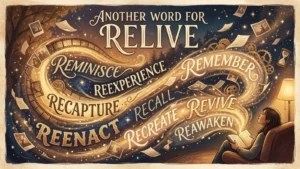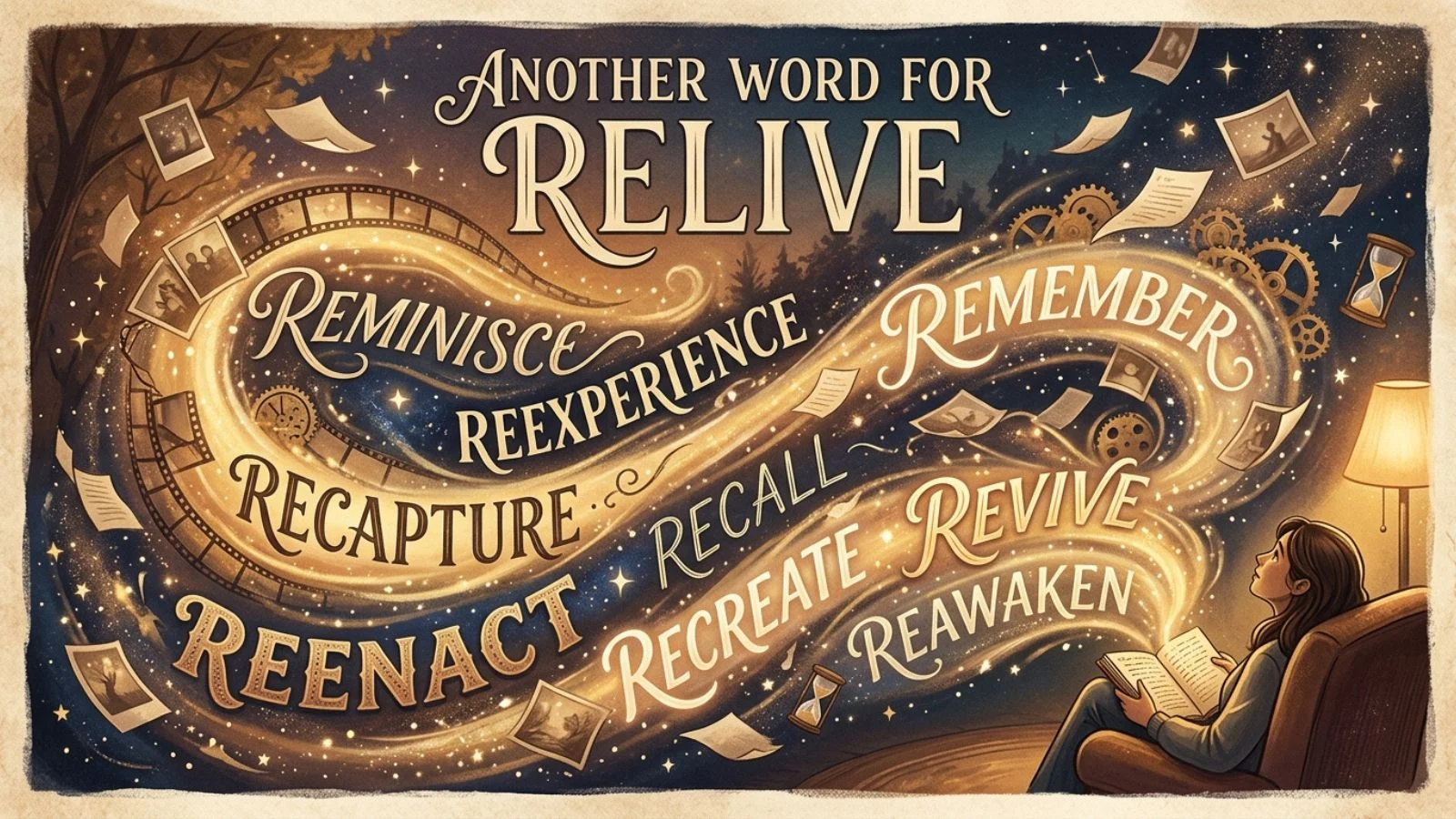
“Relive” means to experience something from the past again often by remembering it vividly or imagining it happening once more.
Common alternatives include re-experience recall, remember reminisce revisit and replay. However these words are not always interchangeable: some focus on memory while others describe mentally returning to an event or experiencing its emotions again.
The best alternative depends on the situation. You might use reminisce when talking about happy memories re-experience when describing an event or feeling and revisit when discussing a past memory or period of life. The word relive can describe both pleasant memories and difficult experiences.
Collins English Dictionary
Quick list: Re-experience recall remember reminisce revisit replay recollect reflect on think back to and go over again.
This guide explores 50 alternatives to relive including their meanings, pronunciation usage notes and example sentences.
It also explains common word pairings, established expressions, word origins and differences that help you choose the right word.
At a Glance: Relive Synonyms and Related Alternatives
| Alternative | Part of Speech | Meaning | Register / Tone | Ideal Context |
| Re-experience | Verb | Experience something again | Neutral | Events and feelings |
| Recall | Verb | Bring something back to mind | Neutral to formal | Memories and details |
| Remember | Verb | Keep or bring something to mind | Everyday | General memories |
| Reminisce | Verb | Talk or think about past experiences | Warm reflective | Shared memories |
| Revisit | Verb | Return to a past subject or experience | Neutral | Memories and ideas |
| Replay | Verb | Repeat mentally or play again | Neutral informal | Moments and recordings |
| Recollect | Verb | Remember something | Slightly formal | Past events |
| Reflect on | Verb phrase | Think carefully about something | Neutral to formal | Life experiences |
| Think back to | Verb phrase | Direct your thoughts to the past | Conversational | Personal memories |
| Go over again | Verb phrase | Review something another time | Everyday | Events details and conversations |
These alternatives overlap with relive but the exact meaning changes with the sentence. For example remembering an event does not always mean experiencing its emotions again.
Collins English Dictionary
Which Word Should You Use?
| If you want to… | Use | Why |
| Experience a past event emotionally again | Re-experience | Closely matches the meaning of relive. |
| Bring a past fact or event to mind | Recall | Focuses on remembering rather than feeling the event again. |
| Talk warmly about old memories | Reminisce | Often suggests enjoyable shared memories. |
| Think about a past event in detail | Revisit | Suggests returning to a subject mentally. |
| Imagine a moment happening again | Replay | Often describes a vivid mental repeat. |
| Remember something you once knew | Recollect | A slightly more formal alternative to remember. |
| Consider what a past event taught you | Reflect on | Emphasizes thought and understanding. |
| Describe going through a difficult experience again | Go through again | Emphasizes experiencing the situation another time. |
Exploring the Multiple Meanings of “Relive”
The verb relive has a few related senses. Its main modern use concerns experiencing a past event again usually in memory or imagination. Dictionaries also record an older sense connected with returning to life.
Collins English Dictionary
1. Experience a Past Event Again
- Meaning: To experience a past event as if it were happening again.
- Explanation: This is the most common modern meaning. The event may be happy, exciting , upsetting or frightening.
- Example: She relived her graduation day while looking through old photographs.
2. Experience an Emotion Again
- Meaning: To feel an earlier emotion once more.
- Explanation: A memory photograph song or conversation may bring back the feelings associated with a past moment.
- Example: Hearing their favorite song helped them relive the joy of their first concert.
3. Mentally Return to a Past Period
- Meaning: To think about a former time as though returning to it.
- Explanation: This sense often appears when people remember childhood school days, holidays or important stages of life.
- Example: The reunion allowed the classmates to relive their school days.
4. Experience a Difficult Event Again in Memory
- Meaning: To feel as though a painful or frightening past event is happening again.
- Explanation: Unlike reminisce which often suggests fond memories relive can describe unwanted or upsetting recollections.
- Example: He found it difficult to relive the stressful experience during the interview.
5. Return to Life Again Historical or Rare
- Meaning: To live again after being dead or no longer alive.
- Explanation: This older dictionary sense is rare in modern everyday English. Revive is more common when discussing the restoration of life energy or activity depending on the context.
- Example: In the old legend the hero was said to relive after a miraculous event.
Sources: Collins English Dictionary (relive entry); Dictionary.com (relive definition and etymology); Online Etymology Dictionary: relive.
Analyzing 50 Relive Alternatives in Detail
The alternatives below include direct synonyms, close substitutes and related expressions. Some work in nearly the same sentence as relive while others are suitable only for particular kinds of memory or experience.
Group 1: Closest Synonyms for Relive
1. Re-experience
IPA: US /ˌriːɪkˈspɪriəns/ · UK /ˌriːɪkˈspɪəriəns/
Definition: To experience something again.
- Usage: One of the closest alternatives to relive. It can describe emotions, events and sensations without suggesting that the memory must be vivid.
- Example: The old recording helped her re-experience the excitement of the performance.
2. Reexperience
IPA: US /ˌriːɪkˈspɪriəns/ · UK /ˌriːɪkˈspɪəriəns/
Definition: To experience something once more.
- Usage: This is a closed spelling variant of re-experience. Use one spelling consistently throughout a document.
- Example: The exhibition allowed visitors to reexperience a historic event through sound and images.
3. Replay
IPA: /ˌriːˈpleɪ/ (US and UK)
Definition: To play something again or mentally repeat an event.
- Usage: A close alternative when a memory repeatedly runs through someone’s mind. It also refers literally to playing audio or video again.
- Example: He continued to replay the conversation in his head.
4. Reenact
IPA: /ˌriːɪˈnækt/ (US and UK)
Definition: To act out an event again.
- Usage: Unlike relive this usually involves physically performing or representing the event not merely remembering it.
- Example: The students reenacted a famous historical meeting.
5. Recreate
IPA: /ˌriːkriˈeɪt/ (US and UK)
Definition: To make or produce something again.
- Usage: A related alternative when someone rebuilds an atmosphere scene or experience. It does not necessarily mean remembering an event.
- Example: The museum recreated the look of a nineteenth-century classroom.
6. Repeat
IPA: /rɪˈpiːt/ (US and UK)
Definition: To do or say something again.
- Usage: A broad alternative for repeating an action or event. It is less specific than relive because it need not involve memory.
- Example: She wanted to repeat the trip with her family.
7. Reproduce
IPA: /ˌriːprəˈduːs/ (US and UK)
Definition: To make a copy or produce something again.
- Usage: A related alternative for recreating an event’s sounds, images or conditions. It is not a direct synonym when referring to a personal memory.
- Example: The filmmakers reproduced the scene using period costumes.
8. Repeat mentally
IPA: repeat /rɪˈpiːt/ · mentally /ˈmɛntəli/ (US and UK)
Definition: To go through an event or thought again in one’s mind.
- Usage: A descriptive phrase rather than a single-word synonym. It works when a person keeps reviewing a memory.
- Example: She repeated the important instructions mentally before the test.
Group 2: Remembering and Recalling the Past
9. Remember
IPA: /rɪˈmɛmbər/ (US and UK)
Definition: To keep something in mind or bring it back to mind.
- Usage: A common broad alternative. Remembering an event does not necessarily mean feeling as though it is happening again.
- Example: I remember our first day at the new school.
10. Recall
IPA: /rɪˈkɔːl/ (US and UK)
Definition: To bring a past event fact or experience to mind.
- Usage: Often more focused on retrieving information or details than reliving.
- Example: She recalled every detail of the school play.
11. Recollect
IPA: /ˌrɛkəˈlɛkt/ (US and UK)
Definition: To remember something from the past.
- Usage: A slightly more formal alternative to remember. It does not automatically imply emotional re-experience.
- Example: He recollected the advice his teacher had given him.
12. Reminisce
IPA: /ˌrɛmɪˈnɪs/ (US and UK)
Definition: To think or talk about past experiences.
- Usage: Especially useful for warm conversations about earlier times. It often suggests pleasant memories unlike relive which can refer to painful experiences too.
- Example: The friends reminisced about their childhood adventures.
13. Recollect mentally
IPA: recollect /ˌrɛkəˈlɛkt/ · mentally /ˈmɛntəli/ (US and UK)
Definition: To bring information or an experience back into one’s thoughts.
- Usage: A descriptive phrase not a distinct dictionary synonym. It can clarify that the act of remembering happens in the mind.
- Example: She tried to recollect mentally what had happened during the meeting.
14. Think back
IPA: /ˌθɪŋk ˈbæk/ (US and UK)
Definition: To direct one’s thoughts toward an earlier time.
- Usage: An everyday phrase that works well for personal memories. It is less vivid than reliving unless the context adds that meaning.
- Example: When I think back I realize how much we learned.
15. Call to mind
IPA: call /kɔːl/ · mind /maɪnd/ (US and UK)
Definition: To cause a memory or idea to come into one’s thoughts.
- Usage: A useful expression when a sound place or object brings back a memory.
- Example: The smell of fresh bread called her grandmother’s kitchen to mind.
16. Bring back memories
IPA: bring /brɪŋ/ · back /bæk/ · memories /ˈmɛməriz/ (US and UK)
Definition: To make someone remember past experiences.
- Usage: A common expression for something that triggers memories. It does not necessarily mean experiencing the original event again.
- Example: The family album brought back memories of summer holidays.
17. Recall vividly
IPA: recall /rɪˈkɔːl/ · vividly /ˈvɪvɪdli/ (US and UK)
Definition: To remember something clearly and in detail.
- Usage: Suitable when clarity of memory matters more than experiencing the event again.
- Example: She could recall vividly the day she won the award.
Group 3: Reflection and Mental Return
18. Revisit
IPA: /ˌriːˈvɪzɪt/ (US and UK)
Definition: To return to a place, subject or idea.
- Usage: A close alternative when someone mentally returns to an experience or reviews a past decision. It can also refer to a literal visit.
- Example: The writer revisited the memories that inspired her first novel.
19. Reflect on
IPA: reflect /rɪˈflɛkt/ · on /ɒn/ (US and UK)
Definition: To think carefully about something.
- Usage: Best when a person considers the meaning lessons or effects of a past event rather than experiencing it again.
- Example: He reflected on his first year at university.
20. Look back on
IPA: /ˌlʊk ˈbæk ɒn/ (US and UK)
Definition: To think about something that happened in the past.
- Usage: Often used to evaluate past experiences from the present.
- Example: She looked back on the journey with pride.
21. Dwell on
IPA: /ˈdwɛl ɒn/ (US and UK)
Definition: To think or talk about something for a long time.
- Usage: Often carries a negative tone when someone focuses too much on an upsetting memory. It is not an exact synonym for relive.
- Example: He tried not to dwell on the small mistake.
22. Go over again
IPA: go /ɡoʊ/ · over /ˈoʊvər/ · again /əˈɡɛn/ (US and UK)
Definition: To review or examine something once more.
- Usage: Appropriate for reviewing a conversation event or sequence of actions. It may involve analysis rather than emotional memory.
- Example: They went over the day’s events again before writing their report.
23. Reconsider
IPA: /ˌriːkənˈsɪdər/ (US and UK)
Definition: To think about something again often before making a decision.
- Usage: A related alternative when someone returns to a past choice. It does not mean experiencing the event again.
- Example: She reconsidered her decision after hearing the new information.
24. Reexamine
IPA: /ˌriːɪɡˈzæmɪn/ (US and UK)
Definition: To examine something again.
- Usage: Useful for carefully reviewing an event belief or earlier conclusion. It is more analytical than reliving.
- Example: The team reexamined the events that led to the result.
25. Revisit mentally
IPA: revisit /ˌriːˈvɪzɪt/ · mentally /ˈmɛntəli/ (US and UK)
Definition: To return to a past experience in one’s thoughts.
- Usage: A descriptive phrase rather than a separate synonym. It makes clear that the return is mental not physical.
- Example: She revisited mentally the moment she first stepped onto the stage.
Group 4: Feelings and Personal Experiences
26. Re-experience emotionally
IPA: emotionally /ɪˈmoʊʃənəli/ (US and UK)
Definition: To feel an earlier experience or emotion again.
- Usage: A descriptive phrase for the emotional side of relive. It is especially useful when the feelings matter more than the facts.
- Example: The song helped him re-experience emotionally the joy of that summer.
27. Go through again
IPA: go /ɡoʊ/ · through /θruː/ · again /əˈɡɛn/ (US and UK)
Definition: To experience or undergo something once more.
- Usage: A close alternative for difficult or demanding experiences as well as repeated processes.
- Example: She did not want to go through the stressful process again.
28. Reawaken
IPA: /ˌriːəˈweɪkən/ (US and UK)
Definition: To cause a feeling of interest or memory to become active again.
- Usage: A related alternative when something brings an old feeling back. It focuses on the return of the feeling, not the whole experience.
- Example: The old letters reawakened his interest in family history.
29. Rekindle
IPA: /ˌriːˈkɪndəl/ (US and UK)
Definition: To make a feeling or interest strong again.
- Usage: Best for emotions, relationships , enthusiasm or interest. It is not a direct substitute for reliving a complete event.
- Example: The reunion rekindled their friendship.
30. Revive
IPA: /rɪˈvaɪv/ (US and UK)
Definition: To bring something back to life, strength or activity.
- Usage: A contextual alternative when an old memory tradition or feeling returns. Reviving a memory can work but reliving a memory emphasizes experiencing it again.
- Example: The documentary revived public interest in the historic event.
31. Recall emotionally
IPA: recall /rɪˈkɔːl/ · emotionally /ɪˈmoʊʃənəli/ (US and UK)
Definition: To remember an event while feeling an emotional connection to it.
- Usage: A descriptive phrase not an exact synonym. It suits writing where both memory and emotion matter.
- Example: She recalled emotionally the kindness her neighbors had shown her.
32. Reconnect with
IPA: reconnect /ˌriːkəˈnɛkt/ · with /wɪð/ (US and UK)
Definition: To establish a connection again.
- Usage: A related alternative when a person returns to an old feeling of interest or part of their past. It does not mean reliving the entire event.
- Example: The visit helped him reconnect with his childhood interests.
33. Revisit emotionally
IPA: revisit /ˌriːˈvɪzɪt/ · emotionally /ɪˈmoʊʃənəli/ (US and UK)
Definition: To return to an experience in thought while engaging with its feelings.
- Usage: A descriptive phrase suited to reflective writing. It is more specific than revisiting alone.
- Example: The memoir revisits the author’s early years emotionally.
Group 5: Repetition Review and Re-creation
34. Review
IPA: /rɪˈvjuː/ (US and UK)
Definition: To examine or study something again.
- Usage: Useful for reviewing what happened especially to understand details or learn from an event. It is less emotional than reliving.
- Example: The coach reviewed the team’s best moments from the season.
35. Recount
IPA: /rɪˈkaʊnt/ (US and UK)
Definition: To tell someone about an event or series of events.
- Usage: A related alternative when a person describes a past experience aloud or in writing. Telling an event is not the same as experiencing it again.
- Example: He recounted the day’s adventures to his family.
36. Retell
IPA: /ˌriːˈtɛl/ (US and UK)
Definition: To tell a story or event again.
- Usage: Best for repeating a narrative not for the private experience of a memory.
- Example: The guide retold the story of the town’s founding.
37. Reproduce mentally
IPA: reproduce /ˌriːprəˈduːs/ · mentally /ˈmɛntəli/ (US and UK)
Definition: To form a mental copy of something previously experienced.
- Usage: A descriptive somewhat technical phrase. It is less natural in everyday conversation than to remember vividly or replay in your mind.
- Example: The musician reproduced mentally the melody she had heard earlier.
38. Reconstruct
IPA: /ˌriːkənˈstrʌkt/ (US and UK)
Definition: To build or put something together again from available information.
- Usage: Appropriate when someone pieces together the details of a past event. It does not necessarily involve experiencing the event emotionally.
- Example: The historian reconstructed the events from old letters.
39. Re-create in memory
IPA: re-create /ˌriːkriˈeɪt/ · memory /ˈmɛməri/ (US and UK)
Definition: To form a mental picture of an earlier experience again.
- Usage: A descriptive phrase for imaginative remembering rather than a fixed synonym.
- Example: Through her diary she could re-create in memory the journey.
40. Go through in one’s mind
IPA: through /θruː/ · mind /maɪnd/ (US and UK)
Definition: To think about an event or sequence of events carefully.
- Usage: Often used when someone mentally reviews what happened, what was said or what they should do next.
- Example: He went through the conversation in his mind before replying.
Group 6: Reflective Literary and Context-Specific Alternatives
41. Treasure
IPA: /ˈtrɛʒər/ (US and UK)
Definition: To value something greatly.
- Usage: A related alternative for describing how someone holds a memory dear. It does not mean experiencing the event again.
- Example: She treasured the memories of her family holidays.
42. Cherish
IPA: /ˈtʃɛrɪʃ/ (US and UK)
Definition: To value and care deeply about someone or something.
- Usage: Useful when describing a lasting affection for a memory or experience rather than its repetition.
- Example: He cherished the memory of his first teacher.
43. Commemorate
IPA: /kəˈmɛmərˌeɪt/ (US and UK)
Definition: To honor the memory of a person or event.
- Usage: A related alternative for public or personal remembrance. It means honoring an event not reliving it.
- Example: The town held a ceremony to commemorate the historic occasion.
44. Memorialize
IPA: /məˈmɔːriəˌlaɪz/ (US and UK)
Definition: To preserve the memory of a person or event.
- Usage: Suitable for writing monuments records and other ways of keeping memories alive. It is not a direct synonym for relive.
- Example: The family created a book to memorialize their shared experiences.
45. Immerse oneself in
IPA: immerse /ɪˈmɜːrs/ · oneself /wʌnˈsɛlf/ (US and UK)
Definition: To become deeply involved in an activity subject or experience.
- Usage: A related expression when someone becomes deeply absorbed in old photographs, recordings or memories. It does not always mean reliving the past.
- Example: She immersed herself in the letters her grandfather had written.
46. Reawaken memories
IPA: reawaken /ˌriːəˈweɪkən/ · memories /ˈmɛməriz/ (US and UK)
Definition: To cause memories to return to awareness.
- Usage: Best when something triggers memories rather than when a person deliberately experiences an event again.
- Example: The familiar tune reawakened memories of family celebrations.
47. Flash back to
IPA: /ˌflæʃ ˈbæk tuː/ (US and UK)
Definition: To suddenly return to a past event.
- Usage: Common in everyday speech and storytelling. It often suggests a sudden or vivid memory.
- Example: The old photograph made her flash back to her first school trip.
48. Transport oneself back
IPA: transport /trænsˈpɔːrt/ · oneself /wʌnˈsɛlf/ (US and UK)
Definition: To imagine being in a different place or time.
- Usage: A figurative expression that suggests strong imagination or vivid memory. It is not literal travel through time.
- Example: The music transported him back to his teenage years.
49. Relive through memories
IPA: relive /ˌriːˈlɪv/ · memories /ˈmɛməriz/ (US and UK)
Definition: To experience the past again through recollection.
- Usage: A descriptive phrase that retains the core meaning of relive. It is useful in reflective writing but is not a separate single-word synonym.
- Example: She relived the trip through memories captured in her journal.
50. Live through again
IPA: live /lɪv/ · through /θruː/ · again /əˈɡɛn/ (US and UK)
Definition: To experience a situation or period once more.
- Usage: A close phrase-level alternative especially for difficult experiences. It is more natural in some sentences than others.
- Example: He did not want to live through that exhausting week again.
Sources: Collins English Dictionary: relive; Thesaurus.com: relive synonyms; Cambridge Dictionary: pronunciation. The alternatives above are selected for meaning and context; some are descriptive phrases or related words not exact synonyms.
Relive in Different Contexts
The closest alternative to relive changes with the type of experience being described. The key distinction is whether you mean remembering an event, feeling it again, talking about it or recreating it.
| Context | Best word or phrase | Example |
| Happy memories | Reminisce | We reminisced about our school days. |
| Vivid memories | Replay | She replayed the moment in her mind. |
| Remembering details | Recall | He recalled the exact conversation. |
| Learning from the past | Reflect on | They reflected on their achievements. |
| Repeating an event | Re-experience | Visitors re-experienced the historic event. |
| Acting out history | Reenact | The group reenacted the famous scene. |
| Remembering a difficult event | Relive | He struggled to relive the experience. |
| Preserving memories | Memorialize | The book memorialized their family history. |
Sources: Collins English Dictionary; Thesaurus.com.
Relive and Opposite/Paired Word Pairs
Relive does not have one exact antonym. Its opposite depends on whether the intended contrast is forgetting moving forward or experiencing something for the first time.
| Word | Paired Word | Note |
| Relive | Forget | Experience again versus no longer remember |
| Remember | Forget | Recall versus lose a memory |
| Revisit | Move on | Return to a past subject versus leave it behind |
| Re-experience | Experience for the first time | Repeat an experience versus encounter it initially |
| Reminisce | Anticipate | Think about the past versus look toward the future |
| Replay | Play for the first time | Repeat a recording versus hear or see it initially |
| Reflect on | Look ahead | Consider the past versus consider the future |
| Recreate | Create originally | Make something again versus make it for the first time |
These are contextual contrasts not all strict antonyms. For example forgetting is the opposite of remembering but a person can remember an event without reliving it.
Sources: Collins English Dictionary; Dictionary.com.
Common Word Partners of “Relive”
Collocations are words that commonly appear together. The following patterns are useful when writing about memories, events and past experiences.
| Pattern | Common Partners | Example |
| Relive + event | an event a moment | They relived the final moment of the competition. |
| Relive + experience | an experience an adventure | The group relived the adventure through photographs. |
| Relive + time period | the past childhood school days | She loved to relive her school days. |
| Relive + memory | a memory a special memory | The video helped them relive a special memory. |
| Relive + negative experience | a nightmare a traumatic experience | He did not want to relive the difficult experience. |
| Relive + achievement | a victory a great performance | The team relived its victory by watching the recording. |
| Relive + occasion | a wedding a celebration | The couple relived their wedding day through their album. |
| Relive + period | those days a memorable period | The reunion let everyone relive those days. |
Sources: Collins English Dictionary: common word partners.
Idiomatic Phrases Featuring “Relive”
Relive has fewer established idioms than many everyday verbs. These expressions are useful but they should not all be classified as traditional idioms. Most are common phrases built around the verb.
1. Relive the Past
- Meaning: To think about or experience earlier events again in memory.
- Example: The old classmates met to relive the past.
2. Relive the Moment
- Meaning: To experience the memory of a particular event again.
- Example: Watching the winning goal helped the fans relive the moment.
3. Relive It All Over Again
- Meaning: To experience an earlier event or feeling once more.
- Example: Looking through the photographs allowed the family to relive it all over again.
4. Relive the Glory Days
- Meaning: To remember and enjoy memories of a successful or exciting period in the past.
- Example: The former players met to relive their glory days.
These expressions are especially useful in personal stories, news reports, sports writing and nostalgic conversations.
Sources: Collins English Dictionary; Thesaurus.com.
Word Formation of “Relive”
Etymology & Structure
The word relive consists of two parts:
- Re-: A prefix meaning “again” or “back.”
- Live: A verb meaning to be alive or experience life.
Together the parts express the idea of living or experiencing something again. In modern English relive most often refers to experiencing a past event again in memory or imagination.
Dictionary.com
Date and History
According to the Online Etymology Dictionary and Dictionary.com relive was first recorded in English in the 1540s. Its earlier meaning was connected with coming back to life or restoring life. The sense of experiencing a past event again is documented from 1711.
Dictionary.com
Word Class Variations
| Word Form | Part of Speech | Meaning | Example |
| Relive | Verb | Experience again | We relive the memory through photographs. |
| Relives | Verb | Present-tense form | She relives the moment in her thoughts. |
| Relived | Verb | Past-tense or past-participle form | They relived their victory. |
| Reliving | Verb form / gerund | Experiencing again | Reliving the adventure made him smile. |
| Relivable | Adjective | Capable of being relived | The experience was memorable and relivable. |
Reliable is a recognized but uncommon derivative. The forms relives, relived and reliving are ordinary grammatical forms of the verb.
Collins English Dictionary
Sources: Online Etymology Dictionary; Dictionary.com; Collins English Dictionary.
Common Word-Choice Mistakes
- Incorrect: I reminisced about the accident. Better: I remembered the accident. Reminisce is generally used without a direct object.
- Incorrect: I relived my childhood. Better: I relived my childhood memories.
- Incorrect: She recreated the memory in her mind. Better: She recalled the memory. Use recreated when something is made or represented again.
- Incorrect: He relived the story to his friends. Better: He recounted the story to his friends.
- Incorrect: We relived about the old days. Better: We reminisced about the old days.
- Incorrect: The video helped me relive the event for the first time. Better: The video helped me re-experience the event. Use for the first time when the experience is genuinely new.
- Incorrect: She memorialized the moment by remembering it privately. Better: She remembered the moment. Memorialising usually means preserving or honoring a memory.
Frequently Asked Questions
1. What is the closest synonym for relive?
Re-experience is one of the closest synonyms because it means experiencing something again. Replay is also suitable when describing a memory that repeats in the mind.
2. What is another word for reliving a memory?
You can say recall a memory, revisit a memory or replay a memory in your mind. Each phrase emphasizes a slightly different aspect of remembering.
3. What is a formal alternative to reliving?
Re-experience is a useful alternative in formal writing. Recall and recollect work when the intended meaning is remembering rather than experiencing an event again.
4. What is a poetic word for relive?
Revisit can sound reflective or literary when used for memories. Phrases such as be transported back in time can also suggest a vivid return to the past.
5. What is the difference between relive and reminisce?
Relive means experiencing a past event or feeling again often in the imagination. Reminisce means thinking or talking about past experiences and often suggests fond memories.
6. Can relive describe negative experiences?
Yes. People can relive difficult upsetting or frightening events in their memories. The word is not limited to happy experiences.
7. What is the opposite of reliving?
There is no single exact opposite in every context. Forget may contrast with remembering while moving on can contrast with repeatedly returning to the past.
8. Is reliving the same as remembering?
No. Remember means keeping or bringing something to mind. Relive suggests experiencing the event or its feelings again often vividly.
9. Can relive be used for a happy memory?
Yes. You can relive a celebration, a holiday , a sporting victory or another enjoyable experience by remembering it vividly or watching a recording.
10. Is it one word or two?
Relive is normally written as one word. Its usual forms are relives, relived and reliving.
Dictionary.com
Conclusion
The closest alternatives to relive include re-experience recall, remember reminisce revisit and replay. Each word offers a different way to describe returning to a past event thought or feeling.
Context matters when choosing a synonym. Reminisce suits conversations about old memories, recall emphasizes remembering details and re-experience closely matches the idea of going through something again.
For clear natural writing choose the word that expresses your exact meaning. A good synonym should fit the sentence, not simply replace the original word.

Olivia Martin is a passionate writer who enjoys exploring English vocabulary, synonyms, and language tips to help readers improve their writing skills.
At PressivoMedia.com, Olivia shares helpful language resources and easy-to-understand content to make communication clearer and more effective.