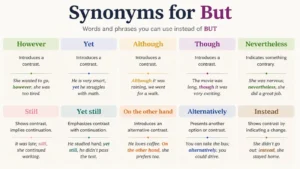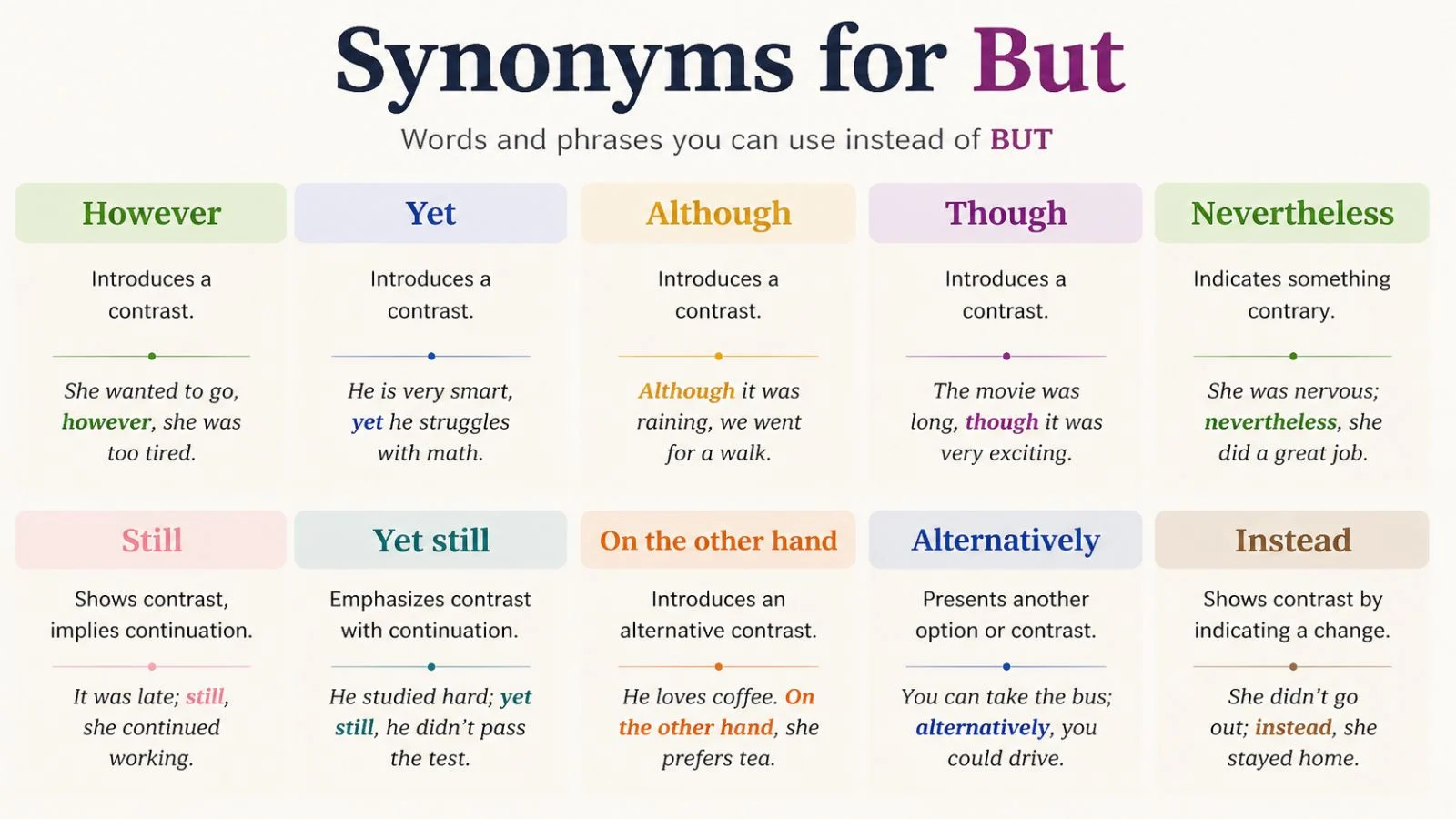
The closest everyday words for “but” are “however,” “yet,” “still,” and “though.” The best choice depends on meaning and tone.
The word “but” does three jobs. It shows contrast, it means “except,” and it can mean “only.” Each job needs different words.
Quick list: however, yet, still, though, although, nevertheless, even so, except, only, on the other hand
This article looks at 30 alternatives. Each one has a meaning, IPA, a usage note, and an example. You will also see which words fit which context.
At a Glance: But Synonyms and Related Alternatives
| Alternative | Part of Speech | Meaning | Register / Tone | Ideal Context |
| However | Adverb | Shows a point against the last one | Neutral to formal | Essays, emails, reports |
| Yet | Conjunction | Adds a surprising contrast | Neutral | Writing and speech |
| Still | Adverb | Shows a point that holds anyway | Casual to neutral | Speech and blogs |
| Though | Conjunction / Adverb | Adds a softer contrast | Neutral | Speech and writing |
| Nevertheless | Adverb | In spite of that | Formal | Reports and essays |
| Even so | Adverb | In spite of that | Neutral | Speech and writing |
| On the other hand | Adverb phrase | Gives a second view | Neutral | Choices and trade-offs |
| Except | Preposition | Leaves one item out | Neutral | Any setting |
| Other than | Preposition | Apart from | Neutral | After negative words |
| Only | Adverb | Nothing more than | Neutral | Any setting |
Which Word Should You Use?
| If you want to… | Use | Why |
| Add a formal contrast | However, nevertheless | Both sound polished in reports |
| Add a surprise in casual talk | Yet, still | They feel natural and short |
| Start with the weaker fact | Although, though | The clause order flips |
| Compare two items | Whereas, while | They set facts side by side |
| Leave one item out | Except, other than | They match the “except” sense |
| Say “only” in a plain way | Only, just | They are clear and common |
| Weigh two sides of a choice | On the other hand | It signals a second view |
| Deny what someone said | On the contrary | It says the opposite |
Exploring the Multiple Meanings of “But”
1. Contrast
- Meaning: Shows that the next idea clashes with the first.
- Explanation: The second idea is often a surprise. It can also soften a request.
- Example: I like cats, but my sister is allergic to them.
2. Except
- Meaning: Leaves out one person or thing from a group.
- Explanation: It often follows words like “all,” “every,” or “nobody.” Here “but” works as a preposition.
- Example: Everyone but Dan brought a coat to the game.
3. Only
- Meaning: Means “just” or “no more than.”
- Explanation: This sense sounds formal or old. It still appears in set phrases.
- Example: She is but a child, so please be gentle.
4. Objection
- Meaning: A reason against a plan or an order.
- Explanation: People use this noun mostly in the plural. It is a casual sense.
- Example: Clean your room now, and I want no buts about it.
5. Protest or surprise
- Meaning: Opens a reply that shows doubt or shock.
- Explanation: Speakers use it at the start of a sentence. It often comes before a question.
- Example: But that can’t be right, because I checked twice.
Sources: Merriam-Webster; Collins English Dictionary; Dictionary.com
Analyzing 30 But Alternatives in Detail
Some alternatives are direct synonyms, while others are related words for one sense or context.
Core Contrast Words
1. However
IPA: US /haʊˈɛvɚ/ · UK /haʊˈɛvə/
Definition: Shows a point that goes against the last one. It also works well at the start of a sentence.
- Usage: It is the most common formal swap for “but.” Also, it needs a comma after it.
- Example: The bus was late. However, we still made the show.
2. Yet
IPA: /jɛt/ (US and UK)
Definition: Adds a surprise that clashes with the first idea. It also fits after “and.”
- Usage: It is a direct synonym. However, it sounds a little more formal than “but.”
- Example: She studied very little, yet she passed the test.
3. Still
IPA: /stɪl/ (US and UK)
Definition: Shows a point that stays true in spite of the facts. It also sounds relaxed.
- Usage: Writers often use it to start a sentence. In fact, it rarely joins two clauses.
- Example: It rained all day. Still, we had a great time.
4. Though
IPA: US /ðoʊ/ · UK /ðəʊ/
Definition: Joins two ideas where the second is less expected. It also ends a sentence in casual speech.
- Usage: It is a close synonym. However, “though” can sit at the end, which “but” cannot do.
- Example: I like the house, though the yard is small.
5. Although
IPA: US /ɔːlˈðoʊ/ · UK /ɔːlˈðəʊ/
Definition: Starts a clause that gives a fact against the main point. It also sounds a bit more formal than “though.”
- Usage: It is a related choice because the clause order flips. For example, you start with the weaker fact.
- Example: Although he felt tired, he kept on running.
6. While
IPA: /waɪl/ (US and UK)
Definition: Compares two facts or shows a small contrast. It also means “at the same time” in other cases.
- Usage: It is a related choice for contrast. However, it can confuse readers when time is also in play.
- Example: She likes tea, while her brother prefers coffee.
Formal Alternatives
7. Nevertheless
IPA: US /ˌnɛvɚðəˈlɛs/ · UK /ˌnɛvəðəˈlɛs/
Definition: Means “in spite of that.” It also marks a formal turn in a text.
- Usage: It is a formal synonym. In fact, writers use it often in reports and essays.
- Example: The test was hard. Nevertheless, most students passed it.
8. Nonetheless
IPA: /ˌnʌnðəˈlɛs/ (US and UK)
Definition: Shows that a fact still holds after a problem. It also sounds formal.
- Usage: It is almost the same as “nevertheless.” Still, many writers find it a bit lighter.
- Example: The road was icy. We arrived on time nonetheless.
9. Notwithstanding
IPA: US /ˌnɑːtwɪθˈstændɪŋ/ · UK /ˌnɒtwɪθˈstændɪŋ/
Definition: Means “in spite of” and often appears in legal texts. It also works as a formal adverb.
- Usage: It is a related alternative, not an exact synonym. For example, it usually comes before a noun.
- Example: Notwithstanding the rain, the match went ahead as planned.
10. Albeit
IPA: /ɔːlˈbiːɪt/ (US and UK)
Definition: Means “even though” and adds a small point. It also sounds formal or literary.
- Usage: It is a related alternative. However, it links words or short phrases rather than full clauses.
- Example: She gave a short albeit clear answer.
11. Whereas
IPA: US /wɛrˈæz/ · UK /weərˈæz/
Definition: Compares two facts that differ. It also appears in formal writing and law.
- Usage: It is a related alternative. In short, it shows a gap rather than a surprise.
- Example: Tom loves loud music, whereas his sister likes quiet songs.
Contrast Phrases
12. Even so
IPA: US /ˌiːvən ˈsoʊ/ · UK /ˌiːvən ˈsəʊ/
Definition: Means “in spite of that.” It also keeps the tone calm.
- Usage: It is a close synonym. For example, it opens a sentence after a fact.
- Example: The food was cold. Even so, we ate every bite.
13. All the same
IPA: /ˌɔːl ðə ˈseɪm/ (US and UK)
Definition: Means “still” or “in spite of that.” It also fits casual talk.
- Usage: It is a close synonym. However, it sounds more spoken than written.
- Example: I knew the risk. All the same, I said yes.
14. That said
IPA: /ðæt ˈsɛd/ (US and UK)
Definition: Adds a limit to what you just wrote. It also softens the turn.
- Usage: It is a related alternative. Also, it sounds natural in blogs and chats.
- Example: The hotel was old. That said, the staff were lovely.
15. On the other hand
IPA: US /ɑːn ði ˈʌðɚ hænd/ · UK /ɒn ði ˈʌðə hænd/
Definition: Brings in a second view on the same topic. It also pairs with “on one hand.”
- Usage: It is a related alternative. However, it fits choices and trade-offs better than a plain contrast.
- Example: Cars are fast. On the other hand, trains are cheaper.
16. In contrast
IPA: US /ɪn ˈkɑːntræst/ · UK /ɪn ˈkɒntrɑːst/
Definition: Puts two facts side by side to show a gap. It also sounds neutral.
- Usage: It is a related alternative. For example, it suits reports and charts.
- Example: Sales rose in May. In contrast, June sales fell.
17. Conversely
IPA: US /kənˈvɜːrsli/ · UK /kənˈvɜːsli/
Definition: Shows that the reverse is also true. It also suits formal writing.
- Usage: It is a related alternative. In fact, it flips an idea rather than adding a surprise.
- Example: Heat makes metal grow. Conversely, the cold makes it shrink.
18. On the contrary
IPA: US /ɑːn ðə ˈkɑːntrɛri/ · UK /ɒn ðə ˈkɒntrəri/
Definition: Says the opposite of what someone said or thought. It also adds strong force.
- Usage: It is a related alternative. However, it denies a claim rather than adding a surprise.
- Example: I am not upset. On the contrary, I feel great.
“Except” Alternatives
19. Except
IPA: /ɪkˈsɛpt/ (US and UK)
Definition: Leaves out one person or thing from a group. It also shows the one case that breaks a rule.
- Usage: It matches the “except” sense of “but.” Also, it works in most settings.
- Example: Everyone came to the party except my cousin.
20. Other than
IPA: US /ˈʌðɚ bæn/ · UK /ˈʌðə bæn/
Definition: Means “apart from” or “except.” It also appears after words like “nothing” or “no one.”
- Usage: It is a close swap after negative words. Also, it feels natural in speech.
- Example: Nobody other than Ana knew the answer.
21. Apart from
IPA: US /əˈpɑːrt frəm/ · UK /əˈpɑːt frəm/
Definition: Leaves out one item from a group. It also can mean “in addition to.”
- Usage: It is a related alternative. However, its meaning can shift, so check the context.
- Example: Apart from the noise, the room was perfect.
22. Save
IPA: /seɪv/ (US and UK)
Definition: Means “except” in a formal or old style. It also appears in poems.
- Usage: It is a related alternative. Still, it sounds dated in everyday talk.
- Example: No one spoke except for the old man.
23. Barring
IPA: /ˈbɑːrɪŋ/ (US and UK)
Definition: Means “unless something happens.” It also hints at a risk.
- Usage: It is a related alternative, not an exact synonym. For example, it suits plans.
- Example: Barring any delays, we will land at noon.
24. Besides
IPA: /bɪˈsaɪdz/ (US and UK)
Definition: Means “other than” when you name a group. It also can mean “as well.”
- Usage: It is a related alternative. However, it can confuse readers because it has two senses.
- Example: Nobody besides Leo wanted the last slice of pizza.
“Only” Alternatives
25. Only
IPA: US /ˈoʊnli/ · UK /ˈəʊnli/
Definition: Means “just” or “no more than.” It also adds a limit.
- Usage: It is a close synonym for the “only” sense of “but.” In fact, “but” sounds formal there.
- Example: He is only a child, so be kind.
26. Merely
IPA: US /ˈmɪrli/ · UK /ˈmɪəli/
Definition: Means “nothing more than.” It also sounds a little formal.
- Usage: It matches the formal “only” sense of “but.” Also, it can sound dismissive.
- Example: This is merely a small mistake, not a disaster.
27. Just
IPA: /dʒʌst/ (US and UK)
Definition: Means “only” or “nothing more.” It also sounds casual.
- Usage: It is a close synonym for the “only” sense. Still, “just” has many other meanings.
- Example: I wanted just a quick word with you.
28. Simply
IPA: /ˈsɪmpli/ (US and UK)
Definition: Means “only” or “nothing but.” It also adds a plain tone.
- Usage: It is a related alternative. However, it stresses ease more than limits.
- Example: She simply wanted a quiet night at home.
Casual and Spoken Alternatives
29. Then again
IPA: /ðɛn əˈɡɛn/ (US and UK)
Definition: Adds a new thought that weakens the last one. It also feels chatty.
- Usage: It is a related alternative. In everyday English, people use it when they doubt themselves.
- Example: I could buy it. Then again, I don’t need it.
30. Mind you
IPA: /ˈmaɪnd ju/ (US and UK)
Definition: Adds a point that limits what you just said. It also sounds mostly British.
- Usage: It is a related alternative. However, it is casual and best for speech.
- Example: The film was long. Mind you, I enjoyed it.
Sources: Merriam-Webster; Collins English Dictionary and Thesaurus; Dictionary.com
But vs. However vs. Yet vs. Though
These four words often swap, but they behave differently in a sentence. The table shows the main gaps.
| Word | Where It Goes | Punctuation | Tone |
| But | Between two clauses | Comma before it | Neutral |
| However | Start, middle, or end | Commas around it | Neutral to formal |
| Yet | Between two clauses | Comma before it | Slightly formal |
| Though | Start, middle, or end | Comma before or after | Neutral |
First, “but” joins two full clauses. Next, “however” works as a bridge between sentences. Finally, “though” can also close a sentence in casual speech.
Sources: Merriam-Webster; Collins English Dictionary
But and Opposite/Paired Word Pairs
| Word | Paired Word | Note |
| But | And | “And” adds an idea while “but” contrasts it |
| But | So | “So” shows a result while “but” shows a clash |
| However | Therefore | One turns against a point and one follows from it |
| Except | Including | They name what is out and what is in |
| Although | Because | One gives a limit and one gives a reason |
| Not only | But also | They work as a fixed pair |
“But” has no true opposite. However, “and” is its closest partner because it joins ideas without a clash.
Sources: Merriam-Webster; Collins English Dictionary
Common Word Partners of “But”
| Pattern | Common Partners | Example |
| Negative word + but | nothing but, no one but | She ate nothing but toast all day. |
| But + for | but for the rain, but for you | But for the rain, we would have walked. |
| Not only … but | but also | He is not only kind but also funny. |
| But then | but then again | It is cheap, but then it is small. |
| Not X + but | but rather | It was not luck but hard work. |
Sources: Merriam-Webster; Collins English Dictionary
Idiomatic Phrases Featuring “But”
“But” has few true idioms. These four are strong, established expressions.
1. No ifs, ands, or buts
- Meaning: Means you will hear no excuses or arguments.
- Example: You will finish your homework tonight, with no ifs, ands, or buts.
2. Last but not least
- Meaning: Introduces the final item, which is still important.
- Example: Last but not least, I want to thank my family.
3. All but
- Meaning: Means “almost” or “very nearly.”
- Example: The team all but won the game in the first half.
4. Anything but
- Meaning: Means “not at all.”
- Example: The test was anything but easy for most of us.
Sources: Merriam-Webster; Collins English Dictionary; Dictionary.com
Word Formation of “But”
Etymology & Structure
“But” comes from Old English butan, which meant “outside” or “without.” It formed from be- (“by”) and ūtan (“out”). So the first sense was “on the outside of.”
Date and History
The word appears in Old English texts, so it is over 900 years old. Its sense moved from “outside” to “except.” Then it grew into the contrast sense we use now.
Word Class Variations
- Conjunction: I tried, but I failed.
- Preposition: Everyone but Sam left.
- Adverb: She is but a child.
- Noun: No buts about it.
The word has no common derivatives. It is also not related to “butt” or “button.”
Sources: Etymonline; Merriam-Webster; Collins English Dictionary
Common Word-Choice Mistakes
Wrong: It rained, however we went. Correct: It rained. However, we went.
Wrong: Although it rained, we went. Correct: Although it rained, we went.
Wrong: Everyone except I came. Correct: Everyone except me came.
Wrong: Nobody beside Tom came. Correct: Nobody besides Tom came.
Wrong: In contrast to last year. Correct: In contrast to last year.
Wrong: I like tea. On the contrary, I like coffee. Correct: I like tea. On the other hand, I like coffee.
Wrong: Nevertheless, but I went. Correct: Nevertheless, I went.
Frequently Asked Questions
What is the closest synonym for “but”?
“However” and “yet” are the closest. Both show a contrast in most sentences.
Can I start a sentence with “but”?
Yes. Modern style guides accept it. Use it for effect and not too often.
What is the difference between “but” and “however”?
“But” joins two clauses in one sentence. “However” links two sentences and needs commas.
What is a formal alternative to “but”?
“Nevertheless” and “nonetheless” are formal. They suit essays and reports.
What is a literary alternative to “but”?
“Albeit” and “save” sound literary. Most people only read them in books.
Is “yet” the same as “but”?
Almost. However, “yet” often adds a stronger sense of surprise.
Can “but” mean “except”?
Yes. In “everyone but Dan,” the word “but” means “except.”
Should I put a comma before “but”?
Yes, when “but” joins two full clauses. Skip it when it joins two short words.
Which alternative can end a sentence?
“Though” and “however” can end a sentence. This is common in casual speech.
What is the opposite of “but”?
No exact opposite exists. “And” is the closest partner because it adds ideas without a clash.
Conclusion
The closest everyday alternatives to “but” are “however,” “yet,” “still,” and “though.” They work in most sentences that show contrast. “Nevertheless” and “nonetheless” suit formal writing.
Context matters because “but” has more than one job. For “except,” use “except” or “other than.” For “only,” use “only” or “just.”
To choose well, first find the meaning. Next, check the tone and the sentence position. Finally, read the sentence aloud to hear if it sounds natural.

Emily Davis is a passionate writer who enjoys exploring English vocabulary, synonyms, and language tips to help readers improve their communication skills.
At PressivoMedia.com, she focuses on creating simple, engaging, and informative content that makes learning English easier and more enjoyable.