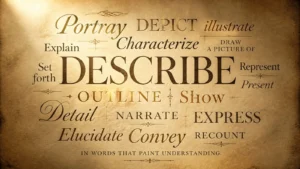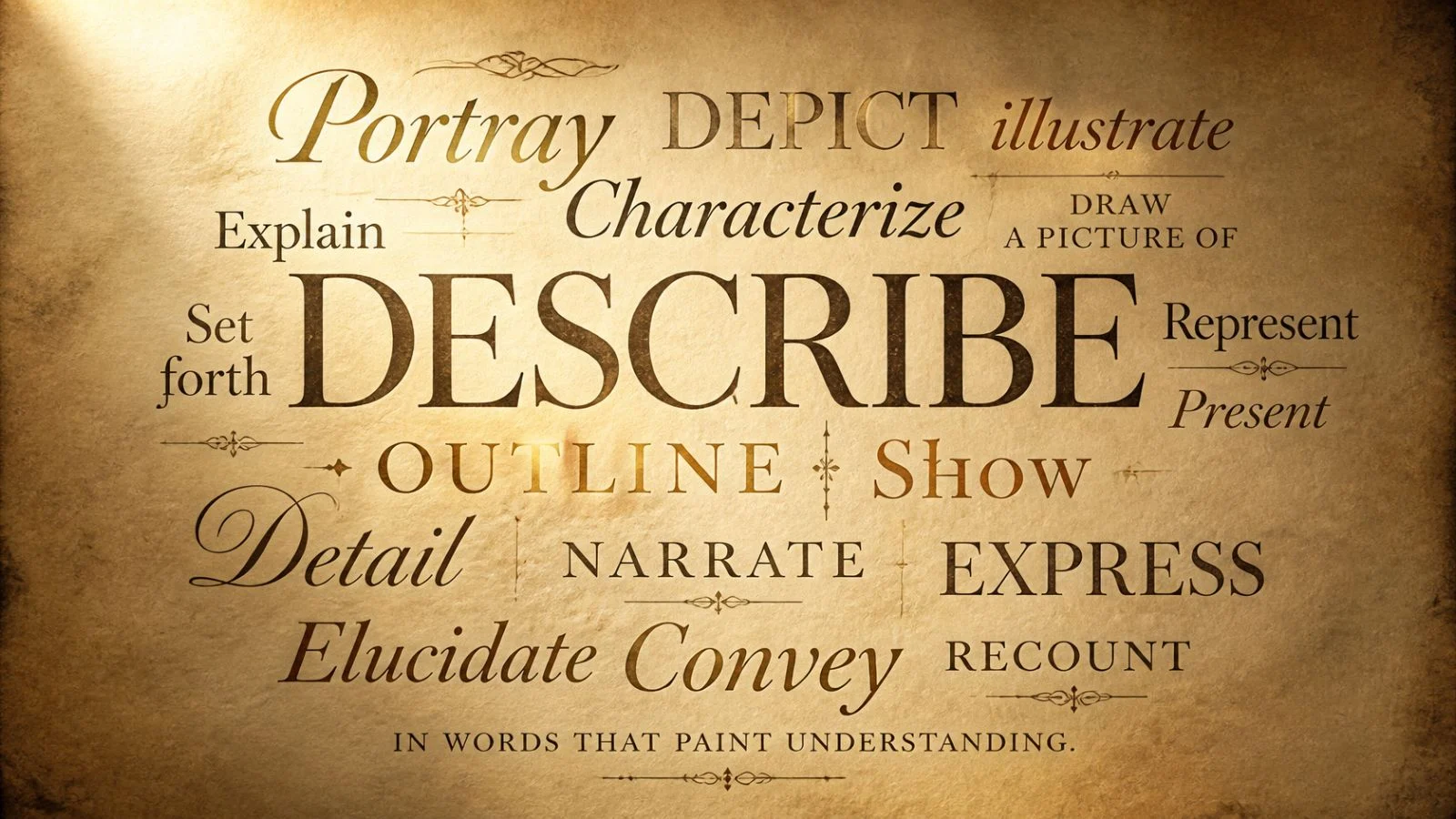
Another word for describe is explain, depict, or portray. Other good choices are detail, outline, and characterise. The right pick depends on what you want to show.
Describe can mean to tell, to draw, to label, or to trace a shape. For example, you can tell a story, paint a scene, or call someone brave. Each meaning has its own best choice.
Quick list: explain, depict, portray, characterize, detail, recount, outline, sketch, illustrate, spell out
This article looks at 30 alternatives. Each one has a meaning, IPA, a usage note, and an example. You will also see how context changes the best pick.
At a Glance: Describe Synonyms and Related Alternatives
| Alternative | Part of Speech | Meaning | Register / Tone | Ideal Context |
| Explain | Verb | Make clear why or how | Neutral | Teaching, daily talk |
| Depict | Verb | Show in words or art | Formal | Writing, art |
| Portray | Verb | Show in a chosen light | Neutral | Media, film, books |
| Characterize | Verb | Name key traits | Formal | Essays, reviews |
| Detail | Verb | Give small facts | Formal | Reports, plans |
| Recount | Verb | Tell events in order | Neutral | Stories, trips |
| Outline | Verb | Give main points | Neutral | Plans, talks |
| Sketch | Verb | Give a rough account | Casual | Quick overviews |
| Illustrate | Verb | Make clear with examples | Neutral | Teaching, charts |
| Spell out | Phrasal verb | Explain in plain detail | Casual | Rules, instructions |
Which Word Should You Use?
| If you want to… | Use | Why |
| Make a hard idea clear | Explain | It focuses on why and how. |
| Tell what happened in order | Recount | It fits events and trips. |
| Give only the main points | Outline | It skips small details. |
| Show someone in a certain light | Portray | It stresses the writer’s view. |
| Paint a vivid scene | Depict | It suits art and strong writing. |
| Give someone a label | Call | It is short and natural. |
| Write a precise formal report | Specify | It stresses exact facts. |
| Guide someone through steps | Walk through | It sounds friendly and clear. |
Exploring the Multiple Meanings of “Describe”
1. Give an account in words
- Meaning: To tell what a person, place, or event is like.
- Explanation: This is the most common sense. It covers looks, feelings, and events.
- Example: Please describe the man you saw at the door.
2. Show with a picture or model
- Meaning: To show something by a picture, chart, or model.
- Explanation: This sense links to art and data. Depict is the nearest choice.
- Example: The chart describes how the river flows through town.
3. Call or label (describe as)
- Meaning: To name someone or something by a trait.
- Explanation: People use the pattern “describe X as Y.” It often shows an opinion.
- Example: Critics describe the film as slow but beautiful.
4. Trace a shape or path
- Meaning: To move along a path that forms a shape.
- Explanation: This sense is rare and technical. You see it in math and science.
- Example: The planet describes a wide arc across the sky.
Sources: Merriam-Webster, Collins Dictionary, Dictionary.com.
Analyzing 30 Describe Alternatives in Detail
Some alternatives are direct synonyms. Others are related words that fit only certain contexts.
Core Synonyms
1. Explain
IPA: /ɪkˈspleɪn/ (US and UK)
Definition: It means to make something clear. It also shows why or how a thing works.
- Usage: Explain is a close synonym. However, it focuses on why, while description focuses on what.
- Example: She explained the rules before the game started.
2. Depict
IPA: /dɪˈpɪkt/ (US and UK)
Definition: It means to show something in words or art. It also works for pictures.
- Usage: Depict is a direct synonym. It also sounds more formal and vivid.
- Example: The novel depicts life in a small fishing town.
3. Portray
IPA: US /pɔːrˈtreɪ/ · UK /pɔːˈtreɪ/
Definition: It means to show a person in a certain way. It also can mean to play a role.
- Usage: Portray is a direct synonym. For example, news can portray a leader as weak.
- Example: The film portrays her as a brave and clever leader.
4. Characterize
IPA: US /ˈkærəktəraɪz/ · UK /ˈkærəktəraɪz/
Definition: It means to name the key traits of someone. It also can mean to be typical of something.
- Usage: Characterize is a formal synonym. However, it often takes the word “as.”
- Example: Friends characterize him as calm and patient.
5. Detail
IPA: /ˈdiːteɪl/ (US and UK)
Definition: It means to list the small facts of something. It also suggests a full account.
- Usage: As a verb, detail is a close alternative. In short, it means to describe with many facts.
- Example: The report details every step of the repair.
Telling and Reporting Words
6. Recount
IPA: /rɪˈkaʊnt/ (US and UK)
Definition: It means to tell what happened in order. It also suggests a full, personal story.
- Usage: Recount is a related alternative. For example, you recount a trip but not a chair.
- Example: He recounted the whole trip to his family.
7. Relate
IPA: /rɪˈleɪt/ (US and UK)
Definition: It means to tell a story or a set of facts. It also sounds a bit formal.
- Usage: Relate is a related alternative. However, it does not fit objects or looks.
- Example: She related what she saw to the police.
8. Narrate
IPA: US /ˈnæreɪt/ · UK /nəˈreɪt/
Definition: It means to tell a story in order. It also can mean to speak over a video.
- Usage: Narrate is a related alternative. It also fits events better than looks.
- Example: A famous actor narrates the nature show.
9. Report
IPA: US /rɪˈpɔːrt/ · UK /rɪˈpɔːt/
Definition: It means to give facts about an event or a thing. It also suggests a work or news setting.
- Usage: Report is a related alternative. For example, doctors ask you to report your symptoms.
- Example: Patients report pain in the left knee.
10. Tell
IPA: /tɛl/ (US and UK)
Definition: It means to give facts or a story to someone. It also is the plain, everyday choice.
- Usage: Tell is casual and short. However, it often needs “about” in this sense.
- Example: Tell me about your new apartment.
Precise and Formal Alternatives
11. Outline
IPA: /ˈaʊtlaɪn/ (US and UK)
Definition: It means to give the main points only. It also leaves out small details.
- Usage: Outline is a related alternative. In short, it gives a brief, rough picture.
- Example: The manager outlined the plan in five minutes.
12. Delineate
IPA: /dɪˈlɪniˌeɪt/ (US and UK)
Definition: It means to show something with great care. It also can mean to draw its edges.
- Usage: Delineate is a formal alternative. In fact, you often see it in law and science.
- Example: The contract delineates each partner’s duties.
13. Specify
IPA: /ˈspɛsɪfaɪ/ (US and UK)
Definition: It means to state exact details. It also leaves nothing unclear.
- Usage: Specify is a related alternative. However, it stresses exact facts, not a general picture.
- Example: Please specify the size and color you want.
14. Define
IPA: /dɪˈfaɪn/ (US and UK)
Definition: It means to give the exact meaning of a word or idea. It also can mean to set limits.
- Usage: Define is related, not exact. For example, you define a word but describe a sunset.
- Example: Teachers define new words before each reading lesson.
15. Summarize
IPA: /ˈsʌməraɪz/ (US and UK)
Definition: It means to give the main points in fewer words. It also shortens a long text.
- Usage: Summarize is a related alternative. So, use it when you need a short version.
- Example: Can you summarize the movie in one sentence?
Visual and Figurative Alternatives
16. Sketch
IPA: /skɛtʃ/ (US and UK)
Definition: It means to give a quick, rough account. It also can mean to draw fast lines.
- Usage: Sketch is a figurative alternative. In everyday English, it means a brief outline.
- Example: He sketched the story for us over lunch.
17. Illustrate
IPA: /ˈɪləstreɪt/ (US and UK)
Definition: It means to make a point clear with an example. It also can mean to add pictures.
- Usage: Illustrate is a related alternative. However, it shows an idea, not a person’s looks.
- Example: This chart illustrates how sales grew last year.
18. Paint
IPA: /peɪnt/ (US and UK)
Definition: It means to describe in vivid words. It also is a figurative use of an art word.
- Usage: Paint works well in the phrase “paint a picture.” Still, it is a figurative choice.
- Example: Her letters paint a warm picture of village life.
19. Picture
IPA: US /ˈpɪktʃər/ · UK /ˈpɪktʃə/
Definition: It means to form an image of something in your mind. It also can mean to show it in a picture.
- Usage: Picture is a related alternative. For example, you picture a scene before you describe it.
- Example: I can picture the old house by the lake.
20. Evoke
IPA: US /ɪˈvoʊk/ · UK /ɪˈvəʊk/
Definition: It means to call up a feeling or memory. It also suggests a mood, not a list of facts.
- Usage: Evoke is a related alternative. However, it does not give clear facts about a thing.
- Example: The poem evokes the quiet of a winter morning.
Naming and Labeling Words
21. Call
IPA: /kɔːl/ (US and UK)
Definition: It means to give a name or label to someone. It also shows how people see a thing.
- Usage: Call is a casual alternative to “describe as.” For example, people call him shy.
- Example: Her coworkers call her the calmest person in the office.
22. Label
IPA: /ˈleɪbəl/ (US and UK)
Definition: It means to put a name or tag on someone. It also can sound harsh.
- Usage: Label is a related alternative. However, it often sums up a person in one word.
- Example: The press labeled the plan a failure.
23. Term
IPA: US /tɜːrm/ · UK /tɜːm/
Definition: It means to give a name to something. It also sounds formal.
- Usage: Term is a formal and rare alternative. In fact, writers use it mostly with a label.
- Example: He termed the result a small win.
24. Dub
IPA: /dʌb/ (US and UK)
Definition: It means to give a person or thing a new name. It also suggests a nickname.
- Usage: Dub is an informal, related alternative. For example, writers dub events with catchy names.
- Example: Fans dubbed the singer the queen of pop.
25. Brand
IPA: /brænd/ (US and UK)
Definition: It means to label someone in a bad way. It also suggests the label will stick.
- Usage: Brand is a related alternative. However, it nearly always has a negative tone.
- Example: The crowd branded him a traitor.
Everyday Phrases
26. Spell out
IPA: /ˌspɛl ˈaʊt/ (US and UK)
Definition: It means to explain in plain, clear detail. It also leaves no room for doubt.
- Usage: Spell out is an informal alternative. For example, you use it when others miss a point.
- Example: Let me spell out what the new rules mean.
27. Break down
IPA: /ˌbreɪk ˈdaʊn/ (US and UK)
Definition: It means to split something into small parts to explain it. It also helps with hard topics.
- Usage: Break down is a casual alternative. In short, it suits steps, costs, or ideas.
- Example: The guide breaks down the process into four steps.
28. Walk through
IPA: /ˌwɔːk ˈθruː/ (US and UK)
Definition: It means to go over a process step by step. It also helps a listener follow along.
- Usage: Walk through is a casual alternative. However, it fits processes, not looks.
- Example: Can you walk me through the signup steps?
29. Give an account of
IPA: /ɡɪv ən əˈkaʊnt əv/ (US and UK)
Definition: It means to tell what happened or how things are. It also sounds formal.
- Usage: This phrase is a formal alternative. Still, it works well in reports and court cases.
- Example: The witness gave an account of the accident.
30. Put into words
IPA: US /pʊt ˈɪntuː wɜːrdz/ · UK /pʊt ˈɪntuː wɜːdz/
Definition: It means to find the words for a thought or feeling. It also suits hard topics.
- Usage: This phrase is a close, everyday alternative. For example, people use it when feelings are hard to share.
- Example: I cannot put my joy into words.
Sources: Merriam-Webster, Collins Dictionary and Thesaurus, Dictionary.com.
Describe vs. Explain vs. Depict vs. Portray
These four words often compete. Each one points to a different goal.
| Word | Main Focus | Best For | Example |
| Describe | What something is like | Everyday and general use | Describe your room. |
| Explain | Why or how | Reasons and processes | Explain how the lock works. |
| Depict | A vivid picture | Art and strong writing | The poem depicts a storm. |
| Portray | A chosen view | Media, film, and books | The show portrays him as a hero. |
In short, describe tells what. Explain why. Depict and portray a scene or a person in a certain way.
Sources: Merriam-Webster, Collins Dictionary.
Describe and Opposite/Paired Word Pairs
| Word | Paired Word | Note |
| Describe | Prescribe | Linguists contrast descriptive and prescriptive rules. |
| Describe | Define | Define gives exact limits, while describe gives a picture. |
| Describe | Explain | Describe says what, while explain says why. |
| Describe | Withhold | You withhold facts when you do not describe them. |
| Description | Explanation | The nouns follow the same split as the verbs. |
Describe has no true antonym. Still, some words work as natural contrasts. Writers often pair describe with explain or define. Language experts also pair “descriptive” with “prescriptive.”
Sources: Merriam-Webster, Collins Dictionary.
Common Word Partners of “Describe”
| Pattern | Common Partners | Example |
| Adverb + describe | briefly, vividly, accurately, fully | She vividly described the storm. |
| Describe + noun | the scene, symptoms, the process, a problem | Please describe your symptoms. |
| Describe in + noun | detail, words | He described the crash in detail. |
| Describe as + adjective | shy, helpful, unusual | Friends describe her as helpful. |
| Describe + reflexive | yourself, himself | Describe yourself in three words. |
| Hard to + describe | hard, difficult, impossible | The feeling is hard to describe. |
Sources: Collins Dictionary, Merriam-Webster.
Idiomatic Phrases Featuring “Describe”
Describe has few true idioms. The items below are fixed expressions that people use often.
1. Beggar description
- Meaning: To be too strange or extreme for words.
- Example: The mess in the kitchen beggared description.
2. Defy description
- Meaning: To be too unusual to explain in words.
- Example: The view from the peak defies description.
3. Fit the description
- Meaning: To match the details someone gave.
- Example: A man fitting the description left the shop.
4. Words cannot describe
- Meaning: A fixed phrase for very strong feelings.
- Example: Words cannot describe how proud I am.
Sources: Merriam-Webster, Collins Dictionary.
Word Formation of “Describe”
Etymology and Structure
Describe comes from Latin describere, which means to write down or copy. It joins de- (down) and scribere (to write). English took it through Old French.
Date and History
Etymonline dates the English verb to the late 14th century. At first, it meant to give an account in words.
Word Class Variations
- Verb: describe, describes, described, describing
- Noun: description, describer, descriptor
- Adjective: descriptive, describable, indescribable
- Adverb: descriptively, indescribably
Sources: Etymonline, Merriam-Webster.
Common Word-Choice Mistakes
- Describe about the trip: describe the trip.
- Describe me the plan: describe the plan to me.
- Describe him to be tall: describe him as tall.
- Describing the scene: describing the scene.
- Describe: describe.
- Explain the rules to me: explain the rules to me.
- Describe him as kind: describe him as kind.
Frequently Asked Questions
What is the closest synonym for describe?
Depict is the closest direct synonym. Explain is also very common, but it focuses on why.
What is a formal alternative to describe?
Delineate and characterize are formal choices. You often see them in reports and essays.
What is a casual alternative to describe?
Tell and spell out work well in daily talk. They sound friendly and plain.
What is the difference between describe and explain?
Describe what something is like. Explain why or how it works.
Is describe the same as define?
No. Define gives the exact meaning or limits. Describe gives a general picture.
Can describe be used for people?
Yes. You can describe how someone looks, acts, or feels. Describe as is very common here.
What is a literary alternative to describe?
Depict, paint, and evoke suit creative writing. They help readers see or feel a scene.
What is the opposite of describing?
Describe has no true opposite. Withhold or conceal can work as loose contrasts.
Can describe mean to label someone?
Yes. In the pattern “describe as,” it means to call someone by a trait. Call and label are near matches.
Is “describe about” correct?
No. Describe does not need “about.” Say “describe the trip” instead.
Conclusion
Explain, depict, and portray are the closest alternatives to describe. Detail, outline, and characterize also work well each one covers a slightly different job.
Context makes the choice. Use explain for reasons and recount for events. Choose to depict or paint for vivid scenes. Pick a call or label when you name a trait.
First, ask what you want to show. Next, match that goal to the right word. Finally, read your sentence aloud to check the tone.

Emily Davis is a passionate writer who enjoys exploring English vocabulary, synonyms, and language tips to help readers improve their communication skills.
At PressivoMedia.com, she focuses on creating simple, engaging, and informative content that makes learning English easier and more enjoyable.