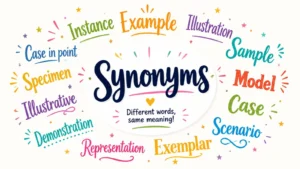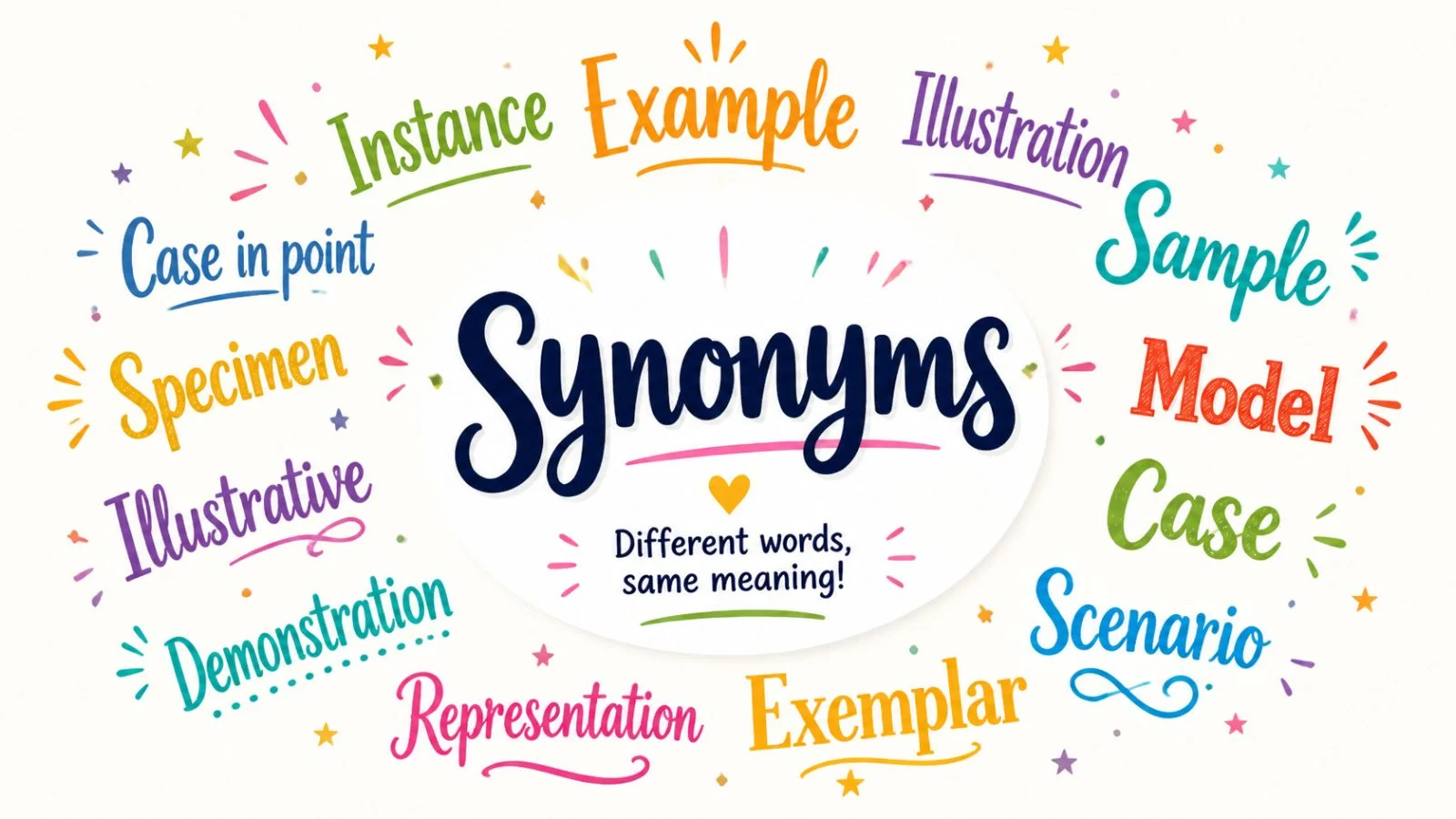
Another word for example is instance, case, sample, or illustration. Each one can replace an example in the right setting. Instance and case are the closest everyday choices.
The best word depends on meaning and context. Examples can mean a typical case, a model to copy, a warning, or a proof. Each meaning has its own best match.
Quick list: instance, case, sample, illustration, specimen, model, case in point, precedent, exemplar, demonstration
This guide looks at 30 alternatives. Each one has a meaning, IPA, a usage note, and an example sentence. You also get tables, word pairs, and common mistakes.
At a Glance: Example Synonyms and Related Alternatives
| Alternative | Part of Speech | Meaning | Register / Tone | Ideal Context |
| Instance | Noun | One single case of something | Neutral to formal | “For instance” in speech and writing |
| Case | Noun | A real event that shows a point | Neutral | Law, health, school |
| Sample | Noun | A small part of a whole | Neutral | Products, tests, data |
| Illustration | Noun | Something that makes a point clear | Neutral to formal | Lessons, essays, reports |
| Specimen | Noun | One item that shows its kind | Formal, scientific | Science, museums |
| Model | Noun | A person or thing to copy | Neutral | Teaching, design, advice |
| Exemplar | Noun | A perfect case to follow | Formal | Praise, academic writing |
| Case in point | Noun phrase | An example that proves a claim | Conversational | Debates, arguments |
| Precedent | Noun | An earlier case that guides later ones | Formal | Law, politics, business |
| Demonstration | Noun | A clear show of how something works | Neutral | Classes, product launches |
Which Word Should You Use?
| If you want to… | Use | Why |
| Give a plain, everyday example | Instance | It is short and works in most sentences. |
| Prove a point you just made | Case in point | It links your claim to one clear proof. |
| Show a small part of a larger whole | Sample | It means a piece taken from something bigger. |
| Explain an idea with a picture or story | Illustration | It makes a hard idea easy to see. |
| Name a person or thing to copy | Model | It shows something worth following. |
| Praise a perfect case | Exemplar | It carries a tone of high praise. |
| Point to a past case in law or business | Precedent | It means an earlier case that guides new choices. |
| Warn people with a real result | Warning | It stresses the bad outcome. |
Exploring the Multiple Meanings of “Example”
- A Typical Case
- Meaning: One thing that shows a general rule or type.
- Explanation: People use this sense most often. It helps readers see an idea in real life.
- Example: Oak is a good example of a hardwood tree.
- A Model to Follow
- Meaning: A person or act that others should copy.
- Explanation: This sense often appears in “set an example.” It carries a tone of praise.
- Example: Good teachers set an example for their students.
- A Warning
- Meaning: A bad result that teaches others what to avoid.
- Explanation: This sense appears in “make an example of.” It often involves punishment.
- Example: The boss fired him to make an example of him.
- An Earlier Case
- Meaning: A past event that guides later choices.
- Explanation: This sense is close to precedent. It often appears in negative sentences.
- Example: There is no example of this rule being broken.
- A Teaching Problem
- Meaning: A solved problem that shows students how to work.
- Explanation: Textbooks use this sense a lot. Students study it before they try their own work.
- Example: Read the worked example before you start the exercise.
Sources: Merriam-Webster; Collins English Dictionary; Cambridge Dictionary; Dictionary.com
Analyzing 30 Example Alternatives in Detail
Some alternatives are direct synonyms. Others are related words that fit only in certain contexts.
Core Synonyms
1. Instance
IPA: (US and UK) /ˈɪnstəns/
Definition: An instance is one single case of something. It also shows a general point in a clear way.
- Usage: Instance is the closest everyday match, especially in “for instance.” However, it sounds a bit more formal than the example.
- Example: In one instance, the app crashed during the demo.
2. Case
IPA: (US and UK) /keɪs/
Definition: A case is a real event that shows a wider point. It also names a single person or situation under study.
- Usage: Case works well in law, health, and school writing. However, it is narrower than an example and not always a swap.
- Example: This case shows how small habits can change a whole day.
3. Sample
IPA: US /ˈsæmpəl/ · UK /ˈsɑːmpəl/
Definition: A sample is a small part taken from a larger whole. It also shows what the rest is like.
- Usage: Sample fits products, tests, and data. However, it means a part of a whole, not a general case.
- Example: The shop gave me a free sample of the new tea.
4. Illustration
IPA: (US and UK) /ˌɪləˈstreɪʃən/
Definition: An illustration is something that makes an idea clear. It also can mean a picture in a book.
- Usage: Illustration is a good swap when an example explains a point. However, the picture sense has a different meaning.
- Example: The chart is a clear illustration of how prices rose last year.
5. Specimen
IPA: US /ˈspɛsəmən/ · UK /ˈspesɪmən/
Definition: A specimen is one item chosen to show its kind. It also means a small amount taken for tests.
- Usage: Specimen fits science and museums. However, it sounds odd in daily talk, so use it with care.
- Example: The museum keeps a rare specimen of this beetle in a glass case.
Typical and Representative Terms
6. Representative
IPA: US /ˌrɛprɪˈzɛntətɪv/ · UK /ˌreprɪˈzentətɪv/
Definition: A representative is one item that stands for a whole group. It also means a person who speaks for others.
- Usage: This is a related alternative, not an exact synonym. For example, it fits when an item is typical of its group.
- Example: This story is a good representative of the author’s early work.
7. Type
IPA: (US and UK) /taɪp/
Definition: A type is a group of things with shared traits. It also can mean one item that shows those traits.
- Usage: Type is a related alternative, not a true synonym. However, it fits when you name a class instead of one item.
- Example: A tabby is one common type of cat.
8. Epitome
IPA: (US and UK) /ɪˈpɪtəmi/
Definition: The epitome of something is a perfect sample of it. It also means the best case you can find.
- Usage: Epitome is a related alternative, not a plain synonym. In fact, it means a perfect example.
- Example: Her calm answer was the epitome of good manners.
9. Embodiment
IPA: US /ɪmˈbɑːdimənt/ · UK /ɪmˈbɒdimənt/
Definition: An embodiment is a clear, real form of an idea or quality. It also means a perfect example of it.
- Usage: Embodiment is formal and strong. However, it is a related alternative, so it does not fit a simple sample.
- Example: He is the embodiment of kindness in our small town.
10. Exemplification
IPA: US /ɪɡˌzɛmpləfəˈkeɪʃən/ · UK /ɪɡˌzemplɪfɪˈkeɪʃn/
Definition: Exemplification is the act of showing something by an example. It also means a case that shows a point.
- Usage: This formal word shares a root with an example. Still, most people prefer simpler words like instance.
- Example: The story is a fine exemplification of how hard work pays off.
Models and Patterns
11. Model
IPA: US /ˈmɑːdl/ · UK /ˈmɒdl/
Definition: A model is a person or thing that others copy. It also means a small copy of a bigger object.
- Usage: Model is a related alternative for a good example to copy. However, it does not fit a plain sample.
- Example: Her calm style is a model for new teachers.
12. Exemplar
IPA: US /ɪɡˈzɛmplɑːr/ · UK /ɪɡˈzemplɑː/
Definition: An exemplar is a perfect or typical case to copy. It also means a model that others can follow.
- Usage: Exemplar is formal and close to example in meaning. However, it often carries praise, so it is not neutral.
- Example: The coach was an exemplar of fair play.
13. Paradigm
IPA: (US and UK) /ˈpærədaɪm/
Definition: A paradigm is a clear model for how something works. It also means a set of ideas that shape a field.
- Usage: Paradigm is a related alternative from academic writing. However, it rarely fits a casual example.
- Example: Online learning created a new paradigm for how schools teach.
14. Archetype
IPA: US /ˈɑːrkitaɪp/ · UK /ˈɑːkitaɪp/
Definition: An archetype is the first or purest model of a kind. It also means a classic character in stories.
- Usage: Archetype is a related alternative, not a plain synonym. For example, the wise old mentor is a common archetype.
- Example: The brave hero is a classic archetype in many old tales.
15. Prototype
IPA: US /ˈproʊtətaɪp/ · UK /ˈprəʊtətaɪp/
Definition: A prototype is a first version used to test an idea. It also serves as a model for later copies.
- Usage: Prototype is a related alternative from design and tech. However, it means an early model, not a simple example.
- Example: The team built a working prototype in just two weeks.
16. Pattern
IPA: US /ˈpætərn/ · UK /ˈpætn/
Definition: A pattern is a set of shapes or acts that repeat. It also means a model that people follow.
- Usage: Pattern is a related alternative when it means a model to copy. For example, sewing guides are called patterns.
- Example: She cut the cloth by following a paper pattern.
Proof and Support Terms
17. Demonstration
IPA: (US and UK) /ˌdɛmənˈstreɪʃən/
Definition: A demonstration is a clear show of how something works. It also gives proof that an idea is true.
- Usage: Demonstration is a related alternative. In fact, it fits when an example proves a point by action.
- Example: The chef gave a short demonstration of how to fold dough.
18. Precedent
IPA: US /ˈprɛsɪdənt/ · UK /ˈpresɪdənt/
Definition: A precedent is an earlier case that guides later choices. It also gives a reason to act the same way.
- Usage: Precedent is a related alternative from law and politics. However, it means a past case, not any example.
- Example: The judge used an old ruling as a precedent.
19. Case in Point
IPA: (US and UK) /ˌkeɪs ɪn ˈpɔɪnt/
Definition: A case in point is an example that proves what you just said. It also fits a debate or a talk.
- Usage: This set phrase is a close match for “a good example.” However, it always backs up a claim.
- Example: Our bus is often late, and today is a case in point.
20. Evidence
IPA: US /ˈɛvɪdəns/ · UK /ˈevɪdəns/
Definition: Evidence is facts or signs that show something is true. It also can mean a clear sign of a trend.
- Usage: Evidence is a related alternative, not an exact synonym. However, it works when an example backs a claim.
- Example: His tan was clear evidence that he had been outdoors.
21. Reference
IPA: US /ˈrɛfərəns/ · UK /ˈref(ə)rəns/
Definition: A reference is a mention of someone or something. It also points readers to a source or a case.
- Usage: Reference is a related alternative when it means a cited case. However, it rarely replaces examples in daily talk.
- Example: The speaker made a reference to a famous court case.
Warning and Lesson Terms
22. Warning
IPA: US /ˈwɔːrnɪŋ/ · UK /ˈwɔːnɪŋ/
Definition: A warning is a sign of danger or a bad result. It also means an example that teaches caution.
- Usage: Warning matches the sense in “make an example of.” However, it is a related alternative with a stern tone.
- Example: His failed business was a warning to the rest of us.
23. Deterrent
IPA: US /dɪˈtɜːrənt/ · UK /dɪˈterənt/
Definition: A deterrent is something that stops people from a bad act. It also may be a penalty shown to others.
- Usage: Deterrent is a related alternative for a punishing example. However, it sounds formal and strong.
- Example: The big fine acted as a deterrent to other drivers.
24. Lesson
IPA: US /ˈlɛsən/ · UK /ˈlesn/
Definition: A lesson is something you learn from an event. It also means a class or a period of teaching.
- Usage: Lesson fits when an example teaches a point. Still, it is a related alternative and not a plain synonym.
- Example: The missed train taught him a lesson about planning.
Standards and Practice Terms
25. Exercise
IPA: US /ˈɛksərsaɪz/ · UK /ˈeksəsaɪz/
Definition: An exercise is a task that helps you practise a skill. It also may mean a sample problem in a book.
- Usage: In school books, an exercise is often a worked example for practice. However, it is a related alternative only in that sense.
- Example: Finish the first exercise on page ten before class.
26. Template
IPA: US /ˈtɛmplət/ · UK /ˈtemplət/
Definition: A template is a ready-made form that you copy and change. It also serves as a model for new work.
- Usage: Template is a related alternative in writing and design. However, it is a form to fill in, not a case.
- Example: She used a free template to write her resume.
27. Benchmark
IPA: US /ˈbɛntʃmɑːrk/ · UK /ˈbentʃmɑːk/
Definition: A benchmark is a level used to judge other things. It also acts as a standard to measure against.
- Usage: Benchmark is a related alternative. In fact, it fits when an example sets the bar for others.
- Example: This phone is the benchmark for battery life in its class.
28. Ideal
IPA: US /aɪˈdiːəl/ · UK /aɪˈdɪəl/
Definition: An ideal is a perfect idea or model of something. It also means a goal that people try to reach.
- Usage: As a noun, ideal is a related alternative for a perfect example. However, it names the best case, not any case.
- Example: Fairness is an ideal that many teams work toward.
29. Paragon
IPA: US /ˈpærəɡɑːn/ · UK /ˈpærəɡən/
Definition: A paragon is a person or thing seen as perfect. It also means a model of good quality.
- Usage: Paragon is formal and a little old-fashioned. However, it is a related alternative for a perfect example.
- Example: Our new neighbor is a true paragon of patience and care.
30. Standard
IPA: US /ˈstændərd/ · UK /ˈstændəd/
Definition: A standard is a level of quality that people accept as normal. It also means a model to match.
- Usage: Standard is a related alternative in the sense of a model. However, it does not mean a single case.
- Example: Her essay set the standard for the whole class.
Sources: Merriam-Webster; Collins English Dictionary and Collins Thesaurus; Cambridge Dictionary; Dictionary.com
Example vs. Instance vs. Sample vs. Illustration
These four words are the most common swaps. They overlap, but each has a main job. The table shows the difference.
| Word | Best For | Key Difference | Quick Test |
| Example | Showing a general point | It is the broadest and most flexible choice. | Does it show what a group is like? |
| Instance | One single event | It stresses a single occurrence. | Did it happen one time? |
| Sample | A piece of a whole | It is a part, not a case. | Can you taste, test, or measure it? |
| Illustration | Making an idea clear | It stresses the act of explaining. | Does it help a reader see the point? |
So use examples when you are unsure. Choose a more exact word only when the meaning fits.
Sources: Merriam-Webster; Collins English Dictionary; Cambridge Dictionary
Example and Opposite/Paired Word Pairs
| Word | Paired Word | Note |
| Example | Counterexample | A counterexample is a case that disproves a claim. |
| Example | Rule | An example shows a rule at work. |
| Example | Exception | An exception is a case that breaks the rule. |
| Good example | Bad example | These two describe models to copy or avoid. |
| Example | Explanation | The example shows the idea, and the explanation tells why. |
| Model | Warning | One shows what to copy. The other shows what to avoid. |
Example has no true one-word opposite. However, it pairs well with rule, exception, and counterexample. Writers often use these pairs when they build an argument.
Sources: Merriam-Webster; Collins English Dictionary; Cambridge Dictionary
Common Word Partners of “Example”
| Pattern | Common Partners | Example |
| Adjective + example | good, classic, perfect, prime, typical, shining | This house is a classic example of 1920s design. |
| Verb + example | give, set, follow, cite, provide | Can you give an example? |
| Noun + example | textbook example, worked example, real-life example | The book has a worked example for each rule. |
| Example of | example of kindness, example of good design | That was an example of true kindness. |
| Preposition + example | for example, by way of example, as an example | Use a verb, for example “run” or “jump.” |
Sources: Oxford Collocations Dictionary; Collins English Dictionary; Cambridge Dictionary
Idiomatic Phrases Featuring “Example”
These are established expressions. Some are fixed idioms, while others are strong phrases.
- Set an example
- Meaning: To act in a way that others should copy.
- Example: Parents set an example when they tell the truth.
- Lead by example
- Meaning: To guide others by your own good conduct.
- Example: The captain led by example and trained harder than anyone.
- Make an example of someone
- Meaning: To punish a person as a warning to others.
- Example: The school made an example of the student who cheated.
- A shining example
- Meaning: A very good case that people admire.
- Example: Her team is a shining example of honest work.
Sources: Merriam-Webster; Cambridge Dictionary; Collins English Dictionary
Word Formation of “Example”
Etymology and Structure
Example comes from Old French and goes back to Latin exemplum. The Latin word comes from eximere, which means “to take out.” It joins ex- (“out”) and emere (“to take”). So an example was first something taken out of a group to show it.
Date and History
Examples entered Middle English around the 1300s. Early spellings include “ensample” and “essample.” The modern form became standard over time.
Word Class Variations
- Noun: example, examples
- Verb: exemplify (a related verb)
- Adjective: exemplary, unexampled
- Adverb: exemplarily (rare)
- Related nouns: exemplar, exemplification
Some dictionaries list a rare verb use as an example. Modern writers prefer to exemplify.
Sources: Etymonline; Merriam-Webster; Collins English Dictionary
Common Word-Choice Mistakes
Give me an example: give me an example.
For example, use a verb: for example, use a verb.
E.g. for example: use either “e.g.” or “for example.”
For instance: for instance.
Do an example: give an example.
Make an example from him: make an example of him.
This is a sample of bad planning: this is an example of bad planning.
Frequently Asked Questions
What is the closest synonym for example?
Instance is the closest everyday synonym. Case also works in many sentences.
What is a formal alternative to an example?
Exemplar and exemplification are formal choices. Instance also sounds more formal than example.
What is the difference between example and sample?
An example shows a general point. A sample is a small part of a larger whole.
Can I say “for instance” instead of “for example”?
Yes, they mean the same thing. For instance, it sounds slightly more formal.
What does “case in point” mean?
It means an example that proves what you just said. People use it right after a claim.
What is the opposite of this example?
Example has no true one-word opposite. Counterexamples and exceptions are the closest contrasts.
Can an example mean a warning?
Yes. In “make an example of someone,” it means a punishment that warns others.
Is illustration the same as an example?
Not always. An illustration makes an idea clear, and it can also mean a picture.
What is a literary alternative for example?
Paragon and archetype fit literary writing. Both carry a strong tone of praise or tradition.
Is precedent a synonym for example?
Only in one sense. Precedent means an earlier case that guides later choices.
Conclusion
The closest alternatives to example are instance, case, sample, and illustration. They work in most daily sentences. Case in point and specimen add useful variety.
Context matters because an example has several meanings. It can mean a typical case, a model, a warning, or an earlier case. Each meaning has its own best match.
To choose well, first ask what you want to show. Then pick the word that fits that job. When in doubt, an example is still a safe choice.

Olivia Martin is a passionate writer who enjoys exploring English vocabulary, synonyms, and language tips to help readers improve their writing skills.
At PressivoMedia.com, Olivia shares helpful language resources and easy-to-understand content to make communication clearer and more effective.