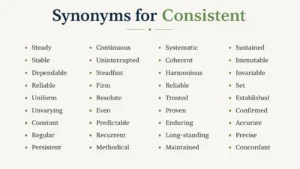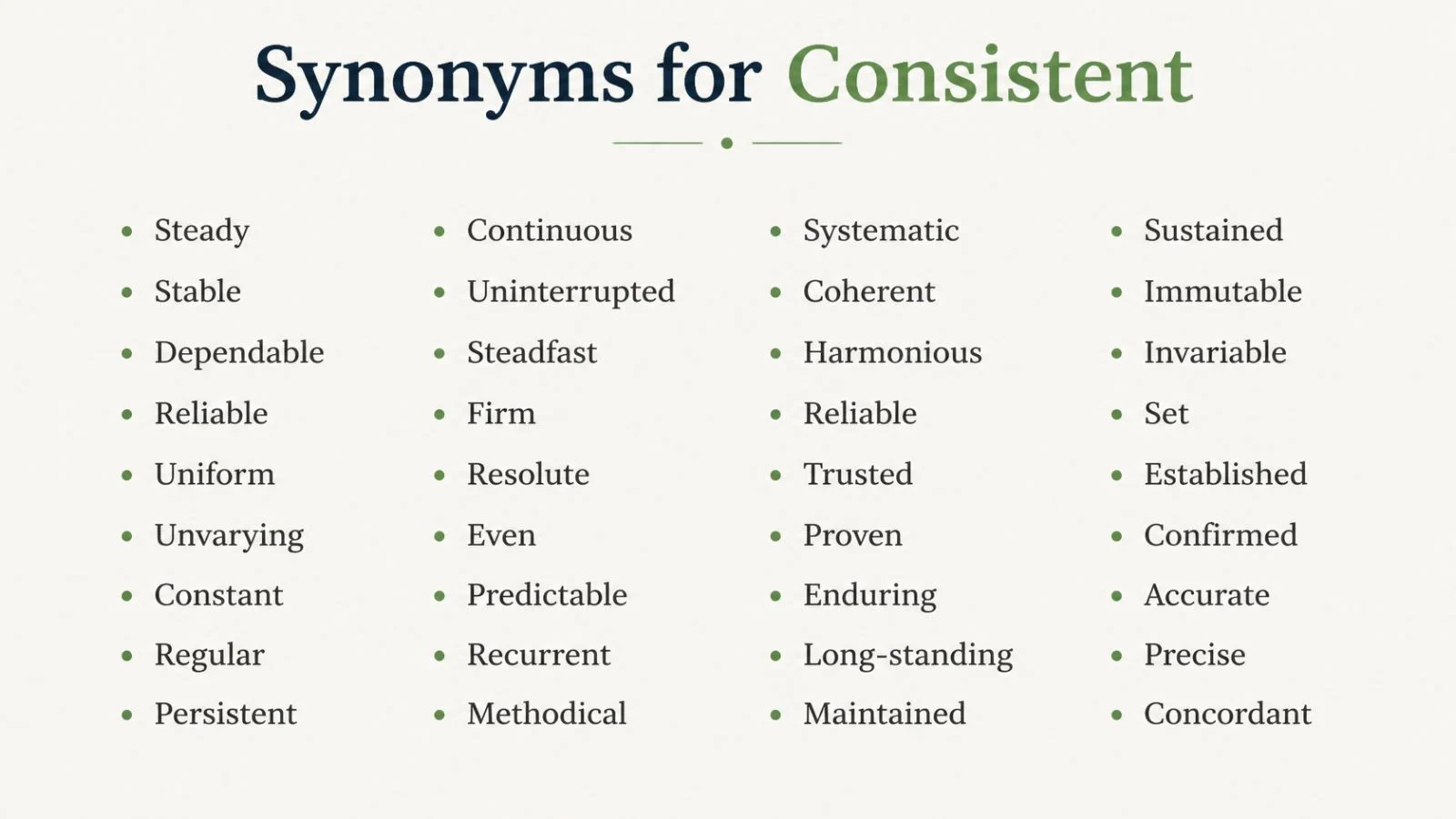
The best another word for consistent is steady. Other close choices are constant, regular, reliable, and uniform. The right pick depends on meaning and context.
Consistent can mean unchanging over time. It can also mean dependable, or in agreement with something else. Each sense needs a different word.
Quick list: steady, constant, regular, reliable, dependable, uniform, stable, steadfast, unwavering, coherent
This article looks at 30 alternatives. Each one has a meaning, IPA, a usage note, and an example. You will also see tables, word partners, and common mistakes.
At a Glance: Consistent Synonyms and Related Alternatives
| Alternative | Part of Speech | Meaning | Register / Tone | Ideal Context |
| Steady | Adjective | Even and not changing much | Neutral | Pace, progress, work |
| Constant | Adjective | Always the same or never stopping | Neutral | Sounds, needs, speed |
| Regular | Adjective | Happening in a fixed pattern | Neutral | Schedules, habits |
| Reliable | Adjective | Safe to trust each time | Neutral, positive | Tools, results, people |
| Dependable | Adjective | Able to be counted on | Warm | Friends, workers |
| Uniform | Adjective | The same in every part | Neutral to formal | Size, color, rules |
| Stable | Adjective | Firm and not likely to change | Neutral | Money, health, mood |
| Steadfast | Adjective | Loyal and firm in purpose | Formal, literary | Loyalty, belief |
| Coherent | Adjective | Clear and well linked | Neutral to formal | Ideas, plans, stories |
| Compatible | Adjective | Able to fit with something | Neutral | Facts, tools, ideas |
Which Word Should You Use?
| If you want to… | Use | Why |
| Describe a smooth pace | steady | It shows even movement with no jumps. |
| Praise results you can trust | reliable | It shows trust built over time. |
| Describe a person you can count on | dependable | It sounds warm and personal. |
| Show that parts look the same | uniform | It stresses sameness across all parts. |
| Show events at fixed times | regular | It points to timing and pattern. |
| Show that ideas agree | coherent | It means the parts make sense together. |
| Show firm loyalty | steadfast | It fits strong, lasting commitment. |
| Show balance in money or mood | stable | It means not likely to swing or fall. |
Exploring the Multiple Meanings of “Consistent”
1. Steady in Pattern
- Meaning: Staying the same over time.
- Explanation: This is the most common sense. It often talks about habits, effort, or pace.
- Example: She is a consistent runner who trains every morning.
2. Same in Quality
- Meaning: Giving the same level of results each time.
- Explanation: Here the word is about quality, not timing. A consistent player does not have bad days often.
- Example: The restaurant is known for consistent food and service.
3. Agreeing With Something
- Meaning: Matching or fitting with another thing.
- Explanation: This sense almost always takes the word “with.” It shows that two things do not clash.
- Example: His story is consistent with the camera footage.
4. Free From Contradiction
- Meaning: Having parts that do not oppose each other.
- Explanation: People use this sense for arguments, rules, and statements. A consistent theory has no hidden conflicts.
- Example: The report is consistent from the first page to the last.
5. Technical Use in Math and Statistics
- Meaning: Having at least one solution, or getting closer to the true value.
- Explanation: A consistent system of equations has a solution. A consistent estimator also improves as the sample grows.
- Example: The two equations form a consistent system.
Sources: Merriam-Webster; Collins English Dictionary; Dictionary.com
Analyzing 30 Consistent Alternatives in Detail
Some alternatives are direct synonyms, while others are related words for one sense only.
Core Synonyms
1. steady
IPA: /ˈstɛdi/ (US and UK)
Definition: Steady means not changing much over time. It also shows a smooth, even pace.
- Usage: It is the plainest swap for consistent. For example, you can say steady progress.
- Example: She kept a steady pace through the whole race.
2. constant
IPA: US /ˈkɑːnstənt/ · UK /ˈkɒnstənt/
Definition: Constant means staying the same over time. It also means going on without a break.
- Usage: It is a close synonym for things that never vary. However, it can sound negative, as in constant noise.
- Example: The constant hum of the fridge kept him awake.
3. regular
IPA: US /ˈrɛɡjələr/ · UK /ˈrɛɡjʊlə/
Definition: Regular means happening in a fixed, even pattern. It also means done at the same times each week.
- Usage: It fits habits and schedules best. In short, regular points to timing, not quality.
- Example: He goes for a regular check-up every spring.
4. uniform
IPA: US /ˈjuːnɪfɔːrm/ · UK /ˈjuːnɪfɔːm/
Definition: Uniform means the same in every part. It also shows no change from place to place.
- Usage: It suits sizes, colors, and rules. However, it can sound dull for people.
- Example: The bricks have a uniform size and shape.
5. even
IPA: /ˈiːvən/ (US and UK)
Definition: Even means smooth and the same across a surface or a span of time. It also means not up and down.
- Usage: Use it for tone, pace, or quality. For example, an even temperature stays level all day.
- Example: The oven gives an even heat across the tray.
Reliable and Dependable Alternatives
6. reliable
IPA: /rɪˈlaɪəbəl/ (US and UK)
Definition: Reliable means you can trust it to work well each time. It also fits people who keep promises.
- Usage: It is a strong match for results or people. In fact, many writers pick it first for trusted results.
- Example: My old car is reliable in every kind of weather.
7. dependable
IPA: /dɪˈpɛndəbəl/ (US and UK)
Definition: Dependable means safe to count on. It also shows a person or tool that rarely lets you down.
- Usage: It sounds warm and personal. As a result, it fits workers and friends well.
- Example: She is a dependable nurse who always shows up on time.
8. stable
IPA: /ˈsteɪbəl/ (US and UK)
Definition: Stable means firm and not likely to change or fall. It also shows a calm, safe state.
- Usage: Use it for money, moods, or health. However, it is about balance more than repeated acts.
- Example: His income stays stable even in a slow year.
9. steadfast
IPA: US /ˈstɛdfæst/ · UK /ˈstɛdfɑːst/
Definition: Steadfast means loyal and firm in purpose. It also shows a mind that does not change.
- Usage: It is a formal, warm word. Also, it fits loyalty better than daily habits.
- Example: They stayed steadfast friends through many hard years of change.
10. unwavering
IPA: /ʌnˈweɪvərɪŋ/ (US and UK)
Definition: Unwavering means very firm and never in doubt. It also shows calm, strong focus.
- Usage: It is a strong word for belief or support. For example, you can show unwavering loyalty.
- Example: Her unwavering focus helped the team win the title.
Unchanging and Fixed Alternatives
11. unchanging
IPA: /ʌnˈtʃeɪndʒɪŋ/ (US and UK)
Definition: Unchanging means staying the same with no shifts. It also shows something that lasts a long time.
- Usage: It is a plain, direct match. However, it may sound cold or dull.
- Example: The village kept its unchanging routine for centuries.
12. unvarying
IPA: US /ʌnˈvɛriɪŋ/ · UK /ʌnˈveəriɪŋ/
Definition: Unvarying means showing no change from one case to the next. It also shows a strict, set pattern.
- Usage: It is formal and rare in speech. Still, it works well in reports.
- Example: The machine makes an unvarying sound each minute.
13. invariable
IPA: US /ɪnˈvɛriəbəl/ · UK /ɪnˈveəriəbəl/
Definition: Invariable means always the same, with no exceptions. It also shows a fixed rule.
- Usage: It is formal and a bit dry. So, use it in science or grammar writing.
- Example: The rule is invariable in all our offices.
14. unfailing
IPA: /ʌnˈfeɪlɪŋ/ (US and UK)
Definition: Unfailing means never running out or breaking down. It also shows deep, steady support.
- Usage: It adds a warm tone. For example, you can praise unfailing kindness.
- Example: He thanked his mother for her unfailing support all year.
15. persistent
IPA: US /pərˈsɪstənt/ · UK /pəˈsɪstənt/
Definition: Persistent means going on without stopping. It also shows someone who does not give up.
- Usage: It is a related word, not an exact synonym. However, it fits effort better than pattern.
- Example: Her persistent effort paid off after two years.
Agreeing and Logical Alternatives
16. compatible
IPA: /kəmˈpætəbəl/ (US and UK)
Definition: Compatible means able to exist or work together without clashes. It also shows ideas that fit.
- Usage: It is a related word for the “agreeing with” sense. In short, use it for ideas or tools.
- Example: Her story is compatible with the facts we know.
17. coherent
IPA: US /koʊˈhɪrənt/ · UK /kəʊˈhɪərənt/
Definition: Coherent means clear and well linked. It also shows parts that make sense together.
- Usage: It is a related word for the logical sense. For example, a coherent plan has no gaps.
- Example: She gave a coherent answer to every question.
18. congruent
IPA: US /kənˈɡruːənt/ · UK /ˈkɒŋɡruənt/
Definition: Congruent means matching or in agreement. It also shows two things that fit well.
- Usage: It is formal and common in math. However, it is rare in daily talk.
- Example: His actions are congruent with his stated values.
19. harmonious
IPA: US /hɑːrˈmoʊniəs/ · UK /hɑːˈməʊniəs/
Definition: Harmonious means free of clashes. It also shows parts that blend in a pleasant way.
- Usage: It is a related word for pleasing agreement. So, it suits teams and colors more than facts.
- Example: The team built a harmonious and calm workplace.
20. logical
IPA: US /ˈlɑːdʒɪkəl/ · UK /ˈlɒdʒɪkəl/
Definition: Logical means based on clear reasoning. It also shows steps that follow in order.
- Usage: It is related to one sense of consistent. Still, it is not an exact synonym.
- Example: Her argument is logical from the first line to the last.
21. consonant
IPA: US /ˈkɑːnsənənt/ · UK /ˈkɒnsənənt/
Definition: Consonant means in harmony or agreement. It also shows ideas that match.
- Usage: It is a formal, rare word. Also, it usually takes “with,” as in consonant with.
- Example: The new law is consonant with our long-held values.
Pattern and Habit Alternatives
22. predictable
IPA: /prɪˈdɪktəbəl/ (US and UK)
Definition: Predictable means easy to guess ahead of time. It also shows acts that follow a clear pattern.
- Usage: It is a related word, not an exact synonym. However, it can sound boring.
- Example: His predictable routine starts with coffee at seven.
23. habitual
IPA: /həˈbɪtʃuəl/ (US and UK)
Definition: Habitual means done again and again out of habit. It also shows a fixed way of acting.
- Usage: It is a related word. However, it focuses on habit, not quality.
- Example: She has a habitual smile when she meets new people.
24. systematic
IPA: /ˌsɪstəˈmætɪk/ (US and UK)
Definition: Systematic means done in an orderly, planned way. It also shows steps that follow a set method.
- Usage: It fits work, checks, and study. However, it is related, not exact.
- Example: The team made a systematic check of every room.
25. methodical
IPA: US /məˈθɑːdɪkəl/ · UK /məˈθɒdɪkəl/
Definition: Methodical means careful and orderly. It also shows someone who works step by step.
- Usage: It describes people more than results. In short, it is a related word.
- Example: He is a methodical worker who never skips a step.
Firm and Resolute Alternatives
26. firm
IPA: US /fɜːrm/ · UK /fɜːm/
Definition: Firm means strong and not easy to move. It also shows a steady, set choice.
- Usage: Use it for views and rules. However, it is related, not exact.
- Example: She took a firm stand on the new policy.
27. fixed
IPA: /fɪkst/ (US and UK)
Definition: Fixed means set in place and not changing. It also shows plans that stay the same.
- Usage: It suits times, rules, and prices. On the other hand, it can sound stiff for people.
- Example: The shop keeps a fixed price for each item.
28. resolute
IPA: /ˈrɛzəluːt/ (US and UK)
Definition: Resolute means firm in purpose. It also shows a will that does not bend.
- Usage: It is formal and strong. Still, it is related, not exact, because it is about will.
- Example: He stayed resolute despite the many setbacks in his career.
29. undeviating
IPA: /ʌnˈdiːvieɪtɪŋ/ (US and UK)
Definition: Undeviating means following one path with no turns. It also shows strict, fixed habits.
- Usage: It is formal and rare. As a result, it works best in writing.
- Example: She kept an undeviating routine through the long winter.
30. unswerving
IPA: US /ʌnˈswɜːrvɪŋ/ · UK /ʌnˈswɜːvɪŋ/
Definition: Unswerving means not turning away from a goal. It also shows deep loyalty.
- Usage: It is a literary word. For example, writers use it with loyalty or faith.
- Example: He gave unswerving loyalty to the club for forty years.
Sources: Merriam-Webster; Collins Thesaurus; Dictionary.com; Oxford Learner’s Dictionaries
Consistent vs. Constant vs. Regular
These three words look close, but each has a core idea. Mixing them can change your meaning.
| Word | Core Idea | Example |
| Consistent | Same quality or pattern each time | She posts consistent results every month. |
| Constant | Never stopping | The constant noise woke the baby. |
| Regular | Fixed timing | He makes regular visits on Sundays. |
Consistent is about sameness. Constant is about time without breaks. Regular is about a set rhythm. So a runner can be regular (every day) without being consistent (same speed).
Sources: Merriam-Webster; Collins English Dictionary
Consistent and Opposite/Paired Word Pairs
| Word | Paired Word | Note |
| Consistent | Inconsistent | The most direct opposite. |
| Consistent | Erratic | Shows unpredictable swings. |
| Consistent | Variable | Shows change from case to case. |
| Consistent | Patchy | Shows good and bad spots. |
| Consistent | Contradictory | Fits the “free from conflict” sense. |
| Consistently | Occasionally | Contrasts always with sometimes. |
Most pairs depend on the sense. Inconsistent works for nearly every sense. Erratic and patchy fit results best, while contradictory fits statements and ideas.
Sources: Merriam-Webster; Collins Thesaurus; Dictionary.com
Common Word Partners of “Consistent”
| Pattern | Common Partners | Example |
| consistent + noun | results, quality, message, effort | The brand keeps a consistent message. |
| consistently + word | good, high, deliver, rank | She consistently ranks near the top. |
| consistent with | facts, evidence, values, findings | The damage is consistent with a storm. |
| stay / remain consistent | over time, in your habits | Stay consistent with your study plan. |
| highly / fairly consistent | data, scores, performance | The scores are fairly consistent across schools. |
Sources: Collins English Dictionary; Oxford Collocations Dictionary
Idiomatic Phrases Featuring “Consistent”
Consistent has few true idioms. These are strongly established expressions instead.
1. Consistent with
- Meaning: Matching or not clashing with something else.
- Example: Her account is consistent with the evidence.
2. Consistency is key
- Meaning: Steady effort matters more than a single big push.
- Example: Coaches say consistency is key to better fitness.
3. A foolish consistency is the hobgoblin of little minds
- Meaning: Sticking to old views just to look steady is a weakness. Ralph Waldo Emerson wrote this in his essay “Self-Reliance.”
- Example: He changed his plan, since a foolish consistency helps no one.
Sources: Merriam-Webster; Collins English Dictionary; Encyclopaedia Britannica
Word Formation of “Consistent”
Etymology & Structure
Consistent comes from Latin consistentem. This is the present participle of consistere, “to stand firm.” The root has two parts: con- (“together”) and sistere (“to stand”). The ending -ent makes it an adjective.
Date and History
Etymonline dates the word to the 1570s. Early use meant “standing firm.” The sense “in agreement” came in the 1640s.
Word Class Variations
- Adjective: consistent
- Adverb: consistently
- Noun: consistency (a rare older form is consistence)
- Related verb: consist (as in consist of)
- Opposites: inconsistent, inconsistency, inconsistently
Sources: Etymonline; Merriam-Webster; Collins English Dictionary
Common Word-Choice Mistakes
Consistent to the facts: consistent with the facts.
Consistant results: consistent results (the ending is -ent).
The team consistent of five people: the team consists of five people.
A uniform worker: a consistent worker (uniform describes things, not effort).
Persistent test scores: consistent test scores (persistent is about not giving up).
Constant grades each term: consistent grades each term (constant means non-stop).
Consistency of the rules with each other: the rules are consistent with each other.
Frequently Asked Questions
What is the closest synonym for consistent?
Steady is the closest everyday synonym. It fits most cases of pace, effort, and results.
What is a formal alternative to consistent?
Invariable and unvarying are formal choices. Congruent is formal for agreement.
What is the difference between consistent and constant?
Consistent means the same in pattern or quality. Constant means going on without a break.
Can consistent describe people?
Yes. It means a person acts or performs the same way each time.
What is the opposite of consistent?
The usual opposite is inconsistent. Erratic and variable also work in many cases.
Is consistent the same as persistent?
No. Persistent is about not giving up. Consistent is about staying the same.
What does “consistent with” mean?
It means matching or agreeing with something. The two things do not clash.
What is a literary alternative to consistent?
Unswerving and steadfast are good literary choices. Writers often use them for loyalty and faith.
Which word fits data or results best?
Reliable fits results you can trust. Uniform fits data that looks the same throughout.
Is consistent always a positive word?
Not always. It often praises good work, but it can also describe poor results, as in consistently late.
Conclusion
The closest everyday alternatives to consistent are steady, constant, regular, and reliable. Uniform and stable also work in many cases. Each word keeps a slightly different core idea.
Context matters most. Consistent can mean steady in pattern, same in quality, or in agreement. Coherent and compatible fit the agreement sense, while steadfast and unswerving suit loyalty.
To choose well, first decide which sense you mean. Next, check the tone you want. Then pick the word that fits both.

Emily Davis is a passionate writer who enjoys exploring English vocabulary, synonyms, and language tips to help readers improve their communication skills.
At PressivoMedia.com, she focuses on creating simple, engaging, and informative content that makes learning English easier and more enjoyable.