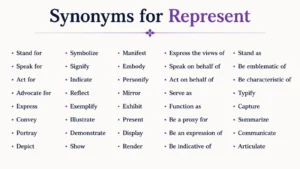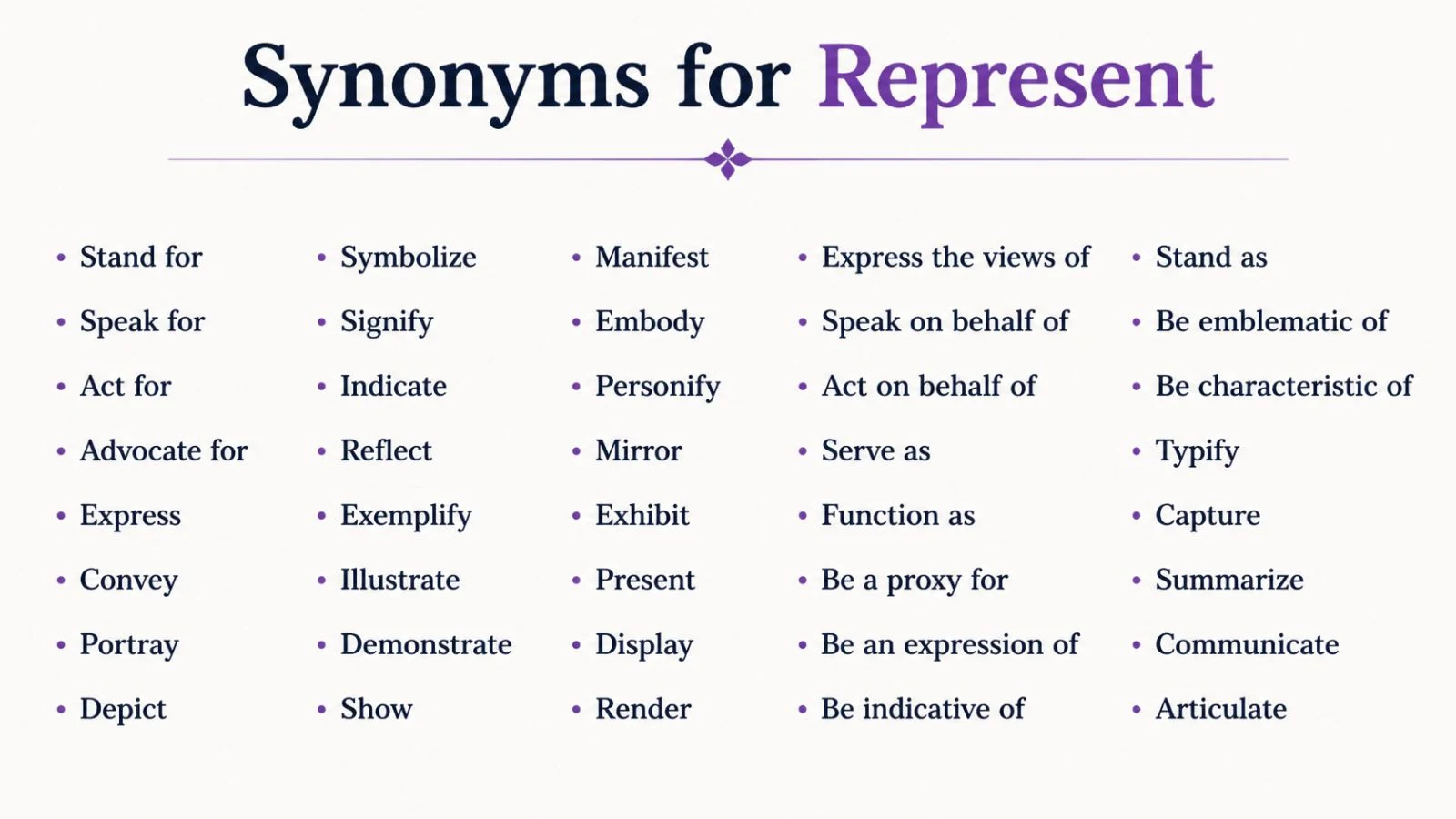
The closest everyday alternatives for represent are stand for, symbolize, speak for, act for, and depict. The best choice depends on the meaning you need.
Use “stand for” or “symbolize” for signs and ideas. Use “speak for” or “act for” when you work on behalf of people.
Represent also covers art, examples, and claims. For art, try “portray” or “depict”. For a perfect example, try “embody” or “exemplify”. In formal writing, “denote” and “constitute” often fit well.
Quick list: stand for, symbolize, denote, signify, speak for, act for, stand in for, depict, portray, embody
This article covers 30 alternatives. Each one has a meaning, IPA, a usage note, and an example. You will also see which words are direct synonyms and which are related choices.
At a Glance: Represent Synonyms and Related Alternatives
| Alternative | Part of Speech | Meaning | Register / Tone | Ideal Context |
| Stand for | Phrasal verb | Be a short form or sign of | Neutral | Letters, flags, symbols |
| Symbolize | Verb | Be a sign of a bigger idea | Neutral to formal | Objects, colors, art |
| Denote | Verb | Point to an exact meaning | Formal | Labels, technical text |
| Speak for | Phrasal verb | Talk for others | Neutral | Groups, meetings |
| Act for | Phrasal verb | Do tasks for someone | Neutral to formal | Law, business |
| Depict | Verb | Show in art or words | Neutral to formal | Paintings, books |
| Portray | Verb | Show a person or scene | Neutral | Film, theater, news |
| Embody | Verb | Be a clear form of an idea | Formal | Values, qualities |
| Exemplify | Verb | Be a good example of | Formal | Essays, reports |
| Constitute | Verb | Make up or equal | Formal | Law, data, reports |
Which Word Should You Use?
| If you want to… | Use | Why |
| Say a flag or sign has a meaning | Symbolize | It fits objects with deep meaning. |
| Explain what a letter or code means | Stand for | It is short and clear. |
| Talk for a group | Speak for | It puts the focus on voice. |
| Work for a client in court | Act for | It fits law and business. |
| Show a scene in a painting | Depict | It suggests a clear image. |
| Play a role on stage | Portray | It fits acting and film. |
| Show a person is a perfect case | Embody | It says the person is the idea. |
| Give an exact label meaning | Denote | It is precise and formal. |
Exploring the Multiple Meanings of “Represent”
1. Stand for or symbolize
- Meaning: To be a sign or symbol of something.
- Explanation: A sign, letter, or object points to an idea. It also works for words and codes.
- Example: The olive branch represents peace in many countries.
2. Act or speak for others
- Meaning: To speak or act in place of a person or group.
- Explanation: Lawyers, agents, and leaders do this. It also covers teams and countries.
- Example: She will represent our school at the national contest.
3. Show or portray
- Meaning: To show a person, scene, or idea in art or words.
- Explanation: Artists and writers do this. The image may be real or imagined.
- Example: The statue represents a farmer holding a sheaf of wheat.
4. Be an example or an equal
- Meaning: To be a case of something or to equal it.
- Explanation: This sense also covers parts of a whole. It often appears with numbers.
- Example: Women represent half of the staff in our office.
5. State or claim
- Meaning: To describe something in a certain way, often to sway others.
- Explanation: This sense is formal. It often appears in law and business.
- Example: The seller represented the car as new.
Sources: Merriam-Webster (merriam-webster.com/dictionary/represent), Collins English Dictionary (collinsdictionary.com/dictionary/english/represent), Dictionary.com (dictionary.com/browse/represent)
Analyzing 30 Represent Alternatives in Detail
Some alternatives are direct synonyms. Others are related choices that fit only one sense.
Core Synonyms
1. Stand for
IPA: US /stænd fɔr/ · UK /stænd fɔː/
Definition: It means a sign or letter is a short form of something. It also shows what a symbol means.
- Usage: This is the plainest swap in everyday English. However, it works best for signs, letters, and symbols.
- Example: The stars on the flag stand for the fifty states.
2. Symbolize
IPA: (US and UK) /ˈsɪmbəlaɪz/
Definition: It means a thing is a sign of a bigger idea. It also fits objects with deep meaning.
- Usage: This is a close synonym for the first sense. It sounds a little more formal, however.
- Example: A white dove often symbolizes peace in many cultures.
3. Denote
IPA: US /dɪˈnoʊt/ · UK /dɪˈnəʊt/
Definition: It means a word or sign points to an exact thing. It also gives the plain meaning.
- Usage: Writers use it in formal or technical text. In fact, it fits labels better than people.
- Example: A red light on the panel denotes a system fault.
4. Signify
IPA: (US and UK) /ˈsɪɡnɪfaɪ/
Definition: It means a thing is a sign of something else. It also can mean to matter.
- Usage: It sounds formal. Still, it works well for hidden meanings.
- Example: A green light signifies that the road is clear.
5. Mean
IPA: (US and UK) /miːn/
Definition: It tells what a word, sign, or act stands for. It also is the simplest choice.
- Usage: This is the easiest everyday option. Still, it feels plain in formal writing.
- Example: The red cross on the box means first aid.
6. Indicate
IPA: (US and UK) /ˈɪndɪkeɪt/
Definition: It means to point to a fact or sign. It also shows a sign without full proof.
- Usage: This is a related alternative, not an exact match. For example, dark clouds indicate rain.
- Example: The test results indicate that the plan is working.
Acting on Behalf of Others
7. Speak for
IPA: US /spiːk fɔr/ · UK /spiːk fɔː/
Definition: It means to talk to another person or group. It also can mean sharing their views.
- Usage: This is a close match for the people. In short, you give a voice to others.
- Example: The union leader will speak for all the workers tomorrow.
8. Act for
IPA: US /ækt fɔr/ · UK /ækt fɔː/
Definition: It means to do jobs for someone else. It also covers legal and business work.
- Usage: Lawyers and agents often act for clients. However, it is less common in casual talk.
- Example: My lawyer will act for me at the hearing.
9. Stand in for
IPA: US /stænd ɪn fɔr/ · UK /stænd ɪn fɔː/
Definition: It means to take someone’s place for a short time. It also fits objects.
- Usage: This is a related alternative, not an exact synonym. It shows a short swap, not a full role.
- Example: Maya will stand in for our manager while she travels.
10. Serve as
IPA: US /sɜrv əz/ · UK /sɜːv əz/
Definition: It means to do the job of something. It also shows the role a thing plays.
- Usage: This is a related alternative. For example, a box can serve as a table.
- Example: The old barn serves as a studio for the artist.
11. Deputize
IPA: US /ˈdɛpjətaɪz/ · UK /ˈdepjʊtaɪz/
Definition: It means to act in place of a boss or leader. It also can mean to give someone that power.
- Usage: This is a related alternative with a formal tone. Still, it fits office and law talk.
- Example: The mayor asked her aide to deputize for her at the event.
Showing or Portraying
12. Depict
IPA: (US and UK) /dɪˈpɪkt/
Definition: It means to show something in a picture or in words. It also suggests a clear image.
- Usage: This is a strong match for the art sense. In fact, it fits paintings best.
- Example: The mural depicts the history of our town.
13. Portray
IPA: US /pɔrˈtreɪ/ · UK /pɔːˈtreɪ/
Definition: It means to show a person or scene in art or acting. It also can mean to shape a view of someone.
- Usage: Actors portray roles. However, the word can also hint at how others see a person.
- Example: The film portrays her as a brave leader.
14. Illustrate
IPA: (US and UK) /ˈɪləstreɪt/
Definition: It means to explain a point with a picture or case. It also can mean to add drawings to a book.
- Usage: This is a related alternative. For example, a chart can illustrate a trend.
- Example: This graph illustrates how prices rose last year.
15. Picture
IPA: US /ˈpɪktʃər/ · UK /ˈpɪktʃə/
Definition: As a verb, it means to form an image in the mind. It also can mean to show in a drawing.
- Usage: This is a casual, related alternative. Still, it is rarer than “depict” as a verb.
- Example: Can you picture her as the new team captain?
16. Show
IPA: US /ʃoʊ/ · UK /ʃəʊ/
Definition: It means to let people see something. It also can mean to prove a point.
- Usage: This is the simplest related word. For example, a map shows where we are.
- Example: The map shows the way to the old mill.
Embodying and Exemplifying
17. Embody
IPA: US /ɪmˈbɑdi/ · UK /ɪmˈbɒdi/
Definition: It means to be a clear form of an idea. It also shows a quality in a person.
- Usage: This is a strong alternative. In fact, it says the person is the idea itself.
- Example: She embodies the spirit of the whole team.
18. Personify
IPA: US /pərˈsɑnɪfaɪ/ · UK /pəˈsɒnɪfaɪ/
Definition: It means to be a perfect case of a quality. It also can mean to give human traits to a thing.
- Usage: This is a related alternative. However, it feels stronger than “represent”.
- Example: The old nurse personifies kindness.
19. Exemplify
IPA: (US and UK) /ɪɡˈzɛmplɪfaɪ/
Definition: It means to be a good example of something. It also can mean to show by example.
- Usage: This is a related alternative. For example, an essay can exemplify clear writing.
- Example: Her work exemplifies the best of local art.
20. Typify
IPA: (US and UK) /ˈtɪpɪfaɪ/
Definition: It means to be a typical case of a group. It also shows common traits.
- Usage: This is a related alternative with a formal tone. Still, it suits reports.
- Example: Small shops and narrow streets typify the old town.
21. Epitomize
IPA: (US and UK) /ɪˈpɪtəmaɪz/
Definition: It means to be the perfect case of a thing. It also suggests the most typical form.
- Usage: This is a related alternative. However, it feels strong, so use it with care.
- Example: The song epitomizes the sound of the 1990s.
Formal and Technical Alternatives
22. Constitute
IPA: US /ˈkɑnstɪtuːt/ · UK /ˈkɒnstɪtjuːt/
Definition: It means to make up a whole. It also can mean to equal something.
- Usage: This fits the “equal” sense of representation. In short, it is formal and common in law and data.
- Example: These fees constitute half of the total cost.
23. Designate
IPA: (US and UK) /ˈdɛzɪɡneɪt/
Definition: It means to name a person or thing for a role. It also can mean to mark with a sign.
- Usage: It is formal. For example, a letter can designate a type of seat.
- Example: The letter A designates the front row.
24. Correspond to
IPA: US /ˌkɔrəˈspɑnd tuː/ · UK /ˌkɒrɪˈspɒnd tuː/
Definition: It means to match another thing in kind. It also shows a link between two items.
- Usage: This is a related alternative. However, it stresses a match, not a symbol.
- Example: Each number on the map corresponds to a street.
25. Betoken
IPA: US /bɪˈtoʊkən/ · UK /bɪˈtəʊkən/
Definition: It means to be a sign of something to come. It also has an old tone.
- Usage: This is a rare, literary, related word. In short, skip it in daily writing.
- Example: Dark skies caused a storm tonight.
Describing and Suggesting
26. Describe
IPA: (US and UK) /dɪˈskraɪb/
Definition: It means to tell what something is like. It also can mean to paint a clear picture in words.
- Usage: This is a related alternative. However, it tells about a thing and does not stand for it.
- Example: The report describes how the system works.
27. Characterize
IPA: US /ˈkɛrəktəraɪz/ · UK /ˈkærəktəraɪz/
Definition: It means to show what a person or thing is like. It also can mean to name key traits.
- Usage: This is a related alternative. It fits the “claim” sense, for example in news writing.
- Example: Critics characterize the plan as risky.
28. Present
IPA: (US and UK) /prɪˈzɛnt/
Definition: As a verb, it means to show or offer something to others. It also can mean to give a view of a case.
- Usage: This is a related alternative. Still, it lacks the idea of acting for others.
- Example: The ad presents the product as a bargain.
29. Reflect
IPA: (US and UK) /rɪˈflɛkt/
Definition: It means to show the nature of something. It also can mean to give back an image.
- Usage: This is a related alternative. For example, a result can reflect a trend.
- Example: Her art reflects life in a small village.
30. Evoke
IPA: US /ɪˈvoʊk/ · UK /ɪˈvəʊk/
Definition: It means to bring a feeling or memory to mind. It also shows a soft link, not a strict sign.
- Usage: This is a related alternative. However, it works for mood, not for official roles.
- Example: The smell of fresh bread evokes my grandmother’s kitchen.
Sources: Merriam-Webster, Collins English Dictionary and Thesaurus, Dictionary.com
Represent vs. Symbolize vs. Embody
These three words look close, but each has its own focus. First, check what the subject does. Then pick the word that fits.
| Word | Main idea | Typical subject | Example |
| Represent | Stands for or acts for | Signs, people, groups | The flag represents the nation. |
| Symbolize | Is a sign of an idea | Objects, colors, images | The flag symbolizes freedom. |
| Embody | Is the idea in real form | People, works, acts | She embodies freedom. |
In short, “represent” is the widest word. “Symbolize” is narrower and focuses on signs. “Embody” says the thing is the idea itself.
Sources: Merriam-Webster, Collins English Dictionary
Represent and Opposite/Paired Word Pairs
| Word | Paired Word | Note |
| Represent | Misrepresent | To show something in a false way |
| Represent | Underrepresent | To give too small a share or voice |
| Represent | Overrepresent | To give too large a share or voice |
| Representation | Misrepresentation | A false or unfair picture |
| Representative | Constituent | A person who speaks for a group and a person in that group |
Represent has no single true opposite. Instead, it has paired words that change the meaning. The prefixes mis-, under-, and over- are the most common. Also, “representative” and “constituent” often appear together in politics.
Sources: Merriam-Webster, Collins English Dictionary
Common Word Partners of “Represent”
| Pattern | Common Partners | Example |
| represent + group | the people, clients, workers, voters | She represents her clients in court. |
| represent + place | your country, your school, a district | He will represent his country at the games. |
| represent + idea | progress, a challenge, a risk, a change | The deal represents a big change. |
| represent + number | a share, a percent, a fraction | Sales represent 40 percent of income. |
| represent + as | as a hero, as a fact, as new | The ad represents the toy as safe. |
| represent oneself | yourself, himself, herself | You may represent yourself in court. |
Sources: Collins English Dictionary, Merriam-Webster
Idiomatic Phrases Featuring “Represent”
Represent has few true idioms. The items below are established expressions, not fixed idioms.
1. Represent yourself
- Meaning: To speak for yourself in court without a lawyer.
- Example: He chose to represent himself at the trial.
2. Represent someone’s interests
- Meaning: To protect and push for what a person or group needs.
- Example: A good agent represents the interests of the client first.
3. Represent oneself as
- Meaning: To claim to be a certain type of person, often to gain trust.
- Example: He represented himself as an expert on old coins.
4. Rep your city
- Meaning: In informal slang, to show pride in your hometown or group.
- Example: She wore the team jersey to represent her city.
Sources: Merriam-Webster, Collins English Dictionary
Word Formation of “Represent”
Etymology and Structure
Represent comes from Old French and Latin. The Latin verb repraesentare means to make a present again. It joins re- (again) and praesentare (to present).
Date and History
Etymonline places the word in English in the late 14th century. Merriam-Webster also lists the 14th century as the first known use. The early meaning was to bring something to mind.
Word Class Variations
- Verb: represent, represents, represented, representing
- Noun: representation, representative, representativeness
- Adjective: representative, representational
- Adverb: representatively
- Related forms: misrepresent, underrepresent, overrepresent, representable
Sources: Etymonline (etymonline.com/word/represent), Merriam-Webster
Common Word-Choice Mistakes
- “The chart represents the data” → “The chart represents the data.”
- “I represent my idea to the class” → “I present my idea to the class.”
- “She will represent our team” → “She will represent our team.”
- “The dove symbolizes peace” → “The dove symbolizes peace.”
- “Red denotes danger” → “Red denotes danger.”
- “He misrepresented the rule” (when he just misread it) → “He misunderstood the rule.”
- “The actor depicted the doctor” (in a play) → “The actor played the doctor” or “portrayed the doctor.”
Frequently Asked Questions
What is the closest synonym for represent?
The closest synonym depends on the sense. “Stand for” fits signs, and “speak for” fits people.
What is a formal alternative to represent?
“Denote” and “constitute” are formal choices. “Designate” also fits the official text.
What is the difference between represent and symbolize?
Representation is broader. It can mean acting for people. Symbolising only means being a sign of an idea.
Can represent be used for people?
Yes. It means to speak or act for them. Lawyers and leaders often represent others.
Does it represent the same as the present?
No. Present means to show or give something. Represent means to stand for or act for.
Conclusion
The closest alternatives for represent are “stand for”, “symbolize”, “speak for”, and “act for.” Each one fits a different sense. “Depict” and “portray” suit art, while “embody” and “exemplify” suit perfect examples.
Context matters most. A sign stands for an idea, but a lawyer acts for a client. Formal words like “denote” and “constitute” work well in reports. Simple words like “mean” and “show” work well in daily conversation.
To choose well, first find the sense you need. Next, check the tone. Finally, read your sentence aloud to test the fit.

Emily Davis is a passionate writer who enjoys exploring English vocabulary, synonyms, and language tips to help readers improve their communication skills.
At PressivoMedia.com, she focuses on creating simple, engaging, and informative content that makes learning English easier and more enjoyable.