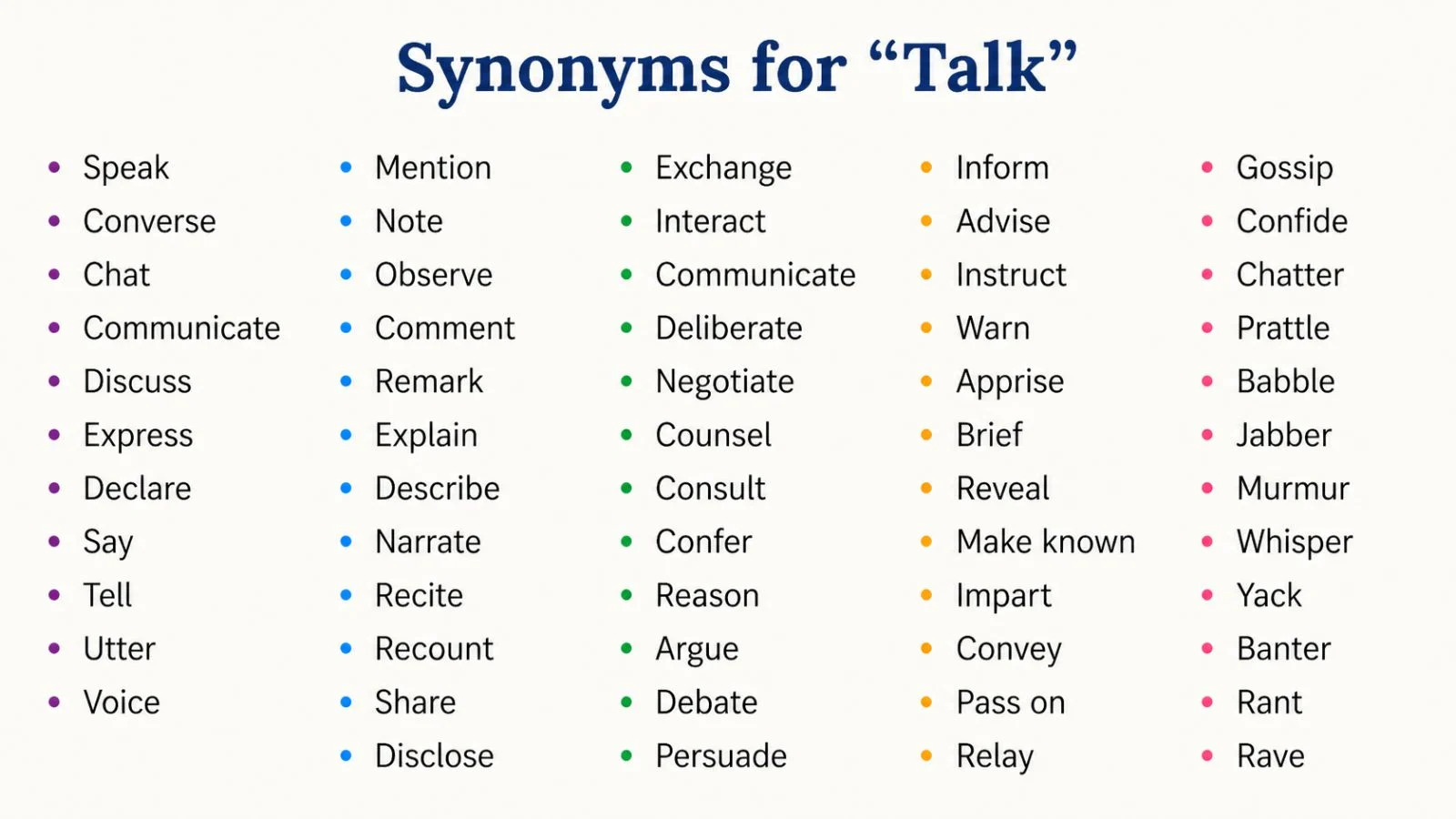
The closest everyday word for talk is speak. Other common choices are chat, converse, discuss, and communicate. The best pick depends on the meaning and the setting.
Talk can mean to chat with a friend or to share ideas. It can also mean to give a speech, to reveal a secret, or to go on too long. Each sense has its own best alternatives.
Quick list: speak, chat, converse, discuss, communicate, chatter, gossip, lecture, negotiate, ramble
This article covers 30 alternatives. Each one has a meaning, IPA, a usage note, and an example. You will also see tables, word partners, idioms, and common mistakes.
At a Glance: Talk Synonyms and Related Alternatives
| Alternative | Part of Speech | Meaning | Register / Tone | Ideal Context |
| Speak | Verb | Say words out loud | Neutral | Everyday and work use |
| Chat | Verb | Talk in a friendly way | Casual | Friends and online messages |
| Converse | Verb | Talk with someone | Formal | Writing and polite speech |
| Discuss | Verb | Talk about a topic in detail | Neutral to formal | Meetings and classes |
| Communicate | Verb | Share ideas or feelings | Neutral | Work and teamwork |
| Negotiate | Verb | Talk to reach a deal | Formal | Business and law |
| Lecture | Verb | Give a long planned talk | Formal | Schools and events |
| Gossip | Verb | Talk about others’ private lives | Informal | Social settings |
| Ramble | Verb | Talk without a clear point | Critical | Long stories |
| Confide | Verb | Share a secret with someone | Warm | Close friendships |
Which Word Should You Use?
| If you want to… | Use | Why |
| Talk in a plain, neutral way | Speak | It fits almost every setting. |
| Have a light, friendly talk | Chat | It sounds warm and relaxed. |
| Sound formal in writing | Converse | It suits polite or careful prose. |
| Look at a topic in depth | Discuss | It shows that ideas are being shared. |
| Reach a deal | Negotiate | It shows give and take. |
| Give a long, planned talk | Lecture | It fits classes and public events. |
| Share news about other people | Gossip | It shows the talk is about private lives. |
| Share a private matter | Confide | It shows trust. |
Exploring the Multiple Meanings of “Talk”
1. Speaking with words
- Meaning: To say words out loud.
- Explanation: This is the most basic sense. It also works for people who cannot yet speak well, like a baby learning words.
- Example: My niece started to talk when she was one year old.
2. Having a conversation
- Meaning: To share ideas or news with another person.
- Explanation: This sense needs at least two people. You often use “to” or “with” after it.
- Example: We talked about our plans over lunch.
3. Formal discussions
- Meaning: A serious meeting to settle an issue.
- Explanation: People use the plural “talks” for this sense. It often appears in news about work and politics.
- Example: The two sides will begin peace talks next week.
4. Giving a speech
- Meaning: A short speech given to a group.
- Explanation: Here “talk” is a noun. It is less formal than “lecture.”
- Example: She gave a short talk on healthy eating.
5. Revealing information
- Meaning: To tell a secret or confess.
- Explanation: This sense often involves pressure. People say a suspect “will talk.”
- Example: The witness finally agreed to talk to the police.
6. Rumor or gossip
- Meaning: Talk that people repeat, often without proof.
- Explanation: It is a noun in this sense. It usually follows “there is” or “there was.”
- Example: There is talk of a new store opening downtown.
Sources: Merriam-Webster, Collins English Dictionary, Dictionary.com
Analyzing 30 Talk Alternatives in Detail
Some of these words are direct synonyms of talk. Others are related alternatives that fit only certain contexts.
Core Synonyms
1. Speak
IPA: (US and UK) /spiːk/
Definition: It means to say words out loud. It also covers one person talking to others.
- Usage: This is the closest plain synonym. However, it often sounds a little more formal than “talk.”
- Example: She speaks softly when the baby is asleep.
2. Chat
IPA: (US and UK) /tʃæt/
Definition: To chat means to talk in a friendly, easy way. It also fits short online messages.
- Usage: It suits light topics like coffee with friends. However, it feels too casual for a formal meeting.
- Example: We chatted for an hour about school and our weekend plans.
3. Converse
IPA: US /kənˈvɜːrs/ · UK /kənˈvɜːs/
Definition: It means to talk with another person about something. It also suggests a two-way exchange.
- Usage: This is a formal choice. In fact, people rarely use it in daily speech.
- Example: The two neighbors conversed quietly over the garden fence.
4. Discuss
IPA: (US and UK) /dɪˈskʌs/
Definition: It means to talk about a topic in detail. It also involves sharing ideas with others.
- Usage: This is a close synonym for serious topics. However, it takes an object, so you discuss something.
- Example: Let’s discuss the budget before we sign the contract.
5. Communicate
IPA: (US and UK) /kəˈmjuːnɪkeɪt/
Definition: It means to share ideas or feelings with someone. It also covers writing, signs, and body language.
- Usage: This is a related alternative, not an exact synonym. It is broader, so you can communicate without speaking.
- Example: Good teams communicate clearly when their plans suddenly change.
Casual and Informal Alternatives
6. Chatter
IPA: US /ˈtʃætər/ · UK /ˈtʃætə/
Definition: It means to talk fast about small or silly things. It also names the quick sound of birds.
- Usage: The tone is often light or a bit annoying. For example, children chatter on the bus.
- Example: The children chattered happily all the way to the zoo.
7. Natter
IPA: US /ˈnætər/ · UK /ˈnætə/
Definition: It means to chat for a long time about nothing much. It also feels warm and friendly.
- Usage: This is a British informal word. However, people in the US rarely use it.
- Example: My aunt loves to natter with the neighbors on Sundays.
8. Gab
IPA: (US and UK) /ɡæb/
Definition: It means to talk a lot in a casual way. It also hints at idle talk.
- Usage: This word is informal and a little playful. In fact, “the gift of the gab” is a well-known phrase.
- Example: They gabbed on the phone until well past midnight last night.
9. Yak
IPA: (US and UK) /jæk/
Definition: It means to talk on and on, often about small things. It also suggests the talk is not very useful.
- Usage: This is slang. Still, it is common in casual speech.
- Example: Please stop yakking on the phone and finish your homework.
10. Jabber
IPA: US /ˈdʒæbər/ · UK /ˈdʒæbə/
Definition: It means to talk fast in a way that is hard to follow. It also suggests noise.
- Usage: The tone is often negative. For example, people may jabber when they feel nervous.
- Example: He jabbered excitedly about the game and nobody understood him.
Formal and Serious Alternatives
11. Negotiate
IPA: US /nɪˈɡoʊʃieɪt/ · UK /nɪˈɡəʊʃieɪt/
Definition: It means to talk to reach a deal. It also involves give and take from both sides.
- Usage: This is a related alternative, not an exact synonym. However, it fits business and law well.
- Example: The union will negotiate a new pay deal this week.
12. Confer
IPA: US /kənˈfɜːr/ · UK /kənˈfɜː/
Definition: It means to talk with others before a decision. It also suggests a short, serious meeting.
- Usage: This is a formal word. For example, two doctors may confer on a hard case.
- Example: The coach conferred with her team before the final play.
13. Consult
IPA: (US and UK) /kənˈsʌlt/
Definition: It means to ask an expert or a group for advice. It also can mean to check a book.
- Usage: This is a related alternative. In short, you consult someone to get help.
- Example: You should consult a lawyer before you sign that lease.
14. Debate
IPA: (US and UK) /dɪˈbeɪt/
Definition: It means to talk about a topic where people disagree. It also involves giving reasons.
- Usage: This fits formal or public talk. However, it is stronger than a calm chat.
- Example: Students will debate the new school rule on Friday.
15. Deliberate
IPA: (US and UK) /dɪˈlɪbəreɪt/
Definition: It means to think and talk about a choice with care. It also takes time.
- Usage: This is a formal, related alternative. For example, a jury will deliberate before it votes.
- Example: The jury deliberated for two days before reaching a verdict.
Public Speaking Alternatives
16. Lecture
IPA: US /ˈlektʃər/ · UK /ˈlektʃə/
Definition: It means to give a long, planned talk to a group. It also can mean to scold someone.
- Usage: In the first sense, it is a formal public talk. However, the scolding sense is often negative.
- Example: The professor will lecture on ancient history tomorrow morning.
17. Address
IPA: (US and UK) /əˈdres/
Definition: It means to speak to a group in a formal way. It also means to talk to someone directly.
- Usage: This is a formal word. For example, leaders address a crowd.
- Example: The mayor will address the crowd outside city hall.
18. Preach
IPA: (US and UK) /priːtʃ/
Definition: It means to give a religious talk to a group. It also can mean to push your views on others.
- Usage: The second sense is negative. For example, people dislike anyone who preaches to them.
- Example: The pastor preached about kindness on Sunday morning.
19. Orate
IPA: (US and UK) /ɔːˈreɪt/
Definition: It means to speak in a grand, formal way. It also suggests a love of speeches.
- Usage: This is a rare, formal word. Still, writers often use it to tease a long speaker.
- Example: He loved to orate at family dinners about politics.
20. Speechify
IPA: (US and UK) /ˈspiːtʃɪfaɪ/
Definition: It means to give a long speech, often in a dull way. It also hints that the speaker loves the sound of his own voice.
- Usage: This is informal and a bit mocking. In fact, it is a rare word.
- Example: The manager began to speechify instead of answering the question.
Gossip and Secret-Sharing Alternatives
21. Gossip
IPA: US /ˈɡɑːsɪp/ · UK /ˈɡɒsɪp/
Definition: It means to talk about other people’s private lives. It also often involves rumors.
- Usage: This is a narrow sense of “talk.” However, it nearly always has a negative tone.
- Example: They gossip about their coworkers during every coffee break.
22. Confide
IPA: (US and UK) /kənˈfaɪd/
Definition: It means to share a secret with someone you trust. It also shows a close bond.
- Usage: This is a related alternative. It fits private talks, so people often say “confide in.”
- Example: She confided in her sister about the job offer.
23. Blab
IPA: (US and UK) /blæb/
Definition: It means to tell a secret by mistake or on purpose. It also suggests the speaker is careless.
- Usage: This word is informal. For example, a friend may blab about a surprise party.
- Example: Someone blabbed about the surprise party before we could plan it.
24. Squeal
IPA: (US and UK) /skwiːl/
Definition: It means to tell on someone, often to the police. It also names a loud, high cry.
- Usage: This is slang for informing. However, it is a related alternative, not a plain synonym.
- Example: The thief squealed to the police after one night in jail.
25. Divulge
IPA: (US and UK) /daɪˈvʌldʒ/
Definition: It means to make a secret known. It also suggests the news was meant to stay private.
- Usage: This is a formal, related alternative. In fact, it often appears in news and legal writing.
- Example: The company refused to divulge the name of its new partner.
Long or Aimless Talk Alternatives
26. Ramble
IPA: (US and UK) /ˈræmbəl/
Definition: It means to talk for a long time without a clear point. It also can mean to walk without a goal.
- Usage: The tone is often critical. For example, an old story may ramble on.
- Example: Grandpa tends to ramble when he tells stories from his youth.
27. Drone
IPA: US /droʊn/ · UK /drəʊn/
Definition: It means to talk in a dull, flat voice. It also has a low, steady hum.
- Usage: Use this word to show boredom. However, the speaker may not mean any harm.
- Example: The speaker droned on for an hour and half while the room slept.
28. Prattle
IPA: (US and UK) /ˈprætl/
Definition: It means to talk a lot about silly or small things. It also suggests a childlike style.
- Usage: The tone is gentle or a bit scornful. For example, a toddler may prattle all day.
- Example: The toddler prattled to her toy rabbit all afternoon.
29. Babble
IPA: (US and UK) /ˈbæbəl/
Definition: It means to talk fast in a way that makes little sense. It also names the sound of running water.
- Usage: This is a related alternative. For example, a nervous speaker may babble.
- Example: The baby babbled happily while we cooked dinner.
30. Waffle
IPA: US /ˈwɑːfəl/ · UK /ˈwɒfəl/
Definition: It means to talk a lot without making a clear point. It also can mean to avoid a firm answer.
- Usage: In British English it means to talk on and on. However, in the US it often means to change your mind.
- Example: Stop waffling and tell me what you really think.
Sources: Merriam-Webster, Collins English Dictionary and Thesaurus, Dictionary.com, Oxford Learner’s Dictionaries
Talk vs. Speak vs. Chat vs. Converse
These four words overlap a lot. Still, each one has its own feel. The table shows the main difference.
| Word | Feel | Typical Use | Example |
| Talk | Neutral and natural | Two-way exchange | We talked after class. |
| Speak | Slightly more formal | One person using words | She speaks three languages. |
| Chat | Casual and friendly | Light topics | They chatted over tea. |
| Converse | Formal | Polite or written style | The guests conversed politely. |
“Talk” is the safest choice in daily English. “Speak” works well when the focus is on the speaker. “Chat” is best for easy topics. “Converse” mostly appears in formal writing.
Prepositions also change the meaning. You talk to someone when you do most of the speaking. You talk with someone when both people share the talk.
Sources: Merriam-Webster, Collins English Dictionary, Cambridge Dictionary
Talk and Opposite/Paired Word Pairs
| Word | Paired Word | Note |
| Talk | Listen | The most natural pair in conversation |
| Talk | Silence | Shows the lack of speech |
| Talk | Action | Used in sayings like “actions speak louder than words” |
| Talk | Write | Contrasts spoken and written messages |
| Talk | Walk | Appears in the phrase “talk the talk, walk the walk” |
Talk has no single exact opposite. “Listen” is the closest pair because both skills work together. “Silence” and “action” show other contrasts.
Sources: Merriam-Webster, Collins Thesaurus, Dictionary.com
Common Word Partners of “Talk”
| Pattern | Common Partners | Example |
| Verb + talk | give a talk, have a talk, hold talks | She gave a talk at the library. |
| Adjective + talk | small talk, pep talk, baby talk, straight talk | The coach gave the team a pep talk. |
| Noun + talk | peace talks, trade talks, pillow talk | The leaders held trade talks in May. |
| Talk + preposition | talk to, talk with, talk about | I talked to my boss this morning. |
| Talk + particle | talk back, talk into, talk out of, talk down | Don’t talk back to your teacher. |
| Talk + adverb | talk quietly, talk openly, talk freely | They talked openly about money. |
Sources: Oxford Learner’s Dictionaries, Cambridge Dictionary, Collins English Dictionary
Idiomatic Phrases Featuring “Talk”
1. Talk is cheap
- Meaning: Words cost nothing, so actions matter more.
- Example: He promised to help, but talk is cheap.
2. Talk of the town
- Meaning: A person or event that everyone is discussing.
- Example: The new bakery became the talk of the town.
3. Talk turkey
- Meaning: To speak plainly about a real business matter.
- Example: Let’s sit down and talk turkey about the price.
4. Talk shop
- Meaning: To talk about work in a social setting.
- Example: The nurses talked shop at the dinner party.
Sources: Merriam-Webster, Cambridge Dictionary, Collins English Dictionary
Word Formation of “Talk”
Etymology & Structure
Dictionaries link “talk” to Middle English talken. It probably comes from talen, which means to tell. The ending -k shows repeated action. A similar ending appears in “walk.”
Date and History
Dictionaries date the verb to the 13th century. It has been in English for a very long time.
Word Class Variations
- Verb: talk, talks, talked, talking
- Noun: talk, talks (a talk, small talk)
- Adjective: talkative, talky (informal)
- Adverb: talkatively
- Related words: talker, talkativeness, talkback, talking-to
Sources: Merriam-Webster, Etymonline, Collins English Dictionary
Common Word-Choice Mistakes
- Tell me the secret: Tell me the secret.
- Talk the truth: Tell the truth.
- We discussed the budget: We discussed the budget.
- I talked him yesterday: I talked to him yesterday.
- He said hello to me hello: He said hello to me.
- Do small talk: Make small talk.
- Communicate to each other: Communicate with each other.
Frequently Asked Questions
What is the closest synonym for talk?
Speak is the closest everyday synonym. It fits most cases where you use talk.
What is a formal alternative to talk?
Converse and confer are formal choices. Discuss also works in serious settings.
What is the difference between talk and speak?
Speak often sounds more formal and focuses on the speaker. Talk feels more natural and two-way.
What is the difference between talk and chat?
Chat is lighter and friendlier. Talk can cover any topic, from small to serious.
What is a word for talking too much?
Ramble, prattle, babble, and waffle all fit. Each one talks without a clear point.
What is a word for talking about other people?
Gossip is the best choice. It means sharing news about private lives.
What is the opposite of talk?
Listen is the closest pair. Silence also works as a contrast.
Can talk mean to reveal a secret?
Yes. People say a suspect “will talk.” Blab, squeal, and divulge are related words.
Is talk a noun as well as a verb?
Yes. As a noun it can mean a speech, a rumor, or a formal discussion.
What is a word for a formal public talk?
Lecture and address fit well. A speech is the plain, common choice.
Conclusion
The closest everyday alternative to talk is speak. Chat, converse, and discuss also cover most cases. Each one fits a different tone.
Context matters most. Chatter and natter suit casual talk. Negotiate, confer, and debate suit serious talk. Gossip, blab, and divulge suit secrets and news.
To choose well, first ask what kind of talk you mean. Then check the tone and the setting. A short look at the usage note will help you pick the right word.

Olivia Martin is a passionate writer who enjoys exploring English vocabulary, synonyms, and language tips to help readers improve their writing skills.
At PressivoMedia.com, Olivia shares helpful language resources and easy-to-understand content to make communication clearer and more effective.