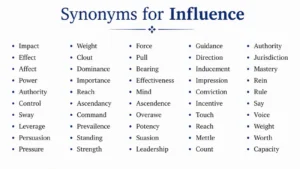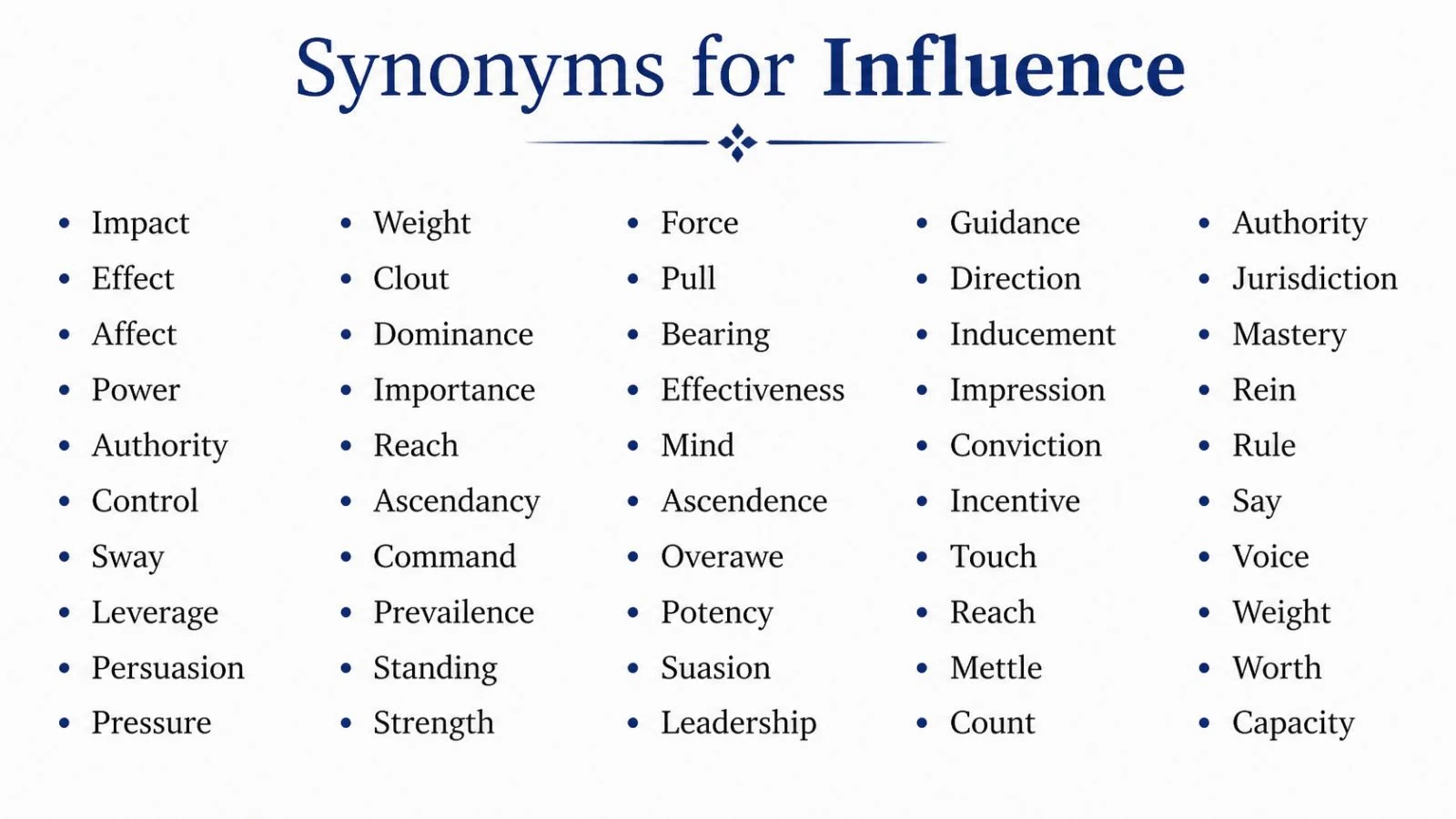
Another word for influence is effect, impact, or sway. Each one fits a different case. Pick the word that matches your meaning.
Influence can be a noun or a verb. As a noun, it means power or effect. As a verb, it means to change what someone thinks or does. So the best choice depends on context.
Quick list: effect, impact, sway, power, clout, authority, control, affect, shape, persuade
This article looks at 30 alternatives. Each one has a meaning, IPA, a usage note, and an example. Some are direct synonyms. Others are related words that fit only certain contexts.
At a Glance: Influence Synonyms and Related Alternatives
| Alternative | Part of Speech | Meaning | Register / Tone | Ideal Context |
| Effect | Noun | A change that one thing causes | Neutral | Science, daily life |
| Impact | Noun | A strong effect | Neutral | News, business |
| Sway | Noun | Power to guide people | Formal | Politics, groups |
| Power | Noun | Ability to make others act | Neutral | Leadership, society |
| Clout | Noun | Strong pull in business or politics | Informal | Work, media |
| Authority | Noun | Right to give orders | Formal | Law, jobs |
| Control | Noun | Power to direct people or things | Neutral | Management |
| Affect | Verb | To cause a change in | Neutral | Health, learning |
| Shape | Verb | To form ideas or habits | Neutral | Education, culture |
| Persuade | Verb | To win someone over | Neutral | Debate, sales |
Which Word Should You Use?
| If you want to… | Use | Why |
| Name a simple result | Effect | It is plain and clear |
| Stress a strong result | Impact | It sounds bigger than effect |
| Talk about power in politics | Sway | It fits groups and leaders |
| Show pull at work | Clout | It is casual and common |
| Show an official right | Authority | It comes from a role |
| Describe a gentle push | Nudge | It hints at light pressure |
| Warn of unfair tricks | Manipulate | It has a bad tone |
| Describe slow, long change | Shape | It shows steady effect |
| Talk about respect and rank | Prestige | It links to status |
Exploring the Multiple Meanings of “Influence”
1. Power to Change People
- Meaning: The power to change what people think, choose, or do.
- Explanation: This power can be quiet and friendly. It often needs no orders.
- Example: Her teacher had a strong influence on her career.
2. Effect on Things
- Meaning: The way one thing changes another thing.
- Explanation: Here, the word can describe things, not just people. Weather and music are common cases.
- Example: Music has a clear influence on how we feel.
3. A Person or Thing With Power
- Meaning: Someone or something that changes others.
- Explanation: People often say “a good influence” or “a bad influence.” The noun then names the source.
- Example: Her older brother was a good influence on her.
4. To Change or Guide (Verb)
- Meaning: To affect what someone thinks or does.
- Explanation: As a verb, it takes a direct object. We influence a person, a choice, or an event.
- Example: Ads can influence what children ask their parents to buy.
Sources: Merriam-Webster; Collins English Dictionary; Dictionary.com
Analyzing 30 Influence Alternatives in Detail
Some alternatives below are direct synonyms. Others are related words that fit only certain contexts. Each usage note says which is which.
Core Synonyms
1. Effect
IPA: /ɪˈfɛkt/ (US and UK)
Definition: Effect means a change that one thing causes in another. It also shows the result of an action.
- Usage: This is a direct synonym for the “result” sense. However, it does not point to a person’s power.
- Example: The new rule had a quick effect on school traffic.
2. Impact
IPA: /ˈɪmpækt/ (US and UK)
Definition: Impact means a strong effect on a person, place, or thing. It also shows a big change.
- Usage: This is a close synonym. However, it often sounds stronger than effect.
- Example: Her kind words had a big impact on the team.
3. Sway
IPA: /sweɪ/ (US and UK)
Definition: Sway means control or power over people. It also means the power to change what they think.
- Usage: This is a direct synonym, but a little formal. For example, writers use it for politics.
- Example: The mayor holds great sway over the town council.
4. Power
IPA: US /ˈpaʊɚ/ · UK /ˈpaʊə/
Definition: Power means the ability to make others act or think a certain way. It also shows strength.
- Usage: This is a related alternative. However, it points to force more than to quiet persuasion.
- Example: Social media gives brands the power to shape what people buy.
5. Clout
IPA: /klaʊt/ (US and UK)
Definition: Clout means strong influence in business or politics. It also shows that people respect your voice.
- Usage: This word is informal. For example, news writers use it for top leaders.
- Example: The new owner has real clout in the music world.
Authority and Control
6. Authority
IPA: US /əˈθɔːrəti/ · UK /ɔːˈθɒrəti/
Definition: Authority means the right to give orders and make choices. It also shows power that people accept.
- Usage: This is a related alternative. However, authority comes from a role, while influence can come from trust.
- Example: Only the manager has the authority to approve a refund.
7. Control
IPA: US /kənˈtroʊl/ · UK /kənˈtrəʊl/
Definition: Control means the power to direct what people or things do. It also shows firm rules.
- Usage: This is related, not exact. In fact, control is stronger than influence.
- Example: The company has control over how its brand is used.
8. Command
IPA: US /kəˈmænd/ · UK /kəˈmɑːnd/
Definition: Command means the power to lead and give orders. It also shows firm leadership.
- Usage: This is a related alternative. For example, people say a speaker has command of the room.
- Example: The captain had command of the crew from day one.
9. Leverage
IPA: US /ˈlɛvərɪdʒ/ · UK /ˈliːvərɪdʒ/
Definition: Leverage means a position that helps you get what you want. It also shows power in a deal.
- Usage: This is a related alternative, common in business. For example, a buyer with other offers has leverage.
- Example: Her job offer gave her leverage in the pay talk.
10. Ascendancy
IPA: /əˈsɛndənsi/ (US and UK)
Definition: Ascendancy means a state of having more power than others. It also shows a lead that people accept.
- Usage: This word is formal and rare. In fact, writers use it for history and politics.
- Example: The party kept its ascendancy for nearly thirty years.
11. Hold
IPA: US /hoʊld/ · UK /həʊld/
Definition: Hold means a firm grip on power over someone. It also shows a strong pull on their mind.
- Usage: This is a related alternative. For example, people say a leader has a hold over fans.
- Example: The old story still has a hold on the town.
Action Words (Verbs)
12. Affect
IPA: /əˈfɛkt/ (US and UK)
Definition: Affect means to cause a change in someone or something. It also shows a mild kind of influence.
- Usage: This is a direct synonym for the verb. However, do not mix it up with the noun effect.
- Example: Sleep can affect how well you learn.
13. Shape
IPA: /ʃeɪp/ (US and UK)
Definition: Shape means to give form to ideas, plans, or habits. It also shows slow, long change.
- Usage: This is a close verb synonym. For example, parents shape how a child sees the world.
- Example: Early books can shape how a child sees the world.
14. Steer
IPA: US /stɪr/ · UK /stɪə/
Definition: Steer means to guide someone toward a choice. It also shows gentle control.
- Usage: This is a related alternative. However, it hints that you aim for one result.
- Example: The teacher tried to steer the class toward a clear plan.
15. Guide
IPA: /ɡaɪd/ (US and UK)
Definition: Guide means to show the way and help someone choose. It also shows kind help.
- Usage: This is a related alternative. However, a guide is softer than an influence and has no pressure.
- Example: A good coach will guide players without forcing them.
16. Persuade
IPA: US /pərˈsweɪd/ · UK /pəˈsweɪd/
Definition: Persuade means to win someone over with reasons or requests. It also shows a clear goal.
- Usage: This is a related alternative. Still, it names the result of a talk, not every kind of influence.
- Example: She tried to persuade her friend to join the club.
17. Inspire
IPA: US /ɪnˈspaɪɚ/ · UK /ɪnˈspaɪə/
Definition: Inspire means to fill someone with the wish to act. It also shows a positive push.
- Usage: This is a related alternative. However, it always has a good tone.
- Example: Her story can inspire students to chase big goals.
Pressure and Persuasion
18. Pressure
IPA: US /ˈprɛʃɚ/ · UK /ˈpreʃə/
Definition: Pressure means strong force used to make someone act. It also shows stress.
- Usage: This is a related alternative. In fact, it is a harsh form of influence.
- Example: Peer pressure can push teens toward risky choices.
19. Nudge
IPA: /nʌdʒ/ (US and UK)
Definition: Nudge means to give a light push toward a choice. It also shows a gentle hint.
- Usage: This is a related alternative with a casual tone. For example, reminders can nudge people to save money.
- Example: A simple reminder can nudge people to vote.
20. Manipulate
IPA: /məˈnɪpjəleɪt/ (US and UK)
Definition: Manipulate means to steer people in a sneaky way. It also shows unfair control.
- Usage: This is a related alternative with a bad tone. However, influence is often neutral.
- Example: Some ads try to manipulate how shoppers feel.
21. Lobby
IPA: US /ˈlɑːbi/ · UK /ˈlɒbi/
Definition: Lobby means to try to sway lawmakers to back a cause. It also shows planned effort.
- Usage: This is a related alternative for politics only. For example, groups lobby leaders for new laws.
- Example: Doctors lobby the government for better hospital funding.
Status and Standing
22. Prestige
IPA: /prɛˈstiːʒ/ (US and UK)
Definition: Prestige means high respect that comes from success or rank. It also gives people weight.
- Usage: This is a related alternative. In fact, prestige can bring influence but is not the same thing.
- Example: The school’s prestige draws students from around the world.
23. Standing
IPA: /ˈstændɪŋ/ (US and UK)
Definition: Standing means your rank or good name in a group. It also shows how much others trust you.
- Usage: This is a related alternative. However, standing shows status more than action.
- Example: Her standing in the town helped her win votes.
24. Weight
IPA: /weɪt/ (US and UK)
Definition: Weight means the value that others give to your words. It also shows how much you count.
- Usage: This is a related alternative. For example, people say a view carries weight.
- Example: The expert’s view carries a lot of weight with judges.
25. Stature
IPA: US /ˈstætʃɚ/ · UK /ˈstætʃə/
Definition: Stature means the respect a person earns from skill or deeds. It also shows high rank.
- Usage: This is a formal, related alternative. Still, it points to standing more than action.
- Example: The author’s stature grew with every new book.
Literary and Formal Alternatives
26. Pull
IPA: /pʊl/ (US and UK)
Definition: Pull means a strong power to attract or sway people. It also shows hidden support.
- Usage: This word is informal. In fact, “has pull” means knowing the right people.
- Example: He got the job because he has a job at the firm.
27. Bearing
IPA: US /ˈbɛrɪŋ/ · UK /ˈbeərɪŋ/
Definition: Bearing means a link that affects an issue. It also shows that something matters.
- Usage: This is a limited, related alternative. However, people use it mostly in “have a bearing on.”
- Example: The weather had no bearing on the final decision.
28. Dominion
IPA: /dəˈmɪnjən/ (US and UK)
Definition: Dominion means rule or control over a place or people. It also shows total power.
- Usage: This word is formal and literary. However, it is far stronger than influence.
- Example: The king held dominion over the land for forty years.
29. Hegemony
IPA: /hɪˈdʒɛməni/ (US and UK)
Definition: Hegemony means the lead that one nation or group holds over others. It also shows control without open force.
- Usage: This is a formal, related term for politics. However, it names a very strong kind of influence.
- Example: The empire’s hegemony shaped trade across the sea.
30. Magnetism
IPA: /ˈmæɡnətɪzəm/ (US and UK)
Definition: Magnetism means a strong charm that draws people in. It also shows a pull on feelings.
- Usage: This is a related alternative. For example, people say a speaker has personal magnetism.
- Example: The singer’s magnetism kept the crowd quiet all night.
Sources: Merriam-Webster; Collins English Dictionary and Thesaurus; Dictionary.com
Influence vs. Impact vs. Effect vs. Affect
These four words overlap, but they are not the same. Writers mix them up often. The table shows the main job of each word.
| Word | Main Part of Speech | Best For | Example |
| Influence | Noun and verb | Power to guide people or events | Her advice had a strong influence on me. |
| Impact | Noun and verb | A big, clear result | The storm had a huge impact on farms. |
| Effect | Noun | The result of a cause | The medicine had a calming effect. |
| Affect | Verb | To cause a change | Stress can affect your sleep. |
Affect is mostly a verb. Effect is mostly a noun. However, effect can also be a verb that means “to bring about,” as in “effect change.”
Influence stands apart because it often needs a person or a source. Effect and impact can describe plain results.
Sources: Merriam-Webster; Collins English Dictionary; Dictionary.com
Influence and Opposite/Paired Word Pairs
| Word | Paired Word | Note |
| Good influence | Bad influence | A common pair for people or habits |
| Positive influence | Negative influence | Used in school, media, and health |
| Influence | Authority | Influence guides, but authority orders |
| Influencer | Follower | Common in social media talk |
| Influence | Independence | Independence means free from outside pull |
| Strong influence | Weak influence | Shows how much power something has |
Influence has no single true opposite. For example, “independence” fits when you think of outside pull. “Powerlessness” fits when you think of lost power.
Sources: Merriam-Webster; Collins English Dictionary; Dictionary.com
Common Word Partners of “Influence”
| Pattern | Common Partners | Example |
| Adjective + influence | strong, positive, negative, growing, lasting | Friends have a strong influence on teens. |
| Verb + influence | have, exert, wield, lose | The group began to exert influence in town. |
| Influence + preposition | on, over | Parents have great influence over young children. |
| Phrase with “of” | sphere of influence, area of influence | The city is within the sphere of influence of the port. |
| Influence + noun | influence campaign, influence peddling | The report named an online influence campaign. |
Sources: Merriam-Webster; Collins English Dictionary; Oxford Learner’s Dictionaries
Idiomatic Phrases Featuring “Influence”
Influence has few true idioms. The items below are set expressions that people use as fixed phrases. Only the first is a true idiom.
1. Under the influence
- Meaning: Drunk or affected by drugs. It can also mean being affected by something else.
- Example: Police stopped the driver for driving under the influence.
2. Sphere of influence
- Meaning: An area where a nation or person has power.
- Example: The small island stayed within the sphere of influence of its neighbor.
3. Undue influence
- Meaning: Unfair pressure that makes someone act against their free will. Courts use this term.
- Example: The court found that the nephew used undue influence on his aunt.
4. Influence peddling
- Meaning: Using links to officials to win favors, often for money.
- Example: The mayor faced charges of influence peddling.
Sources: Merriam-Webster; Collins English Dictionary; Cambridge Dictionary
Word Formation of “Influence”
Etymology and Structure
Influence comes from Old French and Medieval Latin. The Latin root is influere, which means “to flow in.” It joins in- (“in”) and fluere (“to flow”).
Date and History
Etymonline places the first English use in the mid-1300s. At first, it named a flow of power from the stars. People thought this flow shaped human lives. The sense of personal power came later. The Italian word for this idea also gave English the word “influenza.”
Word Class Variations
- Verb: influence, influences, influenced, influencing
- Noun: influence, influencer
- Adjective: influential
- Adverb: influentially
Sources: Etymonline; Merriam-Webster; Collins English Dictionary
Common Word-Choice Mistakes
- He influenced on me: He influenced me.
- Stress can affect your health: Stress can affect your health.
- She has a big influence in her friends: She has a big influence on her friends.
- An influential person: An influential person.
- Influenced by his father: Influenced by his father.
- Make an influence on voters: Have an influence on voters.
- Driving under influence: Driving under the influence.
Frequently Asked Questions
What is the closest synonym for influence?
Sway is the closest noun for power over people. Effect or impact fits when you mean a result.
What is the best verb for influence?
Affect is the closest verb. Shape also works when the change is slow.
What is the difference between influence and authority?
Authority is a right to give orders. Influence guides people without any right to command.
What is the difference between influence and effect?
Effect names a result. Influence names the power that causes it, or the act of changing something.
What is a formal alternative to influence?
Ascendancy and sway are formal choices. Both fit history, law, and politics.
What is a literary alternative to influence?
Dominion and magnetism work in literary writing. Dominion shows rule, while magnetism shows charm.
What is the opposite of influence?
No single word fits every case. Independence or powerlessness often works best.
Can influence be negative?
Yes. People talk about a bad influence or a negative influence. The word itself is neutral.
Can influence mean a person?
Yes. In this case, it names someone who changes others. For example, “She is a good influence.”
What does “under the influence” mean?
It most often means drunk or drugged. It can also mean affected by something else.
Conclusion
The closest everyday alternatives to influence are effect, impact, and sway. For verbs, affect and shape come closest. Power, clout, and authority also help when you talk about status.
Context matters most. Effect names a result. Authority names a right. Manipulate names unfair tricks. Each word shifts the meaning a little.
To choose well, ask three questions. Do you mean a result, a power, or an act? Is the tone good, neutral, or bad? Is the setting casual or formal? Your answers will point to the right word.

Olivia Martin is a passionate writer who enjoys exploring English vocabulary, synonyms, and language tips to help readers improve their writing skills.
At PressivoMedia.com, Olivia shares helpful language resources and easy-to-understand content to make communication clearer and more effective.