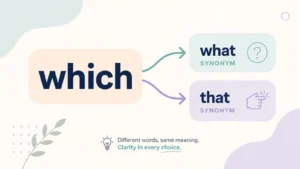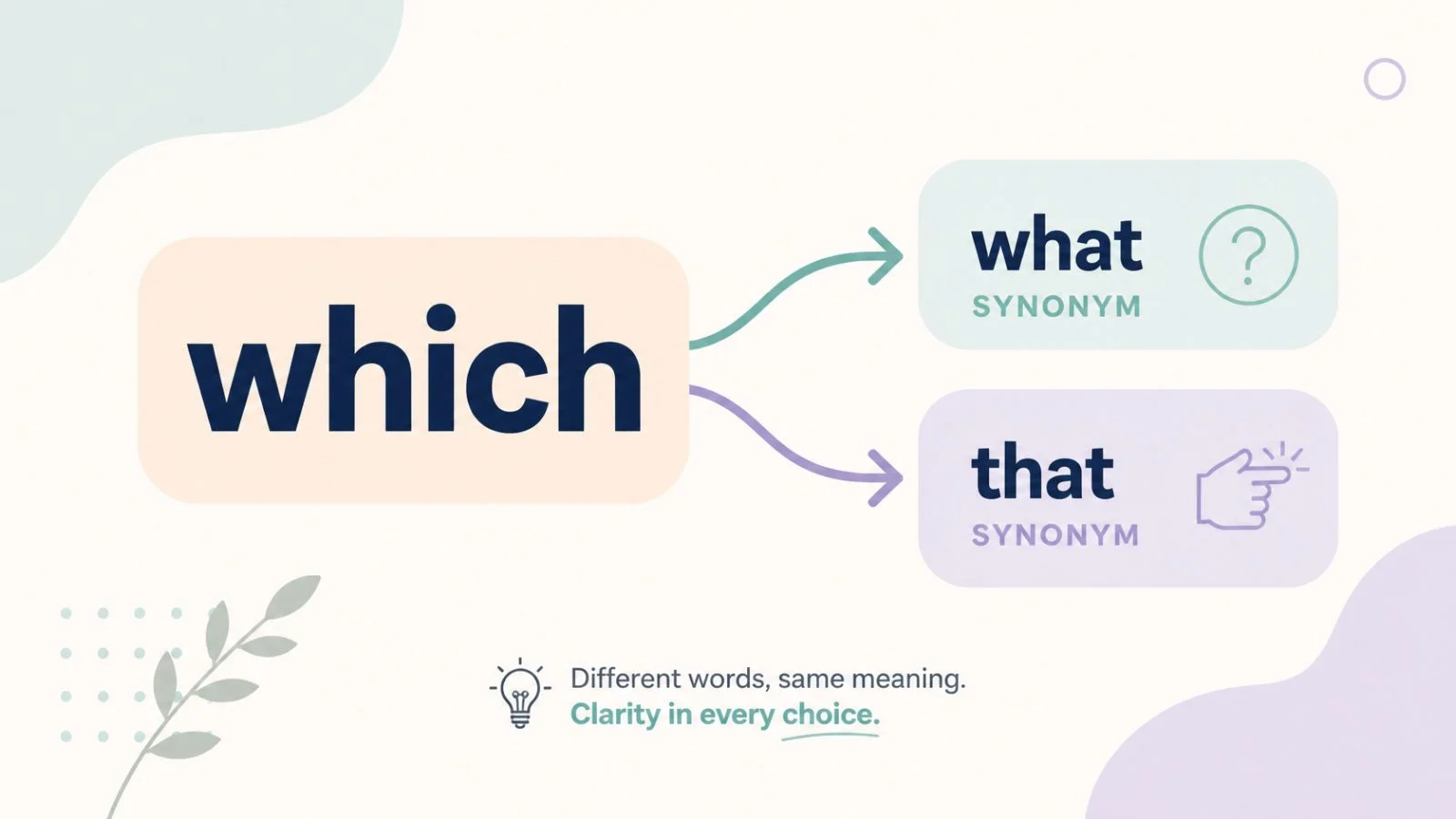
The closest everyday word for which is that. In many sentences, who, whom, or whose can also replace it. What and whichever works when someone picks from choices.
Which has no perfect one-word synonym. It can ask a question, pick an item, or add extra detail. The best swap depends on the job the word does in your sentence.
Quick list: that, who, whom, whose, what, whichever, where, whereby, this, as
This guide covers 30 alternatives. Each one has an IPA, a short meaning, a usage note, and an example. Some are direct swaps, but others only fit certain contexts.
At a Glance: Which Synonyms and Related Alternatives
| Alternative | Part of Speech | Meaning | Register / Tone | Ideal Context |
| That | Pronoun | Links key detail to a noun | Neutral | Everyday speech and writing |
| Who | Pronoun | Links a clause to a person | Neutral | Clauses about people |
| Whom | Pronoun | Object form of who | Formal | After words like to or with |
| Whose | Pronoun / determiner | Shows who owns something | Neutral | People, groups, and things |
| What | Pronoun / determiner | Asks about or names an open choice | Neutral | Open questions |
| Whichever | Pronoun / determiner | Any one from a known set | Neutral | Offers and rules |
| Where | Adverb | Links a clause to a place | Neutral | Places and settings |
| Whereby | Adverb | By which | Formal | Contracts and reports |
| This | Pronoun | Points back to a full idea | Neutral | Starting a new sentence |
| As | Pronoun | Follows words like such or same | Formal | Fixed patterns |
Which Word Should You Use?
| If you want to… | Use | Why |
| Give key detail about a thing | that | It adds detail the reader needs. |
| Add detail about a person | who | Which does not fit people. |
| Link a person after “to” or “with” | whom | It is the object form of who. |
| Ask an open question | what | No fixed list of choices exists. |
| Let the listener pick any item | whichever | It shows the choice does not matter. |
| Point to a place | where | It replaces “in which” with one short word. |
| Write a rule or contract | whereby | It sounds formal and exact. |
| Comment on a whole idea | and this | It splits a long sentence in two. |
Exploring the Multiple Meanings of “Which”
1. Asking for a choice
- Meaning: Which asks someone to pick from a known set.
- Explanation: It works as a question word. It can refer to people or things.
- Example: Which bus goes to the airport from here?
2. Adding extra detail
- Meaning: Which adds detail that the sentence does not need.
- Explanation: Writers put a comma before it. The main idea still works without the clause.
- Example: My laptop, which is five years old, still runs well.
3. Pointing to a specific item
- Meaning: Which names the exact thing in a clause.
- Explanation: British writers often use it this way. It is also the right word after a preposition.
- Example: The room in which we met was small and cold.
4. Commenting on a whole idea
- Meaning: Which can refer to a full clause, not just one noun.
- Explanation: The comment follows a comma. It tells the reader what the whole idea caused or meant.
- Example: The train was late, which made us miss the film.
5. Referring to people in old texts
- Meaning: Older English used which for people.
- Explanation: Modern English uses who here. You still see the old use in prayers.
- Example: Old prayers use which for people, as in “Our Father, which art in heaven.”
Sources: Merriam-Webster; Collins Dictionary; Dictionary.com
Analyzing 30 Which Alternatives in Detail
Some alternatives below are direct swaps for which, while others are related choices for certain contexts.
Core Relative Pronouns
1. That
IPA: /ðæt/ (US and UK)
Definition: That links a clause to a noun and gives key detail. It also works for people and things.
- Usage: That is the closest everyday swap. However, US style prefers it for details you cannot drop.
- Example: The phone that I bought last week already has a cracked screen.
2. Who
IPA: /huː/ (US and UK)
Definition: Who links a clause to a person.
- Usage: Use who for people only. In fact, which sounds wrong when it refers to a person.
- Example: My neighbor, who plays the violin, practices every evening.
3. Whom
IPA: /huːm/ (US and UK)
Definition: Whom is the object form of who. It also follows words like to, with, and for.
- Usage: It sounds formal. Still, writers keep it after prepositions when the noun is a person.
- Example: The woman with whom I spoke was very kind.
4. Whose
IPA: /huːz/ (US and UK)
Definition: Whose shows who owns something. It can also refer to things.
- Usage: It replaces “of which” and sounds smoother. For example, you can say “a car whose door is dented.”
- Example: She bought a house whose garden looks over the river.
5. The one that
IPA: /ðə wʌn ðæt/ (US and UK)
Definition: This phrase points to one item in a group. It also stresses the exact item.
- Usage: It is a related phrase, not an exact synonym. Still, it works well in casual speech.
- Example: Please give me the one that has the red cover.
Choice and Question Words
6. What
IPA: US /wʌt/ · UK /wɒt/
Definition: What asks about an open choice. It can also stand for “the thing that.”
- Usage: It is related, not an exact match. However, it works when no list of options exists.
- Example: What time does the last train leave from the station?
7. Which one
IPA: /wɪtʃ wʌn/ (US and UK)
Definition: Which one asks the listener to pick from a set. It also keeps the focus on one item.
- Usage: It is a small tweak, not a true synonym. However, it makes spoken questions clearer.
- Example: I have two jackets, so which one should I wear?
8. Whichever
IPA: US /wɪtʃˈɛvər/ · UK /wɪtʃˈɛvə/
Definition: Whichever means any item from a known group. It also shows that the choice does not matter.
- Usage: It is a close relative of which. For example, it fits offers and rules, not questions.
- Example: Take whichever seat you like, because they are all free.
9. Whatever
IPA: US /wʌtˈɛvər/ · UK /wɒtˈɛvə/
Definition: Whatever means anything at all, with no limit. It also shows that the choice is wide open.
- Usage: It is wider than which. Still, it works when no list of choices exists.
- Example: Order whatever you want from the menu tonight.
10. Either
IPA: US /ˈiːðər/ · UK /ˈaɪðə/
Definition: Either means one of two options. It also shows that both choices are fine.
- Usage: It fits only two items. However, which can cover many more.
- Example: You can take either road, because both lead to the lake.
11. Any
IPA: /ˈɛni/ (US and UK)
Definition: Any means one or some from a group, with no set choice. It also works with plural nouns.
- Usage: It is a loose alternative to whichever. For example, “any day works” means the day does not matter.
- Example: Any day next week works for me, so pick one.
Place, Time, and Reason Words
12. Where
IPA: US /wɛr/ · UK /weə/
Definition: Where links a clause to a place. It also works with words like city, house, and room.
- Usage: It replaces “in which” when the noun is a place. In short, it keeps the sentence light.
- Example: This is the café where we first met last summer.
13. When
IPA: /wɛn/ (US and UK)
Definition: When linking a clause to a time. It also works with words like day, year, and moment.
- Usage: It replaces “on which” or “in which” with time words. As a result, the sentence reads easier.
- Example: I remember the day when we moved to this town.
14. Why
IPA: /waɪ/ (US and UK)
Definition: Why link a clause to a reason. It also follows the word reason.
- Usage: It replaces “for which” after reason. For example, “the reason why” sounds natural.
- Example: That is the reason why she left the job early.
Formal Where-Words
15. Whereby
IPA: US /wɛrˈbaɪ/ · UK /weəˈbaɪ/
Definition: Whereby means “by which.” It also adds a formal tone to rules and plans.
- Usage: It is a formal synonym for “by which.” However, it sounds stiff in casual conversation.
- Example: The firm has a system whereby staff can vote on new ideas.
16. Wherein
IPA: US /wɛrˈɪn/ · UK /weərˈɪn/
Definition: Wherein means “in which.” It also points to a place, book, or situation.
- Usage: It is formal and a little old-fashioned. Still, legal and school writers use it often.
- Example: He wrote a report wherein he explained the whole plan.
17. Whereupon
IPA: US /ˈwɛrəˌpɑːn/ · UK /ˌweərəˈpɒn/
Definition: Whereupon means “right after which.” It also shows that one event follows another fast.
- Usage: It links two events in a story. However, it sounds formal, so use it with care.
- Example: She raised her hand, whereupon the whole room went quiet.
18. Whereof
IPA: US /wɛrˈʌv/ · UK /weərˈɒv/
Definition: Whereof means “of which” or “of whom.” It also appears in legal and older texts.
- Usage: It is rare today. However, you can still find it in law and old books.
- Example: The documents whereof he spoke were never found.
19. Whence
IPA: /wɛns/ (US and UK)
Definition: Whence means “from where” or “from which.” It also sounds very old.
- Usage: It is a related word, not an exact synonym. In fact, most people now write “from where.”
- Example: He returned to the village whence his family had come.
Words That Link Whole Ideas
20. And this
IPA: /ænd ðɪs/ (US and UK)
Definition: And this adds a comment on a whole idea. It also splits one long sentence into two parts.
- Usage: It replaces which when which points to a full clause. For example, it fixes tangled sentences.
- Example: The bus came late, and this made us miss the film.
21. This
IPA: /ðɪs/ (US and UK)
Definition: This points back to the idea you just stated. It also starts a fresh sentence.
- Usage: It works well after a full stop. However, it feels vague without a noun, so add one.
- Example: The store raised its prices. This upset many regular customers.
22. Something that
IPA: /ˈsʌmθɪŋ ðæt/ (US and UK)
Definition: This phrase points to a fact, event, or thing. It also fits comment clauses.
- Usage: It is a plain swap for which after a clause. For example, it sounds natural in speech.
- Example: He forgot my birthday, something that hurt me a lot.
23. Meaning
IPA: /ˈmiːnɪŋ/ (US and UK)
Definition: Meaning shows the result of an earlier fact. It also starts with a short comment.
- Usage: It is a tight swap for “which means.” In short, it saves two words.
- Example: The road is closed, meaning we must take the long way.
24. So
IPA: US /soʊ/ · UK /səʊ/
Definition: So links a cause to its result. It also keeps the sentence short.
- Usage: It replaces “which is why” or “which meant.” However, it needs a new clause.
- Example: It rained all day, so we stayed home and watched films.
25. As a result
IPA: /æz ə rɪˈzʌlt/ (US and UK)
Definition: As a result shows what happened because of something. It also begins a new sentence well.
- Usage: It replaces “which led to.” Still, it is wordier than that.
- Example: Sales fell in May. As a result, the shop cut its hours.
Pattern Words and Rare Forms
26. As
IPA: /æz/ (US and UK)
Definition: As links a clause to words like such or same. It also works as a relative pronoun.
- Usage: It replaces which in the “such… as” pattern. However, the pattern sounds formal.
- Example: She reads such books to help her relax after work.
27. That which
IPA: /ðæt wɪtʃ/ (US and UK)
Definition: That which means “the thing that.” It also sounds formal and a bit poetic.
- Usage: It is a related phrase, not an exact synonym. However, plain “what” is the simpler choice.
- Example: We must protect that which we value most.
28. Whichsoever
IPA: US /ˌwɪtʃsoʊˈɛvər/ · UK /ˌwɪtʃsəʊˈɛvə/
Definition: Whichsoever means any one at all from a group. It also sounds old and formal.
- Usage: It is an old form of whichever. In fact, you mostly see it in legal and old texts.
- Example: Take whichever route you prefer, because all lead to town.
29. Those that
IPA: US /ðoʊz ðæt/ · UK /ðəʊz ðæt/
Definition: Those that point to a group of things already named. It also fits plural nouns.
- Usage: It replaces which when the noun is plural. Still, “those which” appears in formal text.
- Example: Choose those that match your budget and your needs.
30. Then
IPA: /ðɛn/ (US and UK)
Definition: Then links an event to a time or step. It also stands for “at which point.”
- Usage: It is a related word, not a true synonym. However, it replaces “at which point” and “in which case.”
- Example: If it rains, then we will move the party indoors.
Sources: Merriam-Webster; Collins Dictionary; Dictionary.com
Which vs. That vs. What: How to Choose
These three words cause the most mix-ups. Each one does a different job.
| Word | Best Use | Example |
| Which | Extra detail, or a pick from a known set | My car, which is old, still runs well. |
| That | Key detail the reader needs | The car that I bought is red. |
| What | An open question or “the thing that” | What car do you drive? |
Many US editors use that for key detail and with commas for extra detail. British writers often use which for both. In short, both styles are accepted.
After a preposition, use which, not that. For example, write “the house in which she lives.”
Sources: Merriam-Webster; Collins Dictionary; Dictionary.com
Which and Its Paired Words
| Word | Paired Word | Note |
| which | what | Which picks from a known set. What asks about an open field. |
| which | that | Which adds extra detail. That adds key detail. |
| which | who | Which refers to things. Who refers to people. |
| which | whichever | Which asks for points. Whichever says any choice is fine. |
| which | whose | Which names the thing. Who shows who owns it. |
Which has no true opposite. It is a function word, so it works with other function words instead. These pairs show how each word narrows the meaning. Learners often swap them by mistake.
Sources: Merriam-Webster; Collins Dictionary
Common Word Partners of “Which”
| Pattern | Common Partners | Example |
| Preposition + which | in which, of which, to which, by which, for which | The town in which she grew up is small. |
| Which + noun | which way, which side, which day, which one | Which way is the station? |
| Which of + group | which of them, which of the two, which of you | Which of you left the door open? |
| Verb + which | know which, decide which, ask which, tell which | I cannot tell which key is mine. |
| Quantity + of which | all of which, some of which, none of which | She read three books, all of which were short. |
| Which + verb | which is why, which means | It rained, which is why we stayed home. |
| No matter which | no matter which route, no matter which team | No matter which route you take, you will arrive late. |
Sources: Collins Dictionary; Merriam-Webster; Dictionary.com
Idiomatic Phrases Featuring “Which”
The first two items are true idioms. The last two are strong, established expressions.
1. Know which side your bread is buttered on
- Meaning: Know who or what helps you most, and act to protect it.
- Example: She stays polite to her boss because she knows which side her bread is buttered on.
2. See which way the wind is blowing
- Meaning: Notice how events or opinions are shifting.
- Example: He waited to see which way the wind was blowing before he spoke.
3. Which is which
- Meaning: Tell two similar things or people apart.
- Example: The twins look alike, so I cannot tell which is which.
4. Which is to say
- Meaning: Introduces a clearer restatement of what you just said.
- Example: He is frugal, which is to say he hates wasting money.
Sources: Merriam-Webster; Collins Dictionary
Word Formation of “Which”
Etymology & Structure
Which comes from Old English hwilc. That form came from older Germanic roots. The roots mean “who” and “like” or “form.” So the word first meant “of what kind.”
Dutch welk and German welch share the same root. The word such has a similar build, from “so” and “like.”
Date and History
Which has existed since Old English times. It is over 900 years old. Early forms included hwilc and hwylc. Middle English forms such as whilk came later, and the modern spelling settled in time.
Word Class Variations
- Pronoun: Which one is yours?
- Determiner: Which road should we take?
- Related forms: whichever and whichsoever, both pronoun and determiner
Which has no verb, noun, or adverb form.
Sources: Etymonline; Merriam-Webster; Oxford English Dictionary
Common Word-Choice Mistakes
- “The man who called me”: use who. People take who, not which.
- “The book that I read was long”: use which. Commas call for which in US style.
- “The room in which we met”: use in which. That cannot follow a preposition.
- “Which time is it?”: use What time is it? No set list of times exists.
- “The girl whose bike broke”: use whose. Whose shows ownership.
- “He quit, that shocked us”: use which shocked us. Which can comment on a whole idea.
- “Take whatever key on this ring”: use whichever key. Whichever picks from a known set.
Frequently Asked Questions
What is the closest synonym for which?
That is the closest everyday synonym. It works in many clauses that add key detail.
Does which have a true one-word synonym?
No, because it does several jobs. Each job needs a different replacement.
When should I use who instead of which?
Use who when the clause refers to a person. Use which for things and ideas.
What is the difference between which and that?
That adds detail the reader needs. Which adds extra detail, often after a comma.
What is the difference between which and what?
Which picks from a known set. What asks about an open range of choices.
What is a formal alternative for “in which”?
Wherein and whereby are formal choices. Both sound best in contracts and reports.
Can it be used by people?
Yes, in questions such as “Which singer won?” As a relative pronoun, use who.
Can which refer to a whole sentence?
Yes. In “He lost, which surprised us,” which refers to the whole idea.
What is the difference between which and whichever?
Which points to or asks about an item. Whichever says any item in the set is fine.
Does which have an opposite?
No true opposite exists. Words like what and who only contrast with it.
Conclusion
The closest everyday alternative for which is that. Who, whom, and whose cover clauses about people what, whichever, and either fit choices.
Context decides the best word which can ask, point, add detail, or comment on a full idea. Each job needs a different replacement.
To choose well, first find the job which does in your sentence. Next, match it to a word from the lists above. Finally, read the sentence aloud to check the tone.

Emily Davis is a passionate writer who enjoys exploring English vocabulary, synonyms, and language tips to help readers improve their communication skills.
At PressivoMedia.com, she focuses on creating simple, engaging, and informative content that makes learning English easier and more enjoyable.