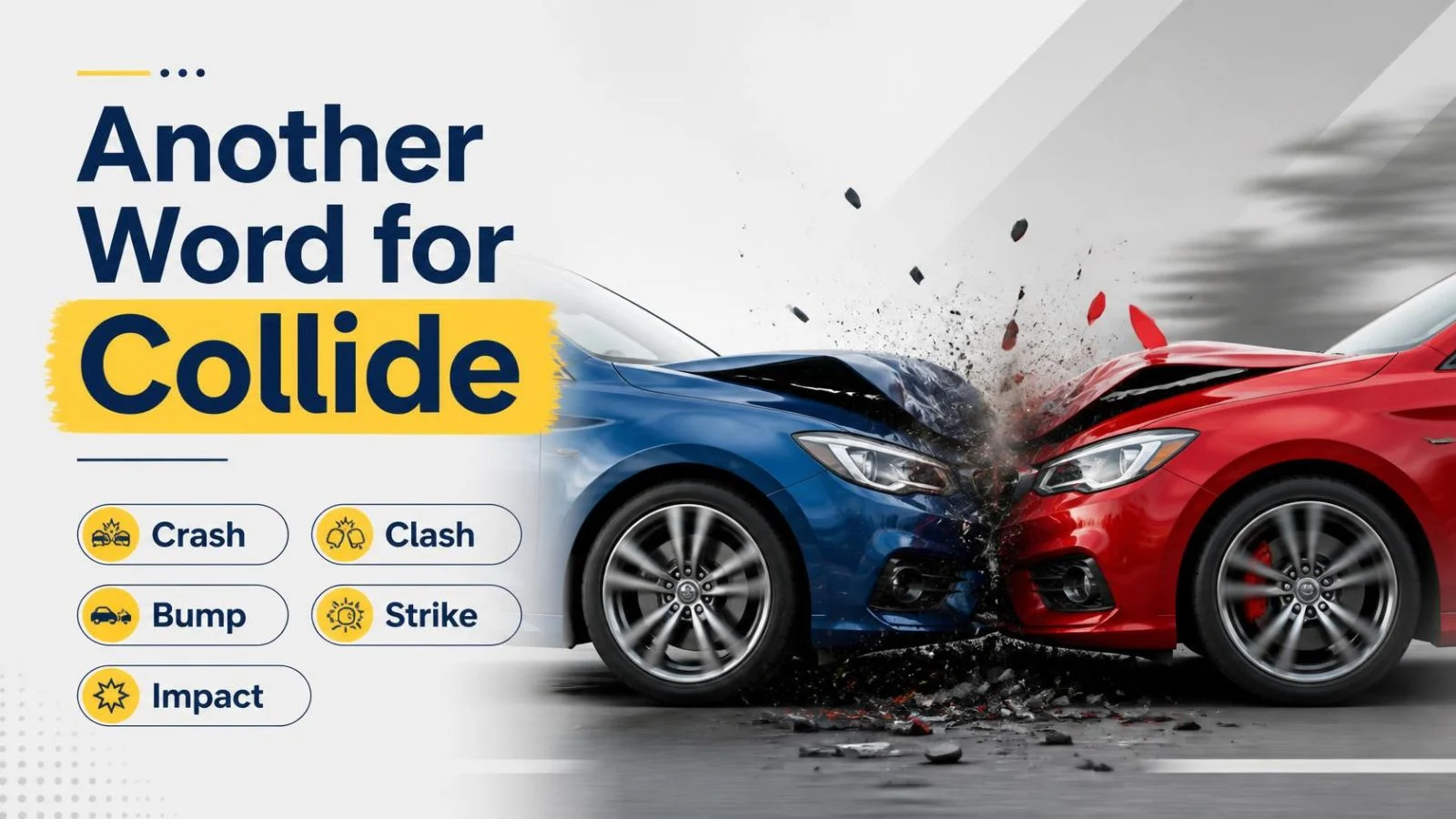
Another word for collide is crash, hit, or bump. In everyday use, strike, smash, and clash also work.
The best choice depends on whether you mean a physical impact, a vehicle accident, a conflict of ideas, or a chance meeting.
Collide has four main areas of meaning. It can describe objects hitting each other, a force that is violent or sudden, opinions or interests that conflict, and events that happen at the same time. Each area has its own better-fitting words.
Quick list: crash, bump, hit, strike, smash, slam, clash, conflict, run into, coincide.
This article examines 35 alternatives with meanings, IPA, usage notes, examples, and context.
At a Glance: Collide Synonyms and Related Alternatives
| Alternative | Part of Speech | Meaning | Register / Tone | Ideal Context |
| Crash | Verb | Hit with force and noise | Neutral | Vehicles, objects |
| Bump | Verb | Hit lightly | Informal | Minor contact |
| Strike | Verb | Hit or come against | Neutral/formal | Impact, accidents |
| Smash | Verb | Hit with great force | Informal | Violent impact |
| Slam | Verb | Hit hard and suddenly | Informal | Sudden, forceful impact |
| Clash | Verb | Come into conflict | Neutral | Opinions, teams, colors |
| Conflict | Verb | Be in opposition | Formal | Interests, schedules |
| Run into | Phrasal verb | Hit, or meet by chance | Informal | Accidents, chance meetings |
| Coincide | Verb | Happen at the same time | Formal | Events, dates |
| Converge | Verb | Come together at one point | Formal | Roads, ideas |
Which Word Should You Use?
| If you want to… | Use | Why |
| Describe a car accident | crash | It is the most common everyday word. |
| Describe a light touch | bump | It suggests a small force. |
| Show great force | smash or slam | Both stress power. |
| Describe opposing opinions | clash | It is the standard word for conflict between people or ideas. |
| Describe two events at one time | coincide | It focuses on timing, not impact. |
| Describe meeting someone by accident | run into | It is natural and friendly. |
| Write formally about competing needs | conflict | It sounds measured and professional. |
| Describe a car hit from behind | rear-end | It is the exact term. |
Exploring the Multiple Meanings of Collide
1. Physical impact
- Meaning: To strike against each other with force.
- Explanation: This is the main sense. Both things are usually moving, or one is moving and one is still.
- Example: The two boats collided in the fog.
2. Vehicle accident
- Meaning: To crash into another vehicle.
- Explanation: Collisions are common in news and official reports. Everyday speakers usually say crash or hit.
- Example: A truck collided with a bus on the highway.
3. Conflict of ideas or interests
- Meaning: To be in direct opposition.
- Explanation: The meaning is figurative. No physical contact is involved.
- Example: Their goals collided during the budget talks.
4. Chance meeting or overlap
- Meaning: To come together unexpectedly, often with a clash of timing.
- Explanation: This sense is less common. It is often used for schedules and events.
- Example: Two big holidays collided that weekend.
Sources: Merriam-Webster; Collins English Dictionary; Dictionary.com.
Analyzing 30 Collide Alternatives in Detail
Some alternatives below are close synonyms. Others are related words that fit only certain contexts, and each Usage note says which is which.
Core Impact Words
1. Crash
IPA: /kræʃ/ (US and UK)
Definition: To hit something with force and a loud noise.
- Usage: The closest everyday synonym, especially for vehicles and objects.
- Example: The bike crashed into a fence.
2. Bump
IPA: /bʌmp/ (US and UK)
Definition: To hit something with a light or sudden knock.
- Usage: A direct synonym for minor collisions. It is weaker than colliding.
- Example: She bumped the table and spilled her tea.
3. Hit
IPA: /hɪt/ (US and UK)
Definition: To come against something with force.
- Usage: A simple, neutral synonym. It is less formal than colliding.
- Example: The ball hit the window.
4. Strike
IPA: /straɪk/ (US and UK)
Definition: To hit or come against something with force.
- Usage: A close synonym with a slightly formal tone.
- Example: The ship struck a rock.
5. Smash
IPA: /smæʃ/ (US and UK)
Definition: To hit with great force, often breaking something.
- Usage: A direct synonym that stresses damage.
- Example: The car smashed into a wall.
6. Ram
IPA: /ræm/ (US and UK)
Definition: To crash into something with great force, often on purpose.
- Usage: A related word. It often suggests intent, which collide does not.
- Example: The truck rammed the gate.
Forceful and Sudden Impact
7. Slam
IPA: /slæm/ (US and UK)
Definition: To hit something hard and suddenly.
- Usage: A close, informal synonym for violent impact.
- Example: The runner slammed into the wall.
8. Plow
IPA: /plaʊ/ (US and UK)
Definition: To drive forcefully into something.
- Usage: A related word, usually in “plow into.” It suggests heavy momentum. British spelling is plough.
- Example: The van plowed into a parked car.
9. Bash
IPA: /bæʃ/ (US and UK)
Definition: To hit something hard.
- Usage: Informal and related. It often suggests clumsy contact.
- Example: He bashed his head on a beam.
10. Hurtle
IPA: US /ˈhɜːrtl/ · UK /ˈhɜːtl/
Definition: To move at great speed, often out of control.
- Usage: Related, not exact. It describes the motion before a collision, usually in “hurtle into.”
- Example: The sled hurtled into a tree.
11. Knock
IPA: US /nɑːk/ · UK /nɒk/
Definition: To hit something so that it moves or makes a sound.
- Usage: A related word for lighter impacts, often in “knock into.”
- Example: He knocked into a chair.
Vehicle and Accident Terms
12. Sideswipe
IPA: /ˈsaɪdswaɪp/ (US and UK)
Definition: To hit the side of something in passing.
- Usage: A context-specific term. It describes a glancing collision.
- Example: A taxi sideswiped our car.
13. Rear-end
IPA: US /ˌrɪr ˈend/ · UK /ˌrɪə ˈend/
Definition: To hit the back of another vehicle.
- Usage: A precise term for one kind of vehicle collision.
- Example: A bus rear-ended the van at the light.
14. T-bone
IPA: US /ˈtiː boʊn/ · UK /ˈtiː bəʊn/
Definition: To hit the side of a vehicle at a right angle.
- Usage: A specific, informal term for crossroad collisions.
- Example: A truck T-boned the sedan.
15. Impact
IPA: /ɪmˈpækt/ (US and UK)
Definition: To strike with force.
- Usage: A formal, technical verb. It appears in science and accident reports.
- Example: The rock impacted the surface at high speed.
Conflict and Opposition
16. Clash
IPA: /klæʃ/ (US and UK)
Definition: To come into conflict, or to fit badly together.
- Usage: A close synonym for the figurative sense of collide.
- Example: The two leaders clashed over taxes.
17. Conflict
IPA: US /kənˈflɪkt/ · UK /kənˈflɪkt/ (US and UK)
Definition: To be in disagreement or opposition.
- Usage: A formal synonym for ideas, rules, and schedules. It has no physical meaning.
- Example: The meeting conflicts with my class.
18. Oppose
IPA: US /əˈpoʊz/ · UK /əˈpəʊz/
Definition: To act against something or someone.
- Usage: Related. It describes opposition but not a head-on meeting.
- Example: Residents opposed the new road.
19. Contend
IPA: /kənˈtend/ (US and UK)
Definition: To compete or struggle against something.
- Usage: A formal, related word for struggle, not impact.
- Example: Farmers contend with harsh weather.
20. Contradict
IPA: US /ˌkɑːntrəˈdɪkt/ · UK /ˌkɒntrəˈdɪkt/
Definition: To state the opposite of something, or to be inconsistent with it.
- Usage: Related, not exact. It covers only clashing statements or facts.
- Example: The two reports contradict each other.
Chance Meetings
21. Bump into
IPA: /bʌmp ˈɪntuː/ (US and UK)
Definition: To meet someone by chance.
- Usage: A related, informal phrasal verb. It covers only the chance-meeting sense.
- Example: I bumped into an old friend.
22. Run into
IPA: /rʌn ˈɪntuː/ (US and UK)
Definition: To hit something, or to meet someone by chance.
- Usage: Informal. It works for both the physical and the chance-meeting sense.
- Example: She ran into a pole while texting.
23. Encounter
IPA: US /ɪnˈkaʊntər/ · UK /ɪnˈkaʊntə/
Definition: To meet or face someone or something, often unexpectedly.
- Usage: A related, formal word. It does not suggest impact.
- Example: The hikers encountered a bear.
24. Jostle
IPA: US /ˈdʒɑːsl/ · UK /ˈdʒɒsl/
Definition: To push or bump against others in a crowd.
- Usage: A related word for repeated, light contact among people.
- Example: Fans jostled at the gate.
Timing, Overlap, and Formal Alternatives
25. Coincide
IPA: US /ˌkoʊɪnˈsaɪd/ · UK /ˌkəʊɪnˈsaɪd/
Definition: To happen at the same time.
- Usage: A formal, related word. It replaces collide only for timing.
- Example: The festival coincides with the harvest.
26. Overlap
IPA: US /ˌoʊvərˈlæp/ · UK /ˌəʊvəˈlæp/
Definition: To cover part of the same time, space, or area.
- Usage: A related word. It is gentler than colliding.
- Example: Our work hours overlap.
27. Converge
IPA: US /kənˈvɜːrdʒ/ · UK /kənˈvɜːdʒ/
Definition: To come together at one point.
- Usage: Formal and related. It suggests gathering, not impact.
- Example: The roads converge near the bridge.
28. Intersect
IPA: US /ˌɪntərˈsekt/ · UK /ˌɪntəˈsekt/
Definition: To cross or meet at a point.
- Usage: Related. It describes crossing paths, not hitting.
- Example: The two lines intersect here.
29. Impinge
IPA: /ɪmˈpɪndʒ/ (US and UK)
Definition: To have an effect on something, often a limiting one.
- Usage: A formal, related word. It is rarely used for physical impact today.
- Example: The rules impinge on our freedom.
30. Interfere
IPA: US /ˌɪntərˈfɪr/ · UK /ˌɪntəˈfɪə/
Definition: To get in the way of something.
- Usage: Related. It describes obstruction, not impact.
- Example: Noise interfered with the signal.
Sources: Merriam-Webster; Collins English Dictionary; Dictionary.com.
Collide vs. Crash vs. Clash
| Word | Main Idea | Typical Use |
| Collide | Two things meet with force | Vehicles, objects, ideas |
| Crash | Heavy impact with noise | Cars, planes, computers |
| Clash | Conflict or poor fit | Opinions, colors, teams |
Collide fits both the physical and the figurative sense. Crash is mostly physical, and clash is mostly figurative.
Sources: Merriam-Webster; Collins English Dictionary.
Collide and Opposite/Paired Word Pairs
| Word | Paired Word | Note |
| Collide | Avoid | Opposite in the sense of contact. |
| Collide | Miss | Used for near-accidents. |
| Collide | Agree | Opposite in the figurative sense. |
| Collide | Harmonize | Used for ideas or interests. |
| Collision | Near miss | A common paired contrast. |
No single word is a perfect opposite. The best one depends on whether you mean contact or conflict.
Sources: Collins Thesaurus; Merriam-Webster.
Common Word Partners of Collide
| Pattern | Common Partners | Example |
| collide with | a car, a wall, a runner | The bike collided with a car. |
| collide + head-on | trains, ideas | The two views collided head-on. |
| two things collide | planes, atoms, worlds | Two cars collided. |
| collide in | the air, a crowd | They collided in the hallway. |
Sources: Collins Dictionary; Merriam-Webster.
Idiomatic Phrases Featuring Collide
These are established expressions built on the word collide or its noun form, collision. They are not strict idioms.
1. On a collision course
- Meaning: Heading toward a conflict or clash.
- Example: The two companies are on a collision course.
2. Head-on collision
- Meaning: A direct clash, either physical or figurative.
- Example: The debate became a head-on collision of values.
3. Collide head-on
- Meaning: To meet directly and with full force.
- Example: Their plans collided head-on.
Sources: Merriam-Webster; Collins Dictionary.
Word Formation of Collide
Etymology & Structure
Collide comes from Latin collidere, meaning to strike together. It combines com- (“together”) and laedere (“to strike, injure”).
Date and History
Etymonline dates the English verb to the early 1600s, with a meaning close to its Latin source.
Word Class Variations
- Verb: collide, collides, collided, colliding
- Noun: collision
- Noun (physics): collider, as in particle collider
Sources: Etymonline; Merriam-Webster.
Common Word-Choice Mistakes
- “Collide to a wall”: use “collide with a wall.”
- “Coincide with a wall”: coincide is for timing, not impact.
- “The car clashed with the truck”: use “collided with” for physical impact.
- “Bump into” for a serious crash: use crash or collide.
- “Conflict a truck”: conflict is not used for physical impact.
- “Our meeting collides with yours”: use “collides with” or “conflicts with.”
- “Ram” for an accident: ram suggests intent, so use crash or collide.
Frequently Asked Questions
What is the closest synonym for collide?
Crash is the closest everyday synonym. Strike is close but more formal.
What is a gentle alternative?
Bump describes a light collision.
What is a formal alternative?
Impact, conflict, or coincide, depending on the sense.
What is the difference between collide and clash?
Collide usually means physical impact. Clash usually means conflict between people or ideas.
Can collide be used for people?
Yes. People can collide in a hallway, or their views can collide.
Can collide mean to meet by chance?
Sometimes, but “run into” or “bump into” is more natural.
What is the opposite of colliding?
Avoid is the nearest opposite for contact. Agree is the opposite for conflict.
What is a figurative alternative?
Clash is the most common one.
Is colliding the same as crashing?
Not exactly. Crash stresses noise and force, while colliding stresses two things meeting.
Do both objects need to move to collide?
No. One can be still, such as a car hitting a wall.
Conclusion
The closest alternatives to collide are crash, hit, bump, and strike. For conflict, clash and conflict fit best. For timing, use coincides.
Context decides the right word. Some alternatives describe impact, while others describe opposition or timing. A word that fits one sense can sound wrong in another.
Start by deciding what kind of meeting you mean. Then pick the word that matches its force, formality, and result.

Emily Davis is a passionate writer who enjoys exploring English vocabulary, synonyms, and language tips to help readers improve their communication skills.
At PressivoMedia.com, she focuses on creating simple, engaging, and informative content that makes learning English easier and more enjoyable.