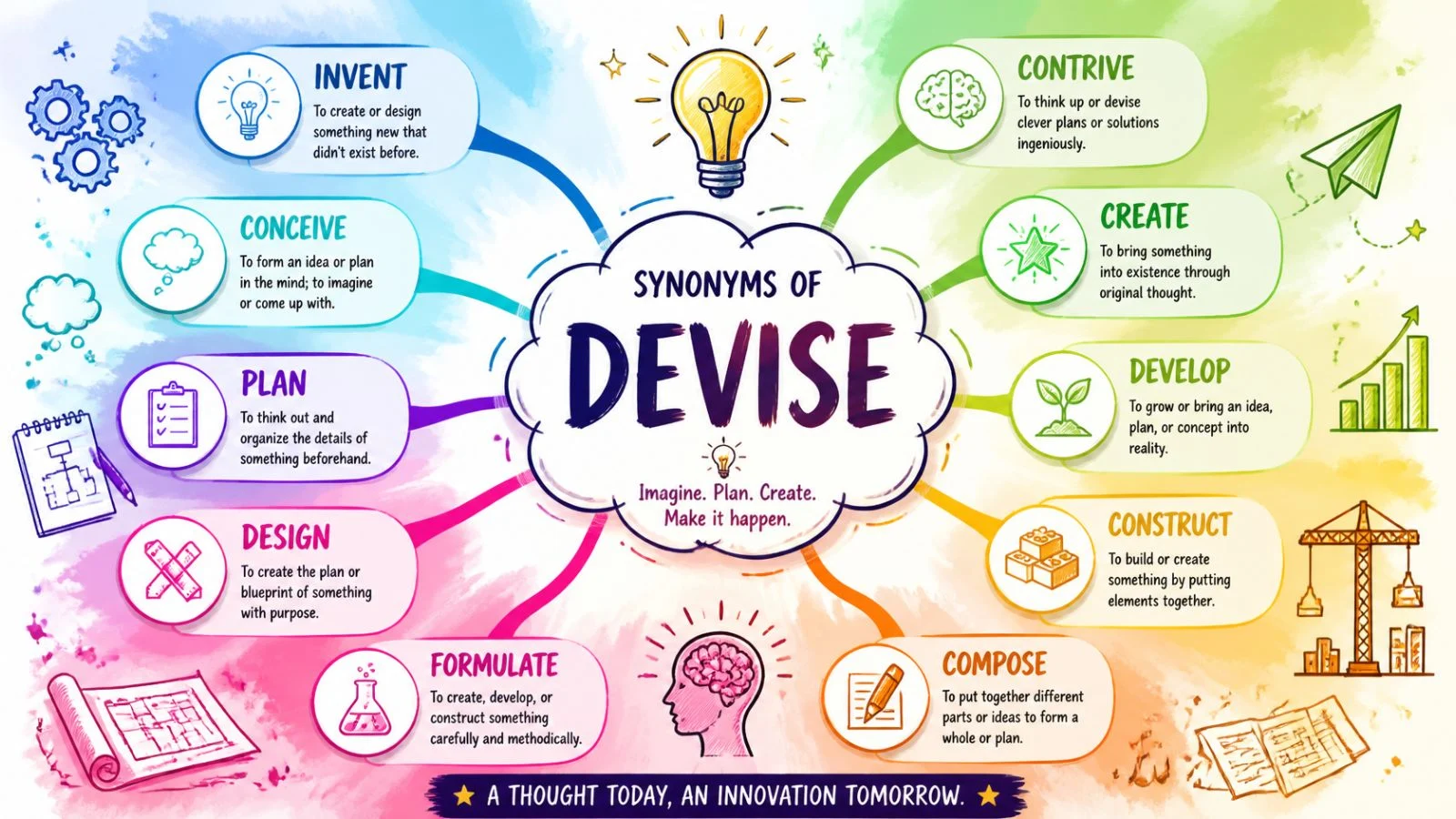
The closest everyday alternatives to devise are invent, design, plan, create, and come up with. Which one fits depends on what you are making.
Do you want a new thing, a method, a plan, or a clever trick? In law, devise also means something else: to leave land or property to someone in a will.
Some alternatives stress newness (invent, originate), others careful planning (formulate, map out), and others secret or tricky planning (concoct, hatch, plot). A few are informal (cook up, dream up), and one is legal (bequeath).
Quick list: invent, design, plan, create, formulate, conceive, contrive, concoct, work out, come up with.
This article covers 30 alternatives with meanings, IPA, usage notes, and examples. It also explains the legal meaning, the device and device mix-up, word pairs, and common mistakes.
At a Glance: Devise Synonyms and Related Alternatives
| Alternative | Part of Speech | Meaning | Register / Tone | Ideal Context |
| Invent | Verb | Make something new for the first time | Neutral | Tools, machines, methods |
| Design | Verb | Plan the form or working of something | Neutral | Products, systems, buildings |
| Plan | Verb | Decide in advance how to do something | Neutral | Everyday and business use |
| Formulate | Verb | Prepare something carefully in detail | Formal | Policies, theories, strategies |
| Conceive | Verb | Form an idea in the mind | Formal | Ideas, projects |
| Contrive | Verb | Create by clever or forced effort | Formal, sometimes negative | Schemes, awkward solutions |
| Concoct | Verb | Make up, often something unlikely | Neutral to negative | Stories, excuses, plans |
| Work out | Phrasal verb | Find a solution by thinking | Informal | Problems, details |
| Come up with | Phrasal verb | Produce an idea or answer | Informal | Ideas, names, solutions |
| Bequeath | Verb | Leave property by will | Formal, legal | Wills, inheritance |
Which Word Should You Use?
| If you want to… | Use | Why |
| Show something brand new was made | invent | It stresses a first-time creation. |
| Describe careful planning of a structure or system | design | It points to form and function. |
| Sound formal in a report | formulate | It suggests careful, organized preparation. |
| Talk about a dishonest or tricky plan | concoct, hatch, plot | They carry a sense of secrecy or trickery. |
| Sound casual | come up with, cook up | Both are natural in speech. |
| Describe a clever but awkward fix | contrive | It can suggest effort or artificiality. |
| Show a solution found step by step | work out | It stresses reasoning. |
| Talk about leaving land in a will | bequeath | It matches the legal meaning. |
Exploring the Multiple Meanings of “Devise”
1. To Invent or Create Through Thought
- Meaning: To form something in the mind by combining ideas or principles.
- Explanation: This is the most common sense. Today it is most often used like invent or plot when the goal is difficult or complicated. The thing devised is usually a method, system, or solution rather than a physical object.
- Example: The team devised a new way to test the software.
2. To Plan a Strategy or Arrangement
- Meaning: To think out the details of a plan.
- Explanation: Here the focus is on organizing steps, not on inventing something new. Plans, strategies, and rules fit this sense.
- Example: The council devised a plan to reduce plastic waste.
3. To Plot or Scheme
- Meaning: To plan something, often secretly or with a clever or harmful aim.
- Explanation: Merriam-Webster lists a sense meaning to plan to obtain or bring about, as in plotting someone’s death. Context decides whether the tone is neutral or negative.
- Example: The villains devised a plot to steal the crown jewels.
4. To Leave Property by Will (Law)
- Meaning: To give real property, such as land or a house, to someone through a will.
- Explanation: This legal sense gives real property by will. Lawyers traditionally used devices for real property and bequeath for personal property, but that distinction is no longer closely followed.
- Example: She devised the family farm for her youngest son.
5. To Imagine or Conceive (Archaic)
- Meaning: To imagine or conceive an idea.
- Explanation: Merriam-Webster marks this sense as archaic. You will mostly see it in older texts.
- Example: In older writing, a character might devise a thing no one had thought of before.
Sources: Merriam-Webster; Etymonline; Dictionary.com.
Analyzing 30 Devise Alternatives in Detail
Some alternatives below are close synonyms, while others fit only certain contexts. Each usage note says which is which.
Group 1: Core Synonyms
1. Invent
IPA: /ɪnˈvɛnt/ (US and UK)
Definition: To create something new for the first time.
- Usage: The closest synonym when something truly new is made. It is stronger on newness than devise.
- Example: She invented a simple filter for dirty water.
2. Create
IPA: /kriˈeɪt/ (US and UK)
Definition: To bring something into existence.
- Usage: A broad, general synonym. It is less focused on thinking than devising.
- Example: They created a new training program.
3. Design
IPA: /dɪˈzaɪn/ (US and UK)
Definition: To plan how something will look, work, or be built.
- Usage: A close synonym for systems, products, and methods.
- Example: He designed a faster way to sort mail.
4. Plan
IPA: /plæn/ (US and UK)
Definition: To decide in advance how to do something.
- Usage: A simple, common alternative for the planning sense of devise.
- Example: We planned a route that avoids traffic.
5. Conceive
IPA: /kənˈsiːv/ (US and UK)
Definition: To form an idea or plan in the mind.
- Usage: A formal synonym. It emphasizes the first idea more than the working-out.
- Example: The architect conceived the building as a bridge between two parks.
6. Contrive
IPA: /kənˈtraɪv/ (US and UK)
Definition: To make or plan something cleverly, often with effort.
- Usage: A related alternative, not an exact match. It can suggest cleverness or an artificial, forced result.
- Example: He contrived a way to fix the engine with spare parts.
7. Formulate
IPA: US /ˈfɔːrmjəleɪt/ · UK /ˈfɔːmjʊleɪt/
Definition: To prepare something carefully, especially in detail.
- Usage: A formal synonym for plans, policies, and theories.
- Example: The committee formulated a new safety policy.
Group 2: Planning and Strategy Terms
8. Map out
IPA: /ˌmæp ˈaʊt/ (US and UK)
Definition: To plan in detail, step by step.
- Usage: An informal, practical alternative when the plan has clear stages.
- Example: She mapped out the project for the whole year.
9. Draw up
IPA: /ˌdrɔː ˈʌp/ (US and UK)
Definition: To prepare a written plan or document.
- Usage: A related alternative for written plans, contracts, or lists. It does not cover inventing.
- Example: The lawyers drew up a new agreement.
10. Work out
IPA: US /ˌwɜːrk ˈaʊt/ · UK /ˌwɜːk ˈaʊt/
Definition: To find a solution by thinking it through.
- Usage: A close informal synonym for problem-solving.
- Example: We worked out a schedule that suits everyone.
11. Outline
IPA: /ˈaʊtlaɪn/ (US and UK)
Definition: To give the main points of a plan.
- Usage: A related alternative. It describes a rough plan, not full creation.
- Example: The manager outlined a plan to cut costs.
12. Strategize
IPA: US /ˈstrætədʒaɪz/ · UK /ˈstrætɪdʒaɪz/
Definition: To plan a strategy.
- Usage: A related alternative common in business English. It suits plans, not inventions.
- Example: The coaches strategized before the final match.
13. Engineer
IPA: US /ˌɛndʒɪˈnɪr/ · UK /ˌɛndʒɪˈnɪə/
Definition: To plan and bring about, often cleverly.
- Usage: A related alternative that can imply skillful or behind-the-scenes arrangement.
- Example: She engineered a deal between the two companies.
Group 3: Creative and Origin Terms
14. Originate
IPA: US /əˈrɪdʒəneɪt/ · UK /əˈrɪdʒɪneɪt/
Definition: To create or start something new.
- Usage: A formal synonym that stresses being the first source.
- Example: The method originated in a small research lab.
15. Pioneer
IPA: US /ˌpaɪəˈnɪr/ · UK /ˌpaɪəˈnɪə/
Definition: To be among the first to develop something.
- Usage: A related alternative. It adds the idea of leading the way.
- Example: The company pioneered a safer packaging method.
16. Coin
IPA: /kɔɪn/ (US and UK)
Definition: To invent a new word or phrase.
- Usage: A narrow, related alternative. Use it only for words and expressions.
- Example: The writer coined a term for the trend.
17. Fashion
IPA: /ˈfæʃən/ (US and UK)
Definition: To make or shape something, often by hand.
- Usage: A related alternative. It leans toward physical shaping and is less common for abstract plans.
- Example: He fashioned a simple tool from scrap wood.
18. Craft
IPA: US /kræft/ · UK /krɑːft/
Definition: To make something with skill and care.
- Usage: A related alternative for plans, messages, and objects made with skill.
- Example: She crafted a clear response to the complaint.
19. Develop
IPA: /dɪˈvɛləp/ (US and UK)
Definition: To work on something until it is complete.
- Usage: A related alternative. It suggests a gradual process, whereas devise can be a single moment of thought.
- Example: The lab developed a new test for the disease.
Group 4: Scheming and Tricky Planning
20. Concoct
IPA: US /kənˈkɑːkt/ · UK /kənˈkɒkt/
Definition: To make up or prepare, often something unlikely.
- Usage: Matches the scheming sense of devise, often with a negative tone.
- Example: He concocted an excuse for being late.
21. Hatch
IPA: /hætʃ/ (US and UK)
Definition: To form a plan, especially in secret.
- Usage: A related alternative that suits plots and schemes.
- Example: The friends hatched a plan to surprise her.
22. Scheme
IPA: /skiːm/ (US and UK)
Definition: To make secret or dishonest plans.
- Usage: A related alternative. It usually implies an unfair or hidden aim.
- Example: They schemed to take over the company.
23. Plot
IPA: US /plɑːt/ · UK /plɒt/
Definition: To plan secretly, often to do harm.
- Usage: Matches the plotting sense of the device. It does not fit neutral planning.
- Example: The rebels plotted to seize the fort.
24. Cook up
IPA: /ˌkʊk ˈʌp/ (US and UK)
Definition: To invent, often something clever or false.
- Usage: An informal, related alternative.
- Example: She cooked up a story to explain the delay.
25. Dream up
IPA: /ˌdriːm ˈʌp/ (US and UK)
Definition: To imagine and invent.
- Usage: An informal alternative for creative or unusual ideas.
- Example: The kids dreamed up a new game.
Group 5: Quick or Informal Terms
26. Come up with
IPA: /ˌkʌm ˈʌp wɪð/ (US and UK)
Definition: To produce an idea, plan, or answer.
- Usage: The most natural everyday alternative in speech and casual writing.
- Example: Can you come up with a better name?
27. Think up
IPA: /ˌθɪŋk ˈʌp/ (US and UK)
Definition: To invent by thinking.
- Usage: An informal synonym for ideas and explanations.
- Example: He thought up a clever slogan.
28. Improvise
IPA: /ˈɪmprəvaɪz/ (US and UK)
Definition: To make or do something without preparation, using what is available.
- Usage: A related alternative. It is the opposite of careful planning, so it fits only quick fixes.
- Example: They improvised a shelter from branches.
Group 6: Legal and Formal Terms
29. Establish
IPA: /ɪˈstæblɪʃ/ (US and UK)
Definition: To set up or put in place.
- Usage: A related alternative for rules, systems, and organizations. It describes setting up, not inventing.
- Example: The school established a new reading program.
30. Bequeath
IPA: /bɪˈkwiːð/ (US and UK)
Definition: To leave property or something valuable to someone in a will.
- Usage: Matches only the legal sense of devise. Do not use it for inventing or planning.
- Example: She bequeathed her library to the university.
Sources: Merriam-Webster; Dictionary.com; Etymonline.
Devise vs. Device: Spelling and Meaning
People often swap these two words. Device means a technique, method, tool, or small machine, and the two words are often confused.
| Word | Part of Speech | Pronunciation | Meaning | Example |
| Devise | Verb (also a legal noun) | /dɪˈvaɪz/ | To invent or plan | They devised a new test. |
| Device | Noun | /dɪˈvaɪs/ | A tool or gadget | The device saves energy. |
One memory trick: ice sits at the end of the noun device, not the verb device.
Sources: Merriam-Webster.
Devise and Opposite or Paired Word Pairs
Devise has no single true antonym. The pairs below show common contrasts and natural pairings.
| Word | Paired Word | Note |
| Devise | Carry out | You devise a plan first, then carry it out. |
| Devise | Scrap | To scrap a plan is to drop one that was devised. |
| Devise | Abandon | The plan was given up after it was made. |
| Devise (plan) | Improvise | One is prepared; the other is unplanned. |
| Devise (law) | Bequeath | Traditionally land versus personal property. |
| Devise | Device | A spelling pair, not a meaning pair. |
Most of these pairs describe steps in a sequence rather than strict opposites. For the legal sense, the device and bequeath contrast is traditional but no longer strictly followed.
Sources: Merriam-Webster; Dictionary.com.
Common Word Partners of “Devise”
| Pattern | Common Partners | Example |
| Devise + noun | plan, strategy, scheme, method, system, solution, test | They devised a strategy to save money. |
| Devise + way | a way, ways, a means | We must devise ways to reduce errors. |
| Devise + to | devise a plan to, devise a method to | She devised a test to check the results. |
| Adverb + devise | cleverly, carefully, quickly, jointly | The rules were carefully devised. |
| Devised by | devised by experts, devised by the team | The system was devised by engineers. |
Sources: Merriam-Webster; Dictionary.com.
Idiomatic Phrases Featuring “Devise”
Devise has no widely used everyday idioms. The expressions below are established legal terms, not idioms.
1. Executory devise
- Meaning: A legal term for a gift of an interest in land that takes effect in the future if a certain event happens.
- Example: The lawyer explained how the executory device would work.
2. Residuary devise
- Meaning: A gift of whatever is left in an estate after debts and other gifts are paid.
- Example: The house went to him as a residuary device.
3. Specific devise
- Meaning: A gift of a particular item or part of an estate.
- Example: The farm was left as a specific device to her niece.
Sources: Merriam-Webster.
Word Formation of “Devise”
Etymology & Structure
Devise comes from Middle English, from Anglo-French deviser, meaning to divide, distinguish, or invent, from Vulgar Latin divisare, a repeated-action form of Latin dividere, “to divide.” Old French deviser meant to arrange, plan, or contrive, literally “dispose in portions.” The word is related to divide.
Date and History
Merriam-Webster dates the verb to the 13th century. Etymonline dates from the early 13th century with the sense “to form, fashion.” Dictionary.com records it between 1150 and 1200. The sense of giving property by will appears in the late 14th century, and the noun for a will dates to the 1540s.
Word Class Variations
- Verb: devise, devises, devised, devising
- Noun: devise (legal: property left by will); deviser, devisor (a person who devises)
- Adjective: devised; devisable (legal)
Sources: Merriam-Webster; Etymonline; Dictionary.com.
Common Word-Choice Mistakes
- “The new device a plan”: use devise a plan. Device is a noun.
- “Devise a smartphone”: use invent or design. Devices fit methods and plans better than physical products.
- “Plot a birthday party”: use plan. The plot sounds secret or harmful.
- “Bequeath a plan”: use devise or formulate. Bequeath is only for property in wills.
- “Contrive a good idea”: use devise or come up with. Contrive may sound forced.
- “Devise the dishes”: use prepare or cook. The device is not for everyday making.
- “I devised a mistake”: use made. Mistakes are not devised.
Frequently Asked Questions
What is the closest synonym for devise?
Invent and design are the closest everyday synonyms. Formulate is closest in formal writing.
What is a formal alternative?
Formulate, conceive, and originate are formal choices.
What is an informal alternative?
Come up with, think up, and cook up work well in casual speech.
What is the difference between devise and invent?
Invent stresses making something new for the first time. Devising often means working out a method or plan with careful thought.
What is the difference between device and device?
Devise is mainly a verb meaning to plan or invent, while device is a noun meaning a tool or gadget.
Can devise mean to plot?
Yes. It can mean to plan something secretly, as in devising a scheme.
Can a device be used for a will?
Yes. In law, it means to leave real property to someone through a will.
Is devise the same as bequeath?
Not exactly. Traditionally devise is for land and bequeath for personal property, though the distinction is no longer closely followed.
What is the opposite of devise?
There is no single opposite. Scrap and abandon describe giving up what was devised.
Which alternative sounds most natural in daily speech?
Coming up with is the most natural everyday choice.
Conclusion
The closest alternatives to devise are invent, design, plan, and create. For formal writing, formulate and conceive fit well, and for casual speech come up with sounds natural.
Context matters more than the list. Concoct, hatch, and plot suggest tricks or secrecy, improvise suggests no preparation, and bequeath belongs only in the legal sense.
Keep device and device apart, since one is a verb and the other a noun to choose well, first decide what is being made: a new thing, a plan, a trick, or a gift in a will then pick the word that matches that meaning and the tone you want.

Olivia Martin is a passionate writer who enjoys exploring English vocabulary, synonyms, and language tips to help readers improve their writing skills.
At PressivoMedia.com, Olivia shares helpful language resources and easy-to-understand content to make communication clearer and more effective.