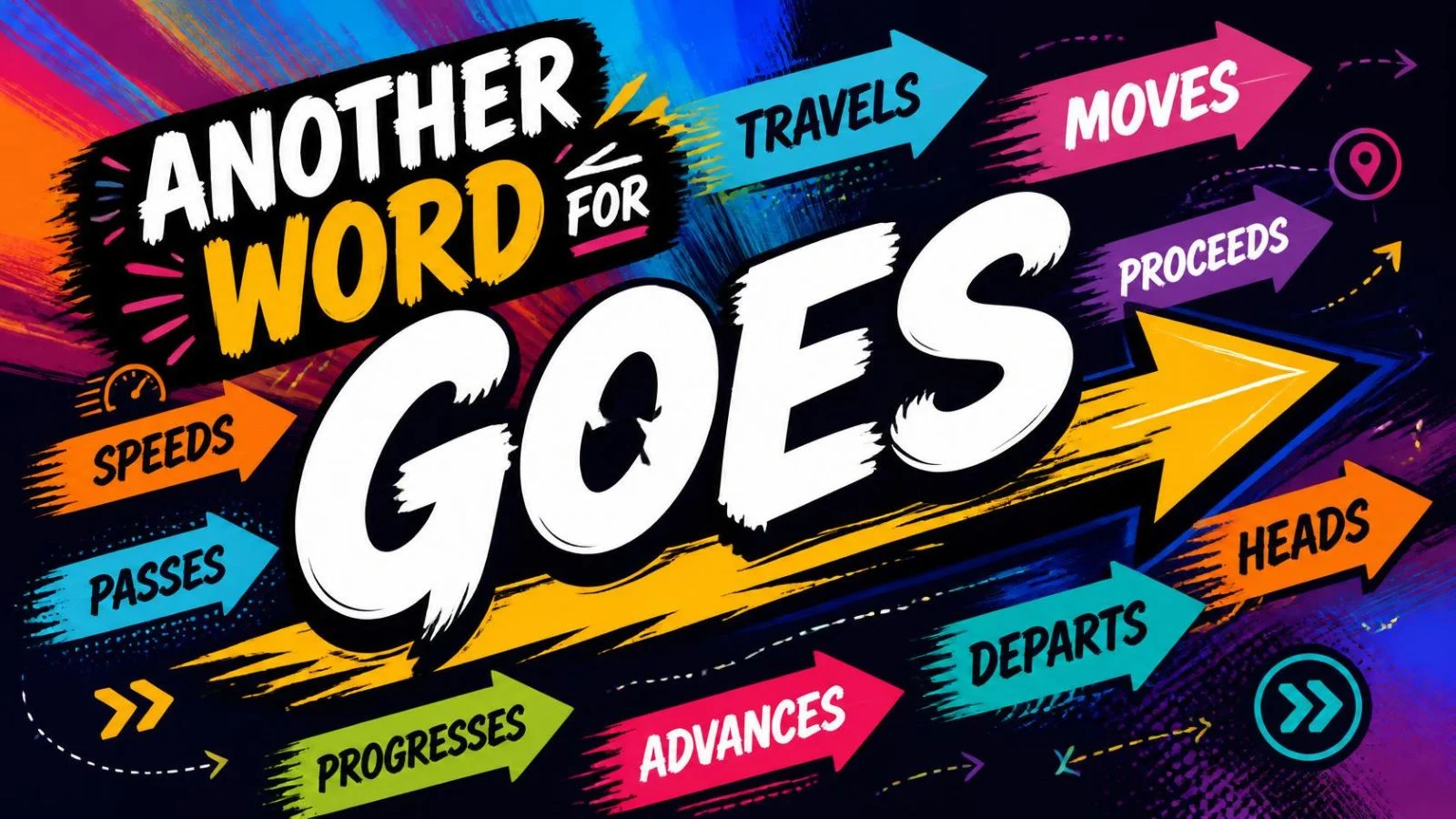
The simplest alternatives to “goes” are moves, travels, leaves, works, and becomes. The best choice depends on whether “goes” means movement, leaving, direction, operation, change, or placement.
Quick list: moves, travels, proceeds, heads, leaves, departs, runs, works, becomes, turns
Below are 30 alternatives with meanings, IPA, usage notes, and examples. Direct synonyms and related alternatives are labeled.
At a Glance: Goes Synonyms and Related Alternatives
| Alternative | Part of Speech | Meaning | Register / Tone | Ideal Context |
| Moves | Verb | Changes place | Neutral | General movement |
| Travels | Verb | Makes a journey | Neutral | Trips |
| Leaves | Verb | Goes away | Neutral | Departure |
| Departs | Verb | Leaves on schedule | Formal | Trains, flights |
| Heads | Verb | Goes toward | Conversational | Direction |
| Leads | Verb | Reaches a place | Neutral | Roads, paths |
| Runs | Verb | Extends | Neutral | Routes |
| Works | Verb | Operates | Neutral | Devices |
| Becomes | Verb | Changes state | Neutral | Change |
| Belongs | Verb | Has its place | Neutral | Storage |
Which Word Should You Use?
| If you want to… | Use | Why |
| Describe movement | moves | Broadest match |
| Describe a long trip | travels | Suggests distance |
| Say someone is going away | leaves | Focuses on the start |
| Sound formal about a schedule | departs | Common for flights |
| Say a road reaches a place | leads | Shows where it ends |
| Say a machine functions | works | Focuses on operation |
| Say something changes | becomes | Shows new state |
| Say where an item is kept | belongs | Shows proper place |
Exploring the Multiple Meanings of “Goes”
1. Moving or Traveling
- Meaning: Moves from one place to another.
- Explanation: The basic sense, usually with a destination.
- Example: She goes to the market every Friday.
2. Leaving or Departing
- Meaning: Leaves a place.
- Explanation: Focuses on the starting point.
- Example: The last train goes at nine.
3. Extending or Leading
- Meaning: Stretches or reaches a place.
- Explanation: Roads and paths “go” without moving.
- Example: This road goes to the lake.
4. Working or Proceeding
- Meaning: Functions or develops.
- Explanation: Describes operation or progress, not travel.
- Example: The meeting goes well.
5. Becoming or Changing State
- Meaning: Passes into a condition, often unwanted.
- Explanation: Usually followed by an adjective.
- Example: The room goes quiet.
6. Belonging or Fitting
- Meaning: Has its proper place.
- Explanation: About placement, not movement.
- Example: The pot goes on the bottom shelf.
Sources: Merriam-Webster; Collins English Dictionary; Dictionary.com.
Analyzing 30 Goes Alternatives in Detail
Some are direct synonyms for one sense of “goes”; others are related alternatives for specific contexts.
Movement and Travel
1. Move
IPA: /muːv/ (US and UK)
Definition: To change place.
- Usage: Direct synonym; no destination needed.
- Example: The line moves slowly.
2. Travel
IPA: /ˈtrævəl/ (US and UK)
Definition: To make a journey.
- Usage: Direct synonym for distance; too strong for short trips.
- Example: He travels to Karachi twice a month.
3. Proceed
IPA: US /proʊˈsiːd/ · UK /prəˈsiːd/
Definition: To move forward.
- Usage: Formal synonym, common in instructions.
- Example: Visitors proceed to the main hall.
4. Advance
IPA: US /ədˈvæns/ · UK /ədˈvɑːns/
Definition: To move forward.
- Usage: Related alternative; suggests progress.
- Example: The team advances to the next round.
5. Head
IPA: /hɛd/ (US and UK)
Definition: To go in a direction.
- Usage: Direct synonym; stresses direction.
- Example: She heads home at closing time.
6. Walk
IPA: US /wɔːk/ · UK /wɔːk/
Definition: To move on foot.
- Usage: Related alternative; names the manner.
- Example: He walks to school.
Leaving and Departing
7. Leave
IPA: /liːv/ (US and UK)
Definition: To go away from a place.
- Usage: Direct synonym; takes the place directly.
- Example: She leaves the office at five.
8. Depart
IPA: US /dɪˈpɑːrt/ · UK /dɪˈpɑːt/
Definition: To leave on a journey.
- Usage: Formal synonym for timetables.
- Example: The flight departs at noon.
9. Exit
IPA: /ˈɛɡzɪt/ (US and UK)
Definition: To go out of a place.
- Usage: Related alternative; formal, takes the place directly.
- Example: The actor exits the stage.
10. Set off
IPA: US /sɛt ˈɔːf/ · UK /sɛt ˈɒf/
Definition: To begin a journey.
- Usage: Direct synonym; spoken tone.
- Example: The group sets off at dawn.
Extension and Direction
11. Lead
IPA: /liːd/ (US and UK)
Definition: To reach a place, as a route.
- Usage: Direct synonym for roads and paths only.
- Example: This path leads to the river.
12. Extend
IPA: /ɪkˈstɛnd/ (US and UK)
Definition: To stretch over a distance.
- Usage: Formal; stresses length, not destination.
- Example: The wall extends for miles.
13. Run
IPA: /rʌn/ (US and UK)
Definition: To extend in a direction.
- Usage: Direct synonym for roads and rivers.
- Example: The road runs along the coast.
14. Stretch
IPA: /strɛtʃ/ (US and UK)
Definition: To extend over a wide area.
- Usage: Related alternative; suggests wide expanse.
- Example: The desert stretches for miles.
Working and Progressing
15. Work
IPA: US /wɜːrk/ · UK /wɜːk/
Definition: To operate as intended.
- Usage: Direct synonym for devices and plans.
- Example: The new system works well.
16. Function
IPA: /ˈfʌŋkʃən/ (US and UK)
Definition: To operate as expected.
- Usage: Formal synonym of “works.”
- Example: The pump functions only with power.
17. Operate
IPA: US /ˈɑːpəreɪt/ · UK /ˈɒpəreɪt/
Definition: To work or run.
- Usage: Related alternative for systems and businesses.
- Example: The shop operates until six.
18. Develop
IPA: /dɪˈvɛləp/ (US and UK)
Definition: To change over time.
- Usage: Related alternative for “how things go.”
- Example: The story develops quickly.
19. Unfold
IPA: US /ʌnˈfoʊld/ · UK /ʌnˈfəʊld/
Definition: To happen gradually.
- Usage: Related alternative; step-by-step.
- Example: The plan unfolds over three days.
20. Turn out
IPA: US /tɜːrn aʊt/ · UK /tɜːn aʊt/
Definition: To end in a certain way.
- Usage: Related alternative; focuses on the result.
- Example: The test turns out easy.
Change and Loss
21. Become
IPA: /bɪˈkʌm/ (US and UK)
Definition: To begin to be something.
- Usage: Direct synonym; more neutral than “goes.”
- Example: The weather becomes cold.
22. Turn
IPA: US /tɜːrn/ · UK /tɜːn/
Definition: To change into another state.
- Usage: Direct synonym for color or condition.
- Example: The leaves turn brown.
23. Grow
IPA: US /ɡroʊ/ · UK /ɡrəʊ/
Definition: To gradually become.
- Usage: Related alternative; used with adjectives.
- Example: The crowd grows restless.
24. Vanish
IPA: /ˈvænɪʃ/ (US and UK)
Definition: To disappear suddenly.
- Usage: Related alternative; stronger than “goes.”
- Example: The stain vanishes after washing.
25. Fail
IPA: /feɪl/ (US and UK)
Definition: To stop working.
- Usage: Related alternative; always means failure.
- Example: The signal fails in storms.
26. Fade
IPA: /feɪd/ (US and UK)
Definition: To become weaker or paler.
- Usage: Related alternative; slow loss.
- Example: The color fades in the sun.
Placement, Sound, and Wording
27. Belong
IPA: US /bɪˈlɔːŋ/ · UK /bɪˈlɒŋ/
Definition: To have a proper place.
- Usage: Direct synonym for placement only.
- Example: The keys belong in the drawer.
28. Fit
IPA: /fɪt/ (US and UK)
Definition: To be the right size for a space.
- Usage: Related alternative; stresses size.
- Example: The sofa fits in the corner.
29. Sound
IPA: /saʊnd/ (US and UK)
Definition: To make a noise.
- Usage: Related alternative; partial match.
- Example: The alarm sounds at six.
30. Read
IPA: /riːd/ (US and UK)
Definition: To have particular wording.
- Usage: Related alternative for “the sign goes like this.”
- Example: The sign reads “Wet paint.”
Sources: Merriam-Webster; Collins English Dictionary and Thesaurus; Dictionary.com.
Goes vs. Leaves vs. Departs vs. Heads
| Word | Stresses | Example |
| Goes | General movement | She goes to work. |
| Leaves | Starting point | She leaves home at seven. |
| Departs | Scheduled start | The train departs at noon. |
| Heads | Direction | She heads toward the station. |
Sources: Merriam-Webster; Collins English Dictionary.
Goes and Opposite/Paired Word Pairs
| Word | Paired Word | Note |
| Goes | Comes | Away from or toward the speaker |
| Goes | Stays | Moving vs. remaining |
| Leaves | Arrives | Start vs. end |
| Works | Fails | Operation vs. breakdown |
“Goes” has no single opposite; choose the pair that matches your meaning.
Sources: Merriam-Webster; Collins English Dictionary.
Common Word Partners of “Goes”
| Pattern | Common Partners | Example |
| goes + adverb | well, wrong, smoothly | The event goes smoothly. |
| goes + adjective | bad, quiet, viral | The video goes viral. |
| goes + preposition | to, through, by | The path goes through the forest. |
| goes + particle | on, off, out | The alarm goes off. |
Sources: Collins English Dictionary; Merriam-Webster.
Idiomatic Phrases Featuring “Goes”
1. Anything goes
- Meaning: There are no limits.
- Example: At the party, anything goes.
2. What goes around comes around
- Meaning: Your actions come back to you.
- Example: He was unkind, and now people avoid him. What goes around comes around.
3. It goes without saying
- Meaning: It is too obvious to mention.
- Example: It goes without saying that you should lock the door.
4. As the saying goes
- Meaning: Introduces a well-known saying.
- Example: As the saying goes, practice makes perfect.
Sources: Merriam-Webster; Collins English Dictionary; Dictionary.com.
Word Formation of “Goes”
Etymology & Structure
“Goes” is the third-person singular of go. Etymonline traces go to Old English gān (“to advance, walk; depart”), from West Germanic *gaian.
Date and History
Go is a defective verb throughout its recorded history. The old past tense ēode was replaced in the 1400s by went, from wenden, “to direct one’s way.” Etymonline dates “Who goes there?” to the 1590s.
Word Class Variations
- Verb: go, goes, going, went, gone
- Noun: go (plural goes), as in “have a go”
- Agent noun: goer
Sources: Etymonline (go, goes, goer, went); Merriam-Webster.
Common Word-Choice Mistakes
- She leaves to the market: use “goes to the market.”
- The bus departs to Lahore: use “departs for Lahore.”
- The actor exits to the stage: use “exits the stage.”
- The lights came out: use “went out.”
- He proceeds the road: use “proceeds along the road.”
Frequently Asked Questions
What is the closest synonym for “goes”?
There is no single one. Use “moves” for movement, “leaves” for departure, and “works” for function.
What is a formal alternative?
“Proceeds” and “departs” are formal.
Can “goes” describe something that does not move?
Yes. A road “goes” somewhere when it extends or leads there.
Is “goes” the same as “becomes”?
Only in phrases like “goes bad.” “Goes” is more informal.
What is the opposite of “goes”?
Usually “comes.” Others are “stays,” “arrives,” and “returns.”
Why is the past tense “went”?
Etymonline says went was originally the past tense of wend and replaced the old past tense of go in the 1400s.
Conclusion
The closest everyday alternatives to “goes” are “moves,” “travels,” “leaves,” “works,” and “becomes.” “Departs” and “proceeds” are the formal options.
Context matters more than any single synonym. A word that fits one sense, such as “works” for a machine, may be wrong for movement or change.
First decide what “goes” means in your sentence, then choose the word from that group that fits your tone.

Emily Davis is a passionate writer who enjoys exploring English vocabulary, synonyms, and language tips to help readers improve their communication skills.
At PressivoMedia.com, she focuses on creating simple, engaging, and informative content that makes learning English easier and more enjoyable.


1 thought on “30 Another Word for Goes: Synonyms With Examples for 2026”