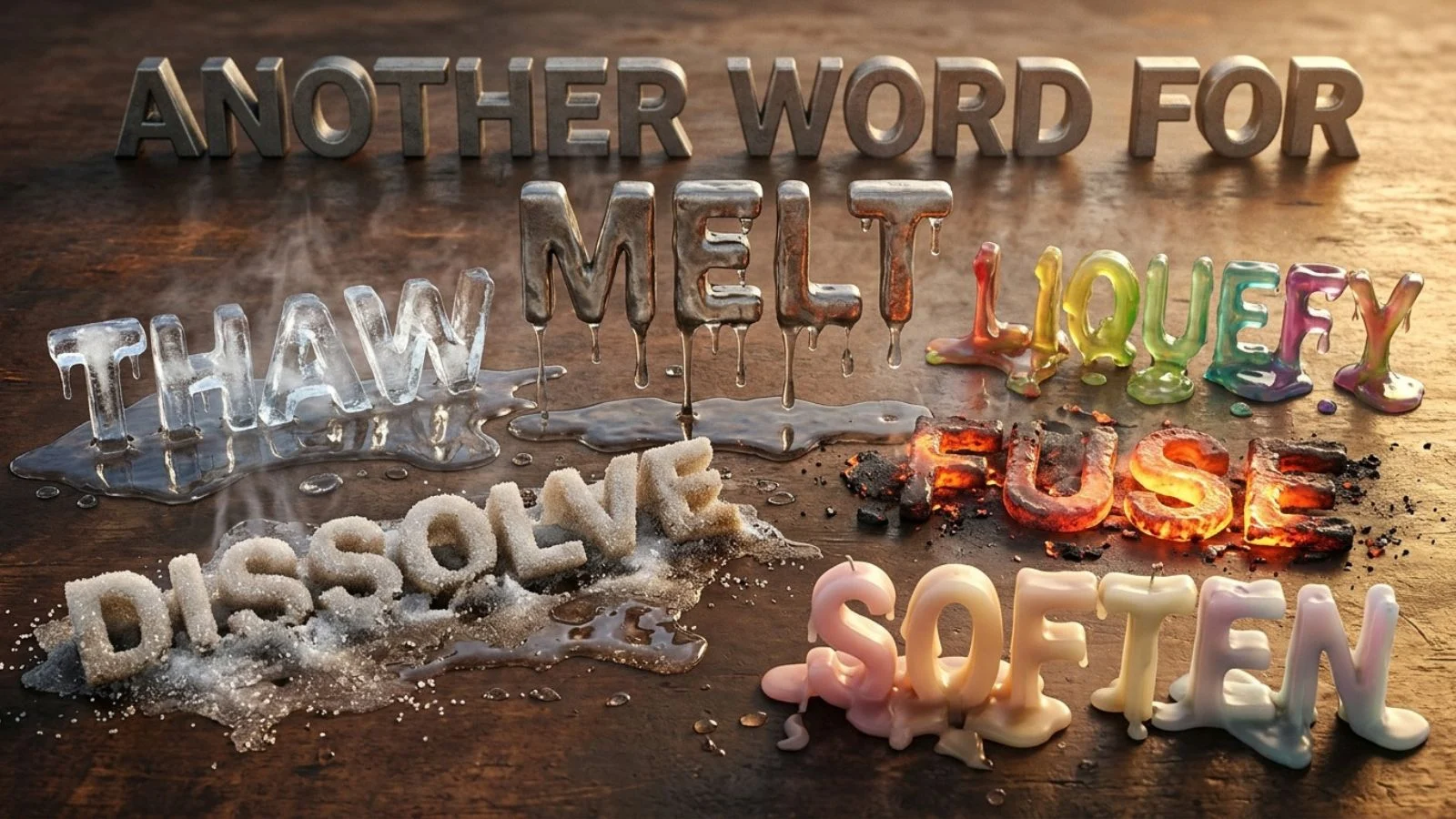
The closest everyday alternatives to melt are thaw, liquefy, dissolve, and soften. Thaw fits ice and snow.
Liquefy is the more general or formal choice for turning a solid into a liquid. Dissolve fits sugar or salt in a drink. Soften works when something becomes gentle, either in texture or in feeling.
The best word depends on the meaning. Melt can describe heat changing a solid, something slowly disappearing, two things blending together, or a person’s feelings becoming gentler. Each sense has its own set of better alternatives.
Quick list: thaw, liquefy, dissolve, soften, defrost, fade, vanish, blend, mellow, relent
At a Glance: Melt Synonyms and Related Alternatives
| Alternative | Part of Speech | Meaning | Register / Tone | Ideal Context |
| Thaw | verb | Become unfrozen or warmer | Neutral | Ice, snow, frozen food, cold relationships |
| Liquefy | verb | Turn into liquid | Formal, technical | Science, cooking, general writing |
| Dissolve | verb | Mix into a liquid and disappear | Neutral | Sugar, salt, tablets |
| Soften | verb | Become soft or gentle | Neutral | Textures, attitudes, feelings |
| Defrost | verb | Remove frost or thaw frozen food | Everyday | Freezers, windscreens, meat |
| Fade | verb | Gradually become less clear or strong | Neutral | Light, colour, memories |
| Vanish | verb | Disappear suddenly or completely | Neutral | Objects, hopes, fears |
| Blend | verb | Mix smoothly so parts are not distinct | Neutral | Colours, sounds, people in a crowd |
| Mellow | verb | Become gentler or more relaxed | Warm, informal | Moods, people, flavours |
| Relent | verb | Become less harsh or strict | Formal, literary | Anger, refusal, punishment |
Which Word Should You Use?
| If you want to… | Use | Why |
| Describe ice or snow turning to water | Thaw | It suits frozen things warming up |
| Describe butter or wax turning liquid | Melt or liquefy | Liquefy is more formal |
| Describe sugar in tea | Dissolve | The sugar mixes into the liquid |
| Describe frozen food coming out of the freezer | Defrost | It is the usual kitchen word |
| Describe a fog or crowd slowly disappearing | Fade or disperse | Both suggest gradual loss |
| Describe a softened attitude | Relent or soften | They fit anger, refusal, or strictness |
| Describe colours or sounds joining smoothly | Blend or meld | They suggest no clear boundary |
| Describe very hot weather | Swelter | It is the standard word for oppressive heat |
Exploring the Multiple Meanings of “Melt”
1. Turning From Solid to Liquid
- Meaning: To change from a solid to a liquid, usually because of heat.
- Explanation: This is the main sense. It applies to ice, butter, wax, chocolate, cheese, and metal.
- Example: The butter melted in the hot pan.
2. Dissolving
- Meaning: To dissolve or break up in a liquid.
- Explanation: Heat is not needed here. The thing simply mixes into the liquid and disappears.
- Example: The sugar melted in the coffee.
3. Disappearing Gradually
- Meaning: To grow less and disappear.
- Explanation: This sense is often used with “away,” as with clouds, fears, or crowds.
- Example: The crowd melted away after the show.
4. Becoming Gentle or Moved
- Meaning: To become tender, soft, or sympathetic, or to make someone so.
- Explanation: It is figurative and describes a change in feeling, not in matter.
- Example: Her heart melted when she saw the puppy.
5. Blending Into Something Else
- Meaning: To lose a clear outline and merge with something else.
- Explanation: This sense is common in descriptions of scenery, light, and colour.
- Example: The tree trunks melted into the evening forest.
6. A Melted Substance (Noun)
- Meaning: A melted substance, the state of being melted, or a sandwich topped with melted cheese.
- Explanation: The noun appears in terms like “spring melt” and “tuna melt.”
- Example: The spring melt filled the river.
Sources: Merriam-Webster Dictionary; Oxford Learner’s Dictionaries; Princeton WordNet
Analyzing 30 Melt Alternatives in Detail
Some of these are close synonyms of melt, while others are related alternatives that fit only one sense. The usage notes say which is which.
Group 1: Core Synonyms for Solid to Liquid
1. Thaw
IPA: /θɔː/ (US and UK)
Definition: To become unfrozen, or to make something unfrozen.
- Usage: This is a close synonym when the thing was frozen. It does not fit wax or butter that was never frozen.
- Example: The lake began to thaw in April.
2. Liquefy
IPA: /ˈlɪkwɪfaɪ/ (US and UK)
Definition: To turn into a liquid.
- Usage: This is a direct, more formal synonym. It is common in science and cooking, and it does not suggest heat as strongly as melt does.
- Example: The wax liquefies at a low temperature.
3. Dissolve
IPA: US /dɪˈzɑːlv/ · UK /dɪˈzɒlv/
Definition: To mix into a liquid so completely that the solid is no longer visible.
- Usage: This is a related alternative for the “melting in a liquid” sense only. Dissolving needs a liquid, while melting needs heat.
- Example: Stir until the salt dissolves.
4. Defrost
IPA: US /diːˈfrɔːst/ · UK /diːˈfrɒst/
Definition: To remove frost or ice, or to bring frozen food to room temperature.
- Usage: This is a related, everyday alternative limited to freezers, windscreens, and frozen food. It does not fit butter or metal.
- Example: Defrost the chicken overnight.
5. Soften
IPA: US /ˈsɔːfn/ · UK /ˈsɒfn/
Definition: To become or make something less hard or firm.
- Usage: This is a partial synonym. Butter softens before it melts, so soften describes a stage and not the full change.
- Example: Let the butter soften on the counter.
Group 2: Technical and Industrial Alternatives
6. Smelt
IPA: /smelt/ (US and UK)
Definition: To melt ore to separate the metal from it.
- Usage: This is a technical, related word. It is not a general synonym of melt, and it is only used for ore.
- Example: The factory smelts iron ore.
7. Fuse
IPA: /fjuːz/ (US and UK)
Definition: To join things together by melting them, or to blend into one.
- Usage: This is a related alternative used for metals, plastics, and glass. It stresses joining and not simply liquefying.
- Example: The heat fused the two pieces of glass.
8. Render
IPA: US /ˈrendər/ · UK /ˈrendə/
Definition: To melt animal fat so it separates from the other tissue.
- Usage: This is a narrow, related word from cooking and food production.
- Example: The cook rendered the fat slowly.
9. Deliquesce
IPA: /ˌdelɪˈkwes/ (US and UK)
Definition: To become liquid by absorbing moisture from the air.
- Usage: This is a rare scientific word. It is related to melt by result, but moisture causes the change, not heat.
- Example: The salt crystals deliquesced in the damp air.
Group 3: Fading and Disappearing Alternatives
10. Fade
IPA: /feɪd/ (US and UK)
Definition: To lose strength, colour, or clearness gradually.
- Usage: This is a close alternative for the “disappear gradually” sense.
- Example: The music faded as we walked away.
11. Vanish
IPA: /ˈvænɪʃ/ (US and UK)
Definition: To disappear suddenly or completely.
- Usage: This is stronger and quicker than melt away, which suggests a slower loss.
- Example: Her worries vanished after the good news.
12. Evaporate
IPA: /ɪˈvæpəreɪt/ (US and UK)
Definition: To turn from liquid into vapor, or to disappear quickly.
- Usage: This is figurative when used for hopes or support. It is not a synonym for melting a solid.
- Example: Their enthusiasm evaporated after the first week.
13. Dissipate
IPA: /ˈdɪsɪpeɪt/ (US and UK)
Definition: To spread out and disappear.
- Usage: This is a formal alternative for fog, smoke, tension, or energy.
- Example: The tension dissipated once they started talking.
14. Disperse
IPA: US /dɪˈspɜːrs/ · UK /dɪˈspɜːs/
Definition: To break up and scatter in different directions.
- Usage: This is related to “melt away” when talking about crowds or clouds.
- Example: The crowd dispersed quietly.
15. Dwindle
IPA: /ˈdwɪndl/ (US and UK)
Definition: To become smaller or fewer over time.
- Usage: This is a related alternative for slow shrinking, such as savings or support. It does not suggest turning liquid.
- Example: Their savings dwindled each month.
16. Ebb
IPA: /eb/ (US and UK)
Definition: To flow back, or to grow weaker.
- Usage: This is a literary, related alternative for feelings or strength that slowly fade.
- Example: His anger began to ebb.
Group 4: Blending Alternatives
17. Blend
IPA: /blend/ (US and UK)
Definition: To mix so that the parts are not easily seen as separate.
- Usage: This is a close alternative for the sense of “melting into” colours, sounds, or backgrounds.
- Example: The colours blend into one another at the horizon.
18. Merge
IPA: US /mɜːrdʒ/ · UK /mɜːdʒ/
Definition: To combine into one.
- Usage: This is a related alternative that focuses on joining, with less softness than blend.
- Example: The two roads merge near the bridge.
19. Meld
IPA: /meld/ (US and UK)
Definition: To blend or combine closely.
- Usage: This is slightly more literary than blend and suggests smooth, complete mixing.
- Example: Their voices melded into one sound.
Group 5: Emotional and Figurative Alternatives
20. Mellow
IPA: US /ˈmeloʊ/ · UK /ˈmeləʊ/
Definition: To become gentler, softer, or more relaxed.
- Usage: This is a close alternative when a person’s mood or manner softens.
- Example: He mellowed with age.
21. Relent
IPA: /rɪˈlent/ (US and UK)
Definition: To become less harsh or strict.
- Usage: This is a formal alternative for “melt” when anger or refusal gives way.
- Example: The teacher relented and gave an extension.
22. Mollify
IPA: US /ˈmɑːlɪfaɪ/ · UK /ˈmɒlɪfaɪ/
Definition: To calm someone who is angry or upset.
- Usage: This is a formal, related alternative. It describes an action done to another person.
- Example: The manager tried to mollify the angry customer.
23. Touch
IPA: /tʌtʃ/ (US and UK)
Definition: To affect someone’s feelings.
- Usage: This is a related alternative to “melt someone’s heart.” It describes the effect, not the change itself.
- Example: Her kind letter touched him deeply.
24. Disarm
IPA: US /dɪsˈɑːrm/ · UK /dɪsˈɑːm/
Definition: To remove someone’s anger or suspicion.
- Usage: This is a related alternative used when charm or kindness lowers a person’s guard.
- Example: Her smile disarmed him completely.
Group 6: Heat, Weakness, and Breakdown Alternatives
25. Swelter
IPA: US /ˈsweltər/ · UK /ˈsweltə/
Definition: To suffer from oppressive heat.
- Usage: This is a related alternative for the informal sense of “I’m melting” in hot weather.
- Example: We sweltered in the afternoon sun.
26. Wilt
IPA: /wɪlt/ (US and UK)
Definition: To droop or lose strength, especially from heat.
- Usage: This is a related alternative for plants or people weakened by heat.
- Example: The flowers wilted in the heat.
27. Collapse
IPA: /kəˈlæps/ (US and UK)
Definition: To fall down or fail suddenly.
- Usage: This is a related alternative for a loss of control. It is closer to the noun “meltdown” than to melt.
- Example: The plan collapsed under pressure.
28. Disintegrate
IPA: /dɪsˈɪntɪɡreɪt/ (US and UK)
Definition: To break into small pieces or fall apart.
- Usage: This is a related alternative when something breaks apart as it dissolves or breaks down.
- Example: The old paper disintegrated in the water.
29. Crumble
IPA: /ˈkrʌmbl/ (US and UK)
Definition: To break into small pieces, or to fail gradually.
- Usage: This is a related alternative for walls, hopes, or resistance that slowly give way.
- Example: His resistance crumbled.
30. Unravel
IPA: /ʌnˈrævl/ (US and UK)
Definition: To come apart, or to fall into disorder.
- Usage: This is a related alternative for plans or composure that fall apart. It does not suggest a liquid.
- Example: The plan unraveled when the leader left.
Sources: Merriam-Webster Dictionary and Thesaurus; Oxford Learner’s Dictionaries; Princeton WordNet
Melt vs. Thaw vs. Dissolve vs. Liquefy
| Word | Need heat? | Main idea | Typical examples |
| Melt | Usually | Solid becomes liquid | Butter, ice, wax, metal |
| Thaw | Warming | Frozen thing becomes unfrozen | Snow, frozen meat, lakes |
| Dissolve | No | Solid mixes into a liquid | Sugar, salt, tablets |
| Liquefy | Not always | General change into liquid | Gas, wax, fruit |
Use melt for everyday heat changes and thaw when the thing is frozen. Use dissolve when a liquid takes the solid into itself. Liquefy is the most formal and widest of the four.
Sources: Merriam-Webster Dictionary; Oxford Learner’s Dictionaries
Melt and Opposite/Paired Word Pairs
| Word | Paired Word | Note |
| Melt | Freeze | The standard opposite for water, ice, and food |
| Melt | Solidify | A more formal opposite for liquids becoming solid |
| Melt | Harden | Works for wax, metal, and figurative hearts |
| Melt | Set | Used for jelly, concrete, and some foods |
| Melt away | Appear | Contrasts gradual disappearance with arrival |
Melt has more than one opposite because it has more than one sense. Freeze and solidify match the physical meaning, while harden also covers feelings.
Sources: Merriam-Webster Thesaurus; Princeton WordNet
Common Word Partners of “Melt”
| Pattern | Common Partners | Example |
| Melt + food | butter, cheese, chocolate | Melt the chocolate slowly. |
| Melt + natural thing | snow, ice, glaciers | The glaciers are melting. |
| Melt + adverb | slowly, quickly, completely | The ice melted quickly. |
| Melted + noun | butter, cheese, wax | Serve it with melted cheese. |
| Melting + noun | point, ice, snow | The melting point of ice is 0°C. |
| Melt + preposition | away, into | The snow melted away. |
| Noun + melt | spring melt, snowmelt | The spring melt raised the river. |
Sources: Oxford Learner’s Dictionaries; Merriam-Webster Dictionary
Idiomatic Phrases Featuring “Melt”
Some of these are fixed idioms, while others are established expressions.
1. Melt in your mouth
- Meaning: To be so soft and delicious that it seems to dissolve when eaten.
- Example: The pastry melts in your mouth.
2. Melt someone’s heart
- Meaning: To make someone feel love, pity, or tenderness.
- Example: The child’s smile melted her heart.
3. Melt away
- Meaning: To disappear gradually.
- Example: All my worries melted away.
4. Melting pot
- Meaning: A place where different peoples and cultures mix.
- Example: The city is a melting pot of cultures.
Sources: Etymonline; Merriam-Webster Dictionary
Word Formation of “Melt”
Etymology & Structure
Melt is an old Germanic word. Etymonline traces Middle English melten to Old English meltan (“to become liquid through heat”) and back to Proto-Germanic meltanan. It is a strong verb with the past forms melt and molten. The root belongs to a Proto-Indo-European family connected with the idea of “soft.”
Date and History
Merriam-Webster dates the verb to before the 12th century. Etymonline records the figurative sense of “wane” or “grow tender” by about 1200, and the sense of softening feelings by the early 14th century. “Melt in one’s mouth” appears in the 1690s. “Melting point” is recorded by 1807, and “melting pot” has been used since the early 15th century. Etymonline dates the noun melt to 1854, and Merriam-Webster gives 1847. Meltdown for a nuclear reactor dates to 1956, and the figurative sense of lost self-control to 1979.
Word Class Variations
- Verb: melt, melts, melted, melting
- Noun: melt, melter, meltdown, meltwater
- Adjective: melting, melted, molten
- Adverb: meltingly
Sources: Etymonline; Merriam-Webster Dictionary
Common Word-Choice Mistakes
- “The sugar thawed in my tea”: use dissolved.
- “Defrost the chocolate”: use to melt the chocolate, since defrost is for frozen things.
- “Smelt the butter”: use melt, because smelt is for ore.
- “Molten snow”: use melted snow, since molten is for metal, rock, glass, and lava.
- “Her anger melted down”: use melted away.
- “The sun dissolved the snow”: use melted, because dissolve needs a liquid to mix into.
- “The butter evaporated in the pan”: use melted, since evaporate means turning into vapor.
Frequently Asked Questions
What is the closest synonym for melt?
Liquefy is the closest general synonym. For ice and snow, thaw is the most natural.
What is a formal alternative to melt?
Liquefy is the common formal choice. Deliquesce is a rare scientific term.
What is the difference between melt and thaw?
Thaw applies to something that was frozen, while melt applies to any solid turning liquid. Snow can do either, but butter only melts.
What is the difference between melt and dissolve?
Melt usually needs heat, while dissolve needs a liquid. Sugar dissolves in tea, but chocolate melts in a pan.
Is melt the same as defrost?
No. Defrost means to bring frozen food back to a usable temperature, and it does not always mean the food turns liquid.
What is a figurative alternative for melt?
Soften, mellow, relent, and touch all work when feelings change.
What is the opposite of melt?
Freeze and solidify are the usual opposites, and harden works for firmness or feeling.
Can melt be used for people?
Yes, figuratively. A person can melt with emotion or be melted by kindness. It is also an informal way to say you feel very hot.
Can melt mean disappear?
Yes. Melt away means to vanish gradually, so fade and dissipate are close alternatives.
Is smelt the same as melt?
No. Smelt means melting ore to extract its metal and is much narrower than melt.
Conclusion
The closest alternatives to melt are thaw, liquefy, dissolve, and soften. They cover most everyday uses, especially ice, butter, sugar, and wax.
Melt also has figurative and technical meanings, so context matters. Fade and vanish fit gradual disappearance, blend and merge fit mixing, and mellow and relent fit softened feelings.
To choose the right word, first decide which sense you mean. If heat turns a solid to liquid, use melt, thaw, or liquefy. If something mixes into a liquid, use dissolve. If a feeling softens, use soften, relent, or mellow.

Emily Davis is a passionate writer who enjoys exploring English vocabulary, synonyms, and language tips to help readers improve their communication skills.
At PressivoMedia.com, she focuses on creating simple, engaging, and informative content that makes learning English easier and more enjoyable.