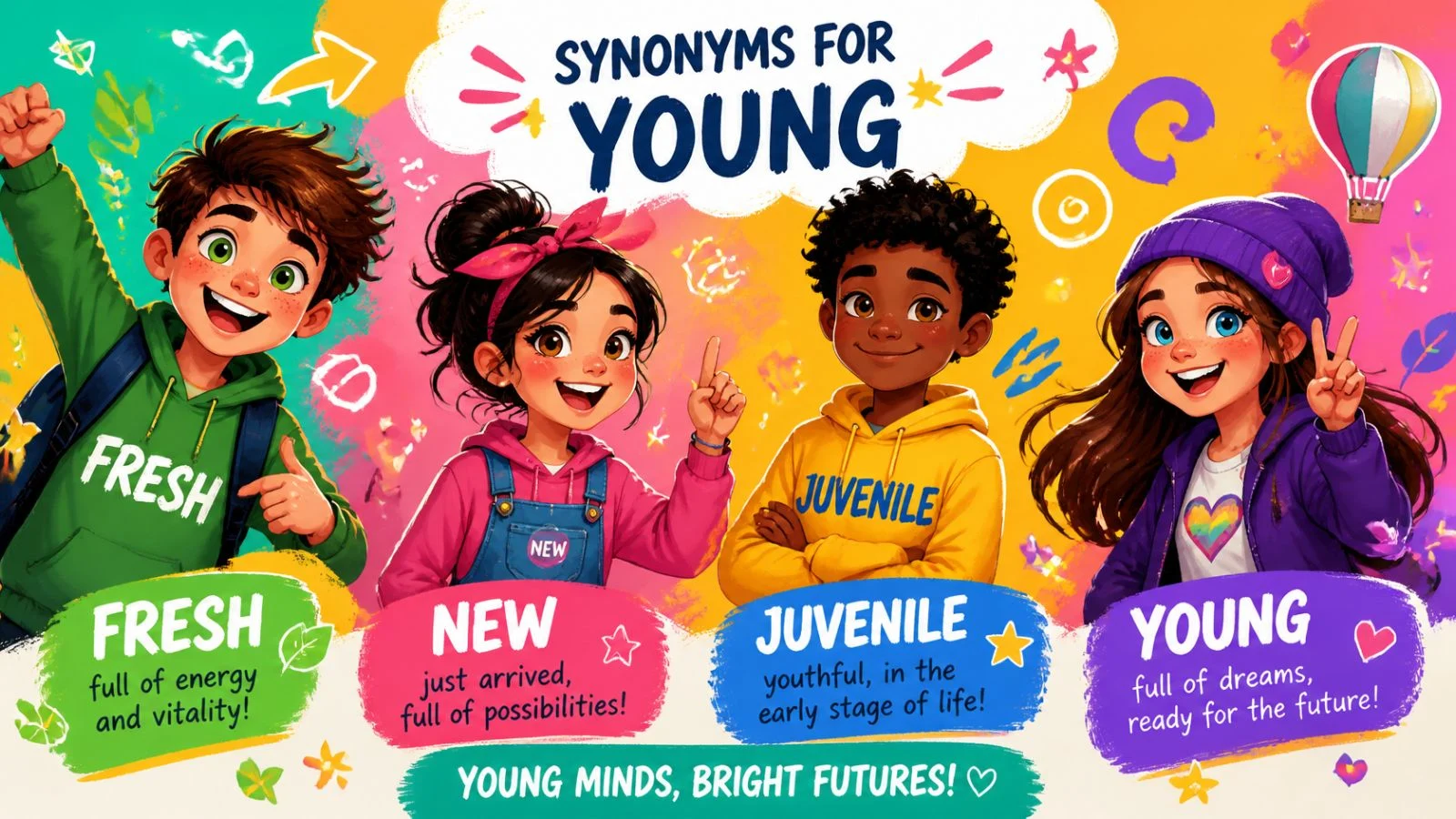
Young is an adjective. Its closest everyday words are youthful, little, and juvenile. Each one points to a slightly different idea.
The best choice depends on what you mean. Young can describe age, skill, newness, or energy. So the right word changes with the case.
Quick list: youthful, juvenile, junior, little, adolescent, teenage, immature, inexperienced, fresh, budding
This article looks at 30 alternatives. You get meanings, IPA, usage notes, and examples for each one. Some are direct synonyms, and others fit only certain contexts.
At a Glance: Young Synonyms and Related Alternatives
| Alternative | Part of Speech | Meaning | Register / Tone | Ideal Context |
| Youthful | Adjective | Having the look or spirit of youth | Neutral, warm | Faces, energy, style |
| Juvenile | Adjective / Noun | Young, or meant for young people | Formal | Law, science, school |
| Junior | Adjective / Noun | Younger or lower in rank | Neutral | Sports, jobs, family names |
| Little | Adjective | Small in age or size | Casual, warm | Young children |
| Adolescent | Adjective / Noun | In the stage between child and adult | Formal | Health, school, research |
| Teenage | Adjective | Aged thirteen to nineteen | Neutral | Everyday talk, news |
| Immature | Adjective | Not fully grown or not grown up in manner | Often critical | Conduct, plants, fruit |
| Inexperienced | Adjective | Having little practice | Neutral | Work, driving, skills |
| Fresh | Adjective | New and not yet tired | Casual, positive | New graduates, new ideas |
| Budding | Adjective | Starting to grow or show promise | Warm, positive | Talent, careers |
Which Word Should You Use?
| If you want to… | Use | Why |
| Describe a face or a spirit | Youthful | It shows a young look or feel. |
| Talk about a small child | Little | It is warm and common in daily talk. |
| Write about law or science | Juvenile | It is a formal and exact term. |
| Name the teen years | Teenage | It points to ages thirteen to nineteen. |
| Say someone lacks skill | Inexperienced | It is about practice, not age. |
| Criticize childish conduct | Immature | It shows poor judgment. |
| Praise early talent | Budding | It adds hope and promise. |
| Describe a new company | Fledgling | It shows a new group still learning. |
Exploring the Multiple Meanings of “Young”
1. Early in life
- Meaning: Not old and in the first part of life.
- Explanation: This is the main sense. It fits people, animals, and plants.
- Example: Their young son learned to swim last summer.
2. Offspring of animals
- Meaning: The babies of an animal.
- Explanation: Here young works as a noun. It is plural in form and has no “s”.
- Example: The mother bird fed her young every hour.
3. New or recent
- Meaning: Started not long ago.
- Explanation: People use this sense for firms, ideas, and countries. It shows a short history.
- Example: This is a young company with a bold plan.
4. Youthful in spirit
- Meaning: Having the energy or look of youth.
- Explanation: This sense is about feeling, not age. Older people can fit it too.
- Example: My grandfather stays young by dancing every weekend.
5. Inexperienced or immature
- Meaning: Lacking skill or life knowledge.
- Explanation: People often use it as a gentle excuse. It can also sound rude.
- Example: He was too young to see the risk.
6. Young people as a group
- Meaning: People in their early years, as a whole.
- Explanation: Writers use “the young” as a plural noun. It often pairs with “the old”.
- Example: The new park is a great place for the young.
Sources: Merriam-Webster; Collins Dictionary; Dictionary.com
Analyzing 30 Young Alternatives in Detail
Some of these words are direct synonyms. Others are related words that fit only certain cases.
Core Synonyms
1. Youthful
IPA: US /ˈjuːθfəl/ · UK /ˈjuːθfʊl/
Definition: It means having the look, energy, or feel of someone young. It also fits people who are not young at all.
- Usage: This is the closest everyday match. However, it often shows looks or spirit, not exact age.
- Example: She has a youthful face and a quick laugh.
2. Juvenile
IPA: US /ˈdʒuːvəˌnaɪl/ · UK /ˈdʒuːvənaɪl/
Definition: It means young or made for young people. It also names a young person in law.
- Usage: It sounds formal in most cases. However, calling an adult juvenile means they act childish.
- Example: The court handles juvenile cases in a separate room.
3. Junior
IPA: US /ˈdʒuːnjər/ · UK /ˈdʒuːniə/
Definition: It means younger or lower in rank. It also names the younger of two family members with one name.
- Usage: It is a related word, not an exact match. For example, a junior doctor may be forty years old.
- Example: The junior team plays on Saturday mornings at the park.
4. Little
IPA: /ˈlɪtl/ (US and UK)
Definition: It means small in size or age. It also shows warmth in many cases.
- Usage: People use it for young children in everyday talk. Still, it can mean small size only.
- Example: Her little brother just started school this week.
5. Small
IPA: /smɔːl/ (US and UK)
Definition: It means not large, and it can mean young too. It also appears in phrases like “small child”.
- Usage: It is only partly a synonym. For example, “small children” means young children.
- Example: The park has a safe area for small children.
Life-Stage Words
6. Infant
IPA: /ˈɪnfənt/ (US and UK)
Definition: It means a baby or a very young child. It also works as an adjective for early stages.
- Usage: It sounds formal and medical. However, it fits only the first years of life.
- Example: The nurse checked the infant before the family left.
7. Baby
IPA: /ˈbeɪbi/ (US and UK)
Definition: It means a very young child or animal. It also names something small for its kind.
- Usage: It is warm and simple. For example, people say “baby birds” for young birds.
- Example: We saw a baby deer near the quiet road.
8. Adolescent
IPA: /ˌædəˈlesnt/ (US and UK)
Definition: It means in the stage between child and adult. It also names a person in that stage.
- Usage: It sounds formal and fits school or science texts. In short, it points to the teen years.
- Example: Adolescent students often need more sleep than adults.
9. Teenage
IPA: /ˈtiːneɪdʒ/ (US and UK)
Definition: It means between thirteen and nineteen years old. It also describes things made for that age.
- Usage: It is an adjective, so say “teenage boy”. However, the noun is teenager.
- Example: Their teenage daughter plays guitar in a school band.
10. Pubescent
IPA: /pjuːˈbesnt/ (US and UK)
Definition: It means reaching puberty, when the body starts to change. It also appears in health texts.
- Usage: This is a related word with a narrow meaning. Also, it sounds clinical in daily talk.
- Example: The doctor explained changes in pubescent children to the parents.
11. Childlike
IPA: /ˈtʃaɪldlaɪk/ (US and UK)
Definition: It means having the good traits of a child. It also shows joy, trust, or wonder.
- Usage: It is a related alternative. However, it is kind, while “childish” is often a criticism.
- Example: He looked at the snow with childlike wonder.
Inexperienced Alternatives
12. Green
IPA: /ɡriːn/ (US and UK)
Definition: It means new to a job or task. It also hints at a lack of skill.
- Usage: This is a related alternative about skill. For example, a green worker may be old.
- Example: The green recruit needed help with every small task.
13. Callow
IPA: US /ˈkæloʊ/ · UK /ˈkæləʊ/
Definition: It means young and short on life skill. It also suggests the person is a bit foolish.
- Usage: It is a formal and often rude word. Still, writers use it for young people with little life knowledge.
- Example: The callow youth boasted about a world he had never seen.
14. Naive
IPA: /naɪˈiːv/ (US and UK)
Definition: It means too trusting and short on life knowledge. It also fits adults.
- Usage: It is related, not exact. However, young people often get this label.
- Example: He was naive and believed every promise the seller made.
15. Raw
IPA: /rɔː/ (US and UK)
Definition: It means new and not yet trained. It also shows rough skill.
- Usage: People use it for recruits and talent. For example, a raw player has power but little polish.
- Example: The coach liked the raw speed of the young runner.
16. Inexperienced
IPA: US /ˌɪnɪkˈspɪriənst/ · UK /ˌɪnɪkˈspɪəriənst/
Definition: It means having little practice or knowledge. It also fits any age.
- Usage: It is a plain, neutral word. However, it is about skill, not age.
- Example: An inexperienced driver should avoid the highway at night.
17. Immature
IPA: US /ˌɪməˈtʃʊr/ · UK /ˌɪməˈtʃʊə/
Definition: It means not fully grown or not acting grown up. It also covers fruit and plants.
- Usage: The word can sound harsh about people. In fact, it often hints at poor conduct.
- Example: His immature jokes made the older guests roll their eyes.
New and Early-Stage Alternatives
18. New
IPA: US /nuː/ · UK /njuː/
Definition: It means made, found, or started not long ago. It also fits young groups.
- Usage: It works as a plain synonym for a young business. However, it does not suit a person’s age.
- Example: The new company has only five workers so far.
19. Fresh
IPA: /freʃ/ (US and UK)
Definition: It means new, clean, or not yet tired. It also hints at youth.
- Usage: People use it for new graduates. For example, a fresh recruit is new to work, not always young.
- Example: She is a fresh graduate with big ideas.
20. Budding
IPA: /ˈbʌdɪŋ/ (US and UK)
Definition: It means starting to grow or show promise. It also pictures a plant bud.
- Usage: It is a warm choice for young talent. For example, a budding artist has early skill.
- Example: The budding chef won a prize at the local contest.
21. Fledgling
IPA: /ˈfledʒlɪŋ/ (US and UK)
Definition: It means new and still learning. It also names a young bird with new feathers.
- Usage: It fits new groups or people in a field. However, it is not a plain age word.
- Example: The fledgling airline flew only two routes last year.
22. Nascent
IPA: /ˈneɪsnt/ (US and UK)
Definition: It means just starting to exist or grow. It also sounds formal.
- Usage: It fits ideas and industries. However, people rarely use it for a person.
- Example: The nascent industry hired its first engineers this spring.
Lively and Youthful-Style Alternatives
23. Lively
IPA: /ˈlaɪvli/ (US and UK)
Definition: It means full of energy and fun. It also fits places and events.
- Usage: It shows the spirit of young people. Still, it is not about age alone.
- Example: The lively kids ran around the garden all afternoon.
24. Vigorous
IPA: /ˈvɪɡərəs/ (US and UK)
Definition: It means strong and full of energy. It also describes strong action.
- Usage: It is a related word for health and strength. For example, a vigorous man can be seventy.
- Example: The vigorous player ran for ninety minutes without rest.
25. Boyish
IPA: /ˈbɔɪɪʃ/ (US and UK)
Definition: It means like a boy in looks or manner. It also suggests a playful charm.
- Usage: It fits men with a young look. However, it shows only a boy’s traits.
- Example: He gave a boyish grin and waved at the crowd.
26. Girlish
IPA: US /ˈɡɜːrlɪʃ/ · UK /ˈɡɜːlɪʃ/
Definition: It means like a girl in looks or manner. It also can sound dated.
- Usage: It is a related word about style, not age. Still, many writers now avoid it.
- Example: She let out a girlish giggle at the surprise.
Informal and Literary Alternatives
27. Youngish
IPA: /ˈjʌŋɪʃ/ (US and UK)
Definition: It means fairly young but not very young. It also sounds casual.
- Usage: This is a close, informal match. For example, a youngish teacher may be thirty.
- Example: The shop owner was a youngish man with a beard.
28. Teen
IPA: /tiːn/ (US and UK)
Definition: It means a person aged thirteen to nineteen. It also works as an adjective.
- Usage: People use it in casual speech. In short, it is a short form of teenager.
- Example: My teen niece loves music and long bike rides.
29. Tender
IPA: US /ˈtendər/ · UK /ˈtendə/
Definition: It means young and not yet strong. It also shows gentle care.
- Usage: It appears mostly in the phrase “tender age”. However, it is rare for other uses.
- Example: She left home at the tender age of sixteen.
30. Stripling
IPA: /ˈstrɪplɪŋ/ (US and UK)
Definition: It means a young man who is not fully grown. It also sounds old-fashioned.
- Usage: This is a literary noun, not an adjective. Still, it suits a thin young man.
- Example: The stripling stood next to the large, bearded blacksmith.
Sources: Merriam-Webster; Collins Dictionary and Thesaurus; Dictionary.com; Oxford Learner’s Dictionaries
Young vs. Youthful vs. Juvenile
These three words look close. They work in different ways.
| Word | Main Idea | Tone | Example |
| Young | Early in life, or new | Neutral | A young nurse joined the team. |
| Youthful | Looks or feels young | Warm | He has a youthful walk. |
| Juvenile | Young in law, or childish in manner | Formal or critical | The judge read the juvenile record. |
Use young for plain age. Pick youthful for a look or a spirit. Choose juvenile for law and science, or to criticize silly acts.
Sources: Merriam-Webster; Collins Dictionary
Young and Opposite/Paired Word Pairs
| Word | Paired Word | Note |
| Young | Old | The most common opposite for age. |
| Young | Older | A polite choice for older people. |
| Young | Aged | Formal and a little distant. |
| Young | Mature | Often used for conduct, not just age. |
| Young | Experienced | Contrasts skill, not years. |
| Younger | Older | A natural pair for comparing two people. |
| Junior | Senior | Pairs rank and age in jobs and sports. |
| Youthful | Weathered | A literary contrast for looks. |
Old is the main opposite. However, other pairs fit different senses. Mature and experienced work when young means “lacking skill”.
Sources: Merriam-Webster; Collins Thesaurus
Common Word Partners of “Young”
| Pattern | Common Partners | Example |
| young + noun | man, woman, child, family, adult, talent | A young family moved in next door. |
| adverb + young | too, so, still, very, relatively | She was too young to vote. |
| verb + young | look, feel, die, stay, start | He still feels young at sixty. |
| young + and | young and old, young and restless | The festival welcomes young and old. |
| young + at heart | fixed phrase | My aunt is young at heart. |
| the + young | the young, the old | The film appeals to the young. |
Sources: Collins Dictionary; Oxford Learner’s Dictionaries
Idiomatic Phrases Featuring “Young”
1. Young at heart
- Meaning: Having a cheerful, youthful spirit at any age.
- Example: My neighbor is eighty and still young at heart.
2. The night is young
- Meaning: It is still early, so there is plenty of time left.
- Example: Don’t leave yet, because the night is young.
3. You’re only young once
- Meaning: Enjoy life now, because youth does not last.
- Example: Take the trip, since you’re only young once.
4. Young blood
- Meaning: New, younger people who bring fresh ideas and energy.
- Example: The club needs young blood to stay alive.
Sources: Merriam-Webster; Collins Dictionary; Cambridge Dictionary
Word Formation of “Young”
Etymology & Structure
Young is a short, native English word. It comes from Old English geong. That form traces back to Proto-Germanic and then to a very old Indo-European root. The same root links to Latin juvenis, which gave us words like “juvenile” and “rejuvenate”.
Date and History
The word dates back to Old English, so it is among the oldest words for youth in English. Its spelling changed over time, from young to young and then to young.
Word Class Variations
- Adjective: young, younger, youngest, youngish
- Noun: young (as in “the young”), youngster, youngling
- Related word: youth, which is a noun from the same root
- Related adjective: youthful
Sources: Etymonline; Merriam-Webster; Collins Dictionary
Common Word-Choice Mistakes
A juvenile man: use “a young man”. Juvenile sounds legal or rude.
A youthful child of five: use “a young child”. Youth shows spirit or looks.
A teenager boy: use “a teenage boy”. Teenager is a noun.
Childish wonder: use “childlike wonder”. Childishness is critical.
He is nascent: use “a nascent industry”. Nascent rarely fits people.
She is green at five: use “She is only five”. Green means new to a task.
A fledgling man: use “a fledgling writer”. Fledgling needs a field or a role.
Frequently Asked Questions
What is the closest synonym for young?
Youthful is the closest everyday match. Little also works well for small children.
What is a formal alternative to young?
Juveniles and adolescents are formal choices. People use them in law, science, and school texts.
What is the difference between young and youthful?
Young is about age. Youthfulness is about looks, energy, or spirit.
What is a literary alternative for young people?
Stripling and callow are literary choices. Both sound old-fashioned or critical.
What is the opposite of young?
Old is the main opposite. Older is a polite option for people.
Can young describe things that are not alive?
Yes, it can describe new things. For example, you can call a company or a country young.
Is young the same as inexperienced?
Not always. Young is about age, but inexperienced is about skill.
Can a juvenile be rude?
Yes, it can. Calling an adult juvenile means their conduct is childish.
What does “the young” mean?
It means young people as a group. It is a plural noun phrase.
Which word suits a new business?
New and fledgling both work. Nascent also fits, but it sounds formal.
Conclusion
The closest everyday words for young are youthful, little, and juvenile. Teenage and adolescent name a clear life stage. These are your safest first choices.
Context matters most. Some words are about age, while others show skill, newness, or energy. Immature and green, for example, are not about years at all.
To choose well, ask what you want to say. First, decide if you mean age, skill, or spirit. Next, pick the tone, whether warm, formal, or critical. Then check the example sentences above.

Olivia Martin is a passionate writer who enjoys exploring English vocabulary, synonyms, and language tips to help readers improve their writing skills.
At PressivoMedia.com, Olivia shares helpful language resources and easy-to-understand content to make communication clearer and more effective.