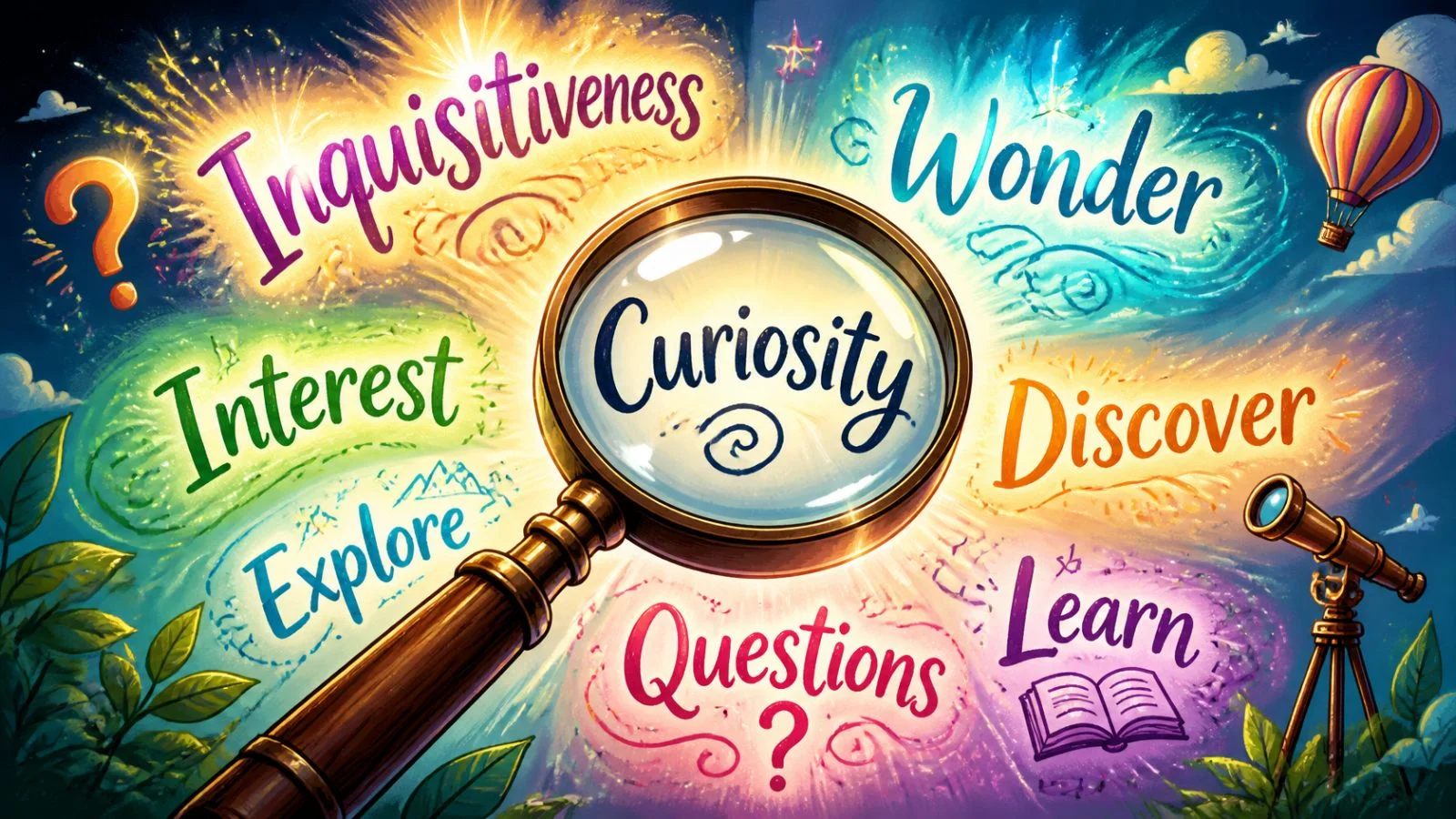
Another word for curiosity is inquisitiveness. Other common choices are interest, wonder, and fascination. The best word depends on your meaning.
Curiosity can mean a wish to learn. It can also mean nosy interest in people. It can even mean a rare object.
Pick a warm word for learning and a sharp word for prying. Pick a noun like curio for a strange thing. Each group in this guide fits a different use.
Quick list: inquisitiveness, interest, wonder, fascination, eagerness, inquiry, exploration, nosiness, curio, oddity
Below you will find 30 words with meanings, IPA, usage notes, and examples. You will also see tables, word partners, idioms, and common mistakes.
At a Glance: Curiosity Synonyms and Related Alternatives
| Alternative | Part of Speech | Meaning | Register / Tone | Ideal Context |
| Inquisitiveness | Noun | Love of asking questions | Neutral, positive | School, work, daily talk |
| Interest | Noun | Wish to know more | Neutral | Everyday speech |
| Fascination | Noun | Strong pull toward a topic | Warm | Hobbies, science |
| Wonder | Noun | Curious awe | Warm, poetic | Nature, childhood |
| Inquiry | Noun | Act of seeking facts | Formal | Research, reports |
| Eagerness | Noun | Keen wish to learn or do | Warm | Learning, new tasks |
| Nosiness | Noun | Unwanted interest in others | Informal, negative | Gossip, privacy |
| Prying | Noun | Rude questions about private things | Negative | Privacy, family |
| Curio | Noun | Small rare object | Neutral | Antiques, travel |
| Oddity | Noun | Strange person or thing | Neutral | Description, reviews |
Which Word Should You Use?
| If you want to… | Use | Why |
| Praise a love of learning | Inquisitiveness | It sounds positive and clear. |
| Keep it simple | Interest | Everyone knows it. |
| Show awe at something big | Wonder | It adds a sense of amazement. |
| Describe a deep pull to a topic | Fascination | It shows strong attention. |
| Describe formal research | Inquiry | It fits reports and studies. |
| Criticize rude questions | Nosiness | It signals unwanted interest. |
| Name a rare small object | Curio | It fits collectibles. |
| Call something strange | Oddity | It stresses what is unusual. |
Exploring the Multiple Meanings of “Curiosity”
1. Desire to Learn
- Meaning: A strong wish to know or learn something.
- Explanation: This is the most common sense. It sounds positive and fits school, work, and daily life.
- Example: Her curiosity about space made her read every book on planets.
2. Nosy Interest in Others
- Meaning: Interest in other people’s private matters.
- Explanation: This sense is often negative. Words like nosiness and prying fit it better.
- Example: Their curiosity about my salary made me feel uncomfortable.
3. An Unusual Object
- Meaning: A rare or strange thing that draws attention.
- Explanation: Here the word is a countable noun. People say “a curiosity” or “curiosities.”
- Example: The old shop was full of dusty curiosities from distant lands.
4. Strangeness or Oddity
- Meaning: The quality of being unusual or odd.
- Explanation: This sense is about the thing, not the person. It is less common today.
- Example: The curiosity of his accent made everyone turn and listen.
5. Care and Fussiness (Old Use)
- Meaning: Great care or fussiness about small details.
- Explanation: Dictionaries mark this sense as old. You will rarely see it now.
- Example: Writers of the 1600s praised a tailor’s curiosity in every stitch.
Sources: Merriam-Webster; Collins English Dictionary; Dictionary.com; Etymonline.
Analyzing 30 Curiosity Alternatives in Detail
Some words below are direct synonyms. Others are related choices that fit only one sense of curiosity.
Core Synonyms
1. Inquisitiveness
IPA: US /ɪnˈkwɪzətɪvnəs/ · UK /ɪnˈkwɪzɪtɪvnəs/
Definition: This means a habit of asking questions and wanting facts. It also shows a mind that likes to dig deeper.
- Usage: It is a direct synonym. However, it can sound slightly nosy in some cases.
- Example: His inquisitiveness made him ask the guide twenty questions.
2. Interest
IPA: (US and UK) /ˈɪntrəst/
Definition: This means a wish to know or hear more about something. It also works in almost any setting.
- Usage: It is the plainest synonym. Still, it is weaker than curiosity.
- Example: She showed real interest in how the engine worked.
3. Eagerness
IPA: US /ˈiːɡərnəs/ · UK /ˈiːɡənəs/
Definition: This means a keen wish to learn or try something. It also carries a sense of energy.
- Usage: It is a related word. For example, it fits a student who wants to start now.
- Example: The kids showed great eagerness to explore the cave.
4. Fascination
IPA: (US and UK) /ˌfæsɪˈneɪʃən/
Definition: This is a deep pull toward a subject. It also holds your attention for a long time.
- Usage: It is stronger than simple curiosity. In short, it means the topic captures you.
- Example: His fascination with birds began when he was six.
5. Wonder
IPA: US /ˈwʌndər/ · UK /ˈwʌndə/
Definition: This is a feeling of awe mixed with a wish to understand. It also fits big or beautiful things.
- Usage: It is a warm, slightly poetic word. As a result, it suits nature and childhood.
- Example: The child watched the snow fall with wide-eyed wonder.
Learning and Mind Words
6. Inquiry
IPA: US /ɪnˈkwaɪri/ · UK /ɪnˈkwaɪəri/
Definition: This is the act of asking or searching for facts. It also names a formal study.
- Usage: It is a related word, not an exact synonym. It is also more formal.
- Example: The team opened an inquiry into why the bridge cracked.
7. Investigation
IPA: (US and UK) /ɪnˌvɛstɪˈɡeɪʃən/
Definition: This is a careful search to find out facts. It also often has a goal or a case.
- Usage: It is a related word. However, it names the work, not the wish to know.
- Example: Her investigation of the old letters took many months.
8. Exploration
IPA: (US and UK) /ˌɛkspləˈreɪʃən/
Definition: This means looking into a place or idea to learn about it. It also shows curiosity in action.
- Usage: It is a related word. For example, it fits travel and science.
- Example: The class enjoyed their exploration of the tide pools.
9. Questioning
IPA: (US and UK) /ˈkwɛstʃənɪŋ/
Definition: This means asking questions to learn more. It also can show doubt.
- Usage: It is a related word. Still, it may sound sharp if the tone is hard.
- Example: Her constant questioning helped the whole team understand the plan.
10. Open-mindedness
IPA: US /ˌoʊpən ˈmaɪndɪdnəs/ · UK /ˌəʊpən ˈmaɪndɪdnəs/
Definition: This means a ready wish to hear new ideas. It also helps people learn.
- Usage: It is a related trait, not a synonym. In fact, curious people are often open-minded.
- Example: His open-mindedness made him try foods from every region.
Hunger and Thirst Words
11. Thirst
IPA: US /θɜːrst/ · UK /θɜːst/
Definition: This is a strong need for knowledge. It also adds a figurative, almost physical feel.
- Usage: Writers use it with “for knowledge.” For example, it fits a hard-working learner.
- Example: She has a thirst for knowledge that never fades.
12. Hunger
IPA: US /ˈhʌŋɡər/ · UK /ˈhʌŋɡə/
Definition: This means a deep wish for something, such as learning. It also suggests urgency.
- Usage: It is a figurative, related word. However, it needs a phrase like “hunger to learn.”
- Example: His hunger to learn kept him in the library all day.
13. Appetite
IPA: (US and UK) /ˈæpɪtaɪt/
Definition: This is a strong taste for something, such as facts. It also shows a steady need.
- Usage: It is a related word. For example, people say “an appetite for adventure.”
- Example: The students have a big appetite for new science projects.
14. Intrigue
IPA: (US and UK) /ˈɪntriːɡ/
Definition: This means a sense of interest from something mysterious. It also has a meaning of secret plans.
- Usage: Use it with care. In fact, the noun more often means a secret plot.
- Example: The odd letter filled him with intrigue about its sender.
Nosy and Prying Words
15. Nosiness
IPA: US /ˈnoʊzinəs/ · UK /ˈnəʊzinəs/
Definition: This is unwanted interest in other people’s lives. It also sounds rude.
- Usage: It is informal and negative. In short, it is curiosity that crosses a line.
- Example: Her nosiness annoyed the neighbors on the quiet street.
16. Prying
IPA: (US and UK) /ˈpraɪɪŋ/
Definition: This means asking about private things in a rude way. It also shows a lack of respect.
- Usage: It is a related, negative word. For example, people say “prying eyes.”
- Example: He locked his diary to keep out prying eyes.
17. Snooping
IPA: (US and UK) /ˈsnuːpɪŋ/
Definition: This means secretly looking into things that are not yours. It also feels sneaky.
- Usage: It is informal and negative. However, it names an act, not a feeling.
- Example: She caught her brother snooping in her room again.
18. Meddling
IPA: (US and UK) /ˈmɛdlɪŋ/
Definition: This means getting into other people’s business without a call. It also can cause trouble.
- Usage: It is a related word, not a true synonym. Still, it often follows nosiness.
- Example: Her meddling made the small quarrel much worse.
19. Intrusiveness
IPA: (US and UK) /ɪnˈtruːsɪvnəs/
Definition: This means pushing into private space or time. It also feels unwelcome.
- Usage: It is formal and related. For example, it fits questions that feel too personal.
- Example: Many users disliked the intrusiveness of the app’s questions.
Unusual Things and Qualities
20. Curio
IPA: US /ˈkjʊrioʊ/ · UK /ˈkjʊərɪəʊ/
Definition: This is a small, rare, or odd object. It also often has a collector’s value.
- Usage: It matches the “unusual object” sense only. In fact, it came from the word curiosity.
- Example: He bought a brass curio at the market in Cairo.
21. Oddity
IPA: US /ˈɑːdəti/ · UK /ˈɒdɪti/
Definition: This is a strange person, thing, or event. It also names the quality of being odd.
- Usage: It matches the object and quality senses. However, it does not mean a wish to know.
- Example: The two-headed coin was a real oddity.
22. Rarity
IPA: US /ˈrɛrəti/ · UK /ˈreərɪti/
Definition: This is something hard to find. It also can mean the fact of being scarce.
- Usage: It is a related word. For example, it fits coins, stamps, and old books.
- Example: That first edition is a true rarity.
23. Novelty
IPA: US /ˈnɑːvlti/ · UK /ˈnɒvlti/
Definition: This means something new and unusual. It also names the charm of newness.
- Usage: It is a related word. Still, a novelty may fade fast.
- Example: The talking robot was a novelty at the fair.
24. Marvel
IPA: US /ˈmɑːrvəl/ · UK /ˈmɑːvəl/
Definition: This is something that fills you with awe. It also suggests great skill or beauty.
- Usage: It is a related word for amazing things. However, it is stronger than curiosity.
- Example: The new bridge is a marvel of design.
25. Peculiarity
IPA: US /pɪˌkjuːliˈɛrəti/ · UK /pɪˌkjuːliˈærɪti/
Definition: This is an odd trait that sets a thing apart. It also can mean a habit.
- Usage: It fits the “oddity” sense of curiosity. For example, people use it for quirks.
- Example: One peculiarity of the town is its silent clock tower.
26. Strangeness
IPA: (US and UK) /ˈstreɪndʒnəs/
Definition: This is the quality of being unusual or hard to explain. It also can feel a little uneasy.
- Usage: It matches the “oddity” sense. In short, it is about the thing itself.
- Example: The strangeness of the empty house made her shiver.
Keenness and Older Senses
27. Keenness
IPA: (US and UK) /ˈkiːnnəs/
Definition: This is a sharp, strong interest in something. It also shows a quick mind.
- Usage: It is a related word. For example, it fits a keenness to learn.
- Example: His keenness to learn impressed every teacher he met.
28. Zeal
IPA: (US and UK) /ziːl/
Definition: This means great energy for a goal or cause. It also can sound strong or formal.
- Usage: It is a related word, not a synonym. However, it can describe a hunt for truth.
- Example: She studied the stars with great zeal.
29. Enthusiasm
IPA: US /ɪnˈθuːziæzəm/ · UK /ɪnˈθjuːziæzəm/
Definition: This is a strong, happy interest in an activity. It also spreads to other people.
- Usage: It is a related word. Still, it shows joy more than a wish to know.
- Example: Her enthusiasm for the project lifted the whole team.
30. Fastidiousness
IPA: (US and UK) /fæˈstɪdiəsnəs/
Definition: This means great care about small details. It also can mean being hard to please.
- Usage: It matches only the old sense of curiosity. In fact, you will rarely see this link today.
- Example: The tailor’s fastidiousness showed in every perfect stitch.
Sources: Merriam-Webster; Collins English Dictionary and Thesaurus; Dictionary.com; Etymonline.
Curiosity vs. Interest vs. Inquisitiveness vs. Nosiness
These four words overlap. Their tone and target are different.
| Word | Core idea | Tone | Example |
| Curiosity | Wish to know or learn | Neutral to positive | Her curiosity led her to the lab. |
| Interest | Mild attention | Neutral | He has an interest in jazz. |
| Inquisitiveness | Habit of asking questions | Positive, sometimes pushy | The child’s inquisitiveness charmed us. |
| Nosiness | Unwanted focus on others | Negative | Their nosiness upset her. |
Think of it as a scale. Interest is mild. Curiosity is stronger. Inquisitiveness is a habit. Nosiness goes too far.
Sources: Merriam-Webster; Collins English Dictionary; Dictionary.com.
Curiosity and Opposite/Paired Word Pairs
| Word | Paired Word | Note |
| Curiosity | Indifference | The clearest opposite. It means no wish to know. |
| Curiosity | Apathy | Stronger than indifference. It means a lack of feeling. |
| Curiosity | Boredom | A state of low interest. It often follows a lack of curiosity. |
| Curiosity | Disinterest | A formal opposite. It means no interest in a topic. |
| Curiosity | Caution | A contrast, not an opposite. The cat proverb uses it. |
Curiosity has one main opposite, which is a lack of interest. The word incurious also exists as an adjective. Caution is not a true antonym, but writers often set it against curiosity.
Sources: Merriam-Webster; Collins Thesaurus; Dictionary.com.
Common Word Partners of “Curiosity”
| Pattern | Common Partners | Example |
| Verb + curiosity | arouse, satisfy, spark, pique, feed | The trailer sparked my curiosity. |
| Adjective + curiosity | idle, natural, burning, morbid, intellectual | She has a natural curiosity about people. |
| Preposition + curiosity | out of, with, full of | He looked inside out of curiosity. |
| Curiosity + about | curiosity about, curiosity regarding | Kids show curiosity about everything. |
| A + curiosity | a curiosity, curiosities | The stone was a curiosity in the museum. |
Sources: Collins English Dictionary; Merriam-Webster; Oxford Learner’s Dictionaries.
Idiomatic Phrases Featuring “Curiosity”
Only the first item below is a true idiom. The others are strong, fixed expressions.
1. Curiosity killed the cat
- Meaning: This proverb warns that asking too many questions can bring harm.
- Example: “Don’t open that box,” she said. “Curiosity killed the cat.”
2. Out of curiosity
- Meaning: This means for no reason except wanting to know.
- Example: I checked the price just out of curiosity.
3. Pique someone’s curiosity
- Meaning: This means to make someone more interested.
- Example: The strange sign piqued my curiosity at once.
4. Idle curiosity
- Meaning: This means interest with no real purpose.
- Example: He asked about her trip from idle curiosity.
Sources: Merriam-Webster; Collins English Dictionary; Cambridge Dictionary.
Word Formation of “Curiosity”
Etymology and Structure
The word comes from Old French curiosité. That came from Latin curiositas, from curiosus, which means “careful” or “inquisitive.” The root is Latin cura, which means “care.” The word has the base curious and the suffix -ity.
Date and History
Etymonline places the word in English in the late 1300s. Early senses leaned toward care and fussiness. The “wish to know” sense grew later, and the “strange object” sense followed.
Word Class Variations
- Noun: curiosity, curiosities, curiousness (rare), curio
- Adjective: curious, incurious
- Adverb: curiously
Curio is a shortened form of curiosity. English has no common verb form.
Sources: Etymonline; Merriam-Webster; Collins English Dictionary.
Common Word-Choice Mistakes
- She is very curious: She is very curious.
- Nosiness about art: Interest in art.
- Curiosity for the news: Curiosity about the news.
- I did it by curiosity: I did it out of curiosity.
- Curious killed the cat: Curiosity killed the cat.
- He has a curiosity of people: He has a curiosity about people.
- A prying student loves science: A curious student loves science.
Frequently Asked Questions
What is the closest synonym for curiosity?
The closest synonym is inquisitiveness. Interest is a simpler and milder choice.
What is a formal word for curiosity?
Inquisitiveness and inquiry both sound formal. Writers use them in reports and essays.
What is a poetic word for curiosity?
Wonder and thirst both sound poetic. For example, you can write “a thirst for knowledge.”
What is a negative word for curiosity?
Nosiness and prying are negative. They mean interest in private matters.
What is the opposite of curiosity?
The opposite is indifference. Apathy and disinterest also work.
Can curiosity mean an object?
Yes. A curiosity can be a rare or strange thing. Curio is a short form.
What is the difference between curiosity and interest?
Interest is milder. Curiosity often drives you to ask questions or look deeper.
Is curiosity good or bad?
It is usually good. However, it can feel rude when it targets private matters.
Is curiosity the same as inquisitiveness?
Not quite. Inquisitiveness is a habit of asking questions, while curiosity can be a single wish to know.
Can you use curiosity for people?
Yes, in two ways. A person can have curiosity, and a person can also be “a curiosity” if others find them unusual.
Conclusion
The closest words for curiosity are inquisitiveness, interest, wonder, and fascination. They fit most daily uses. Each one has its own tone.
Context shapes the best choice. Use nosiness or prying for rude interest. Use curio or oddity for strange things. Use thirst or hunger for a deep wish to learn.
To choose well, ask three questions. What do you mean? Who is the target? How strong is the feeling? The answers will point you to the right word.

Olivia Martin is a passionate writer who enjoys exploring English vocabulary, synonyms, and language tips to help readers improve their writing skills.
At PressivoMedia.com, Olivia shares helpful language resources and easy-to-understand content to make communication clearer and more effective.