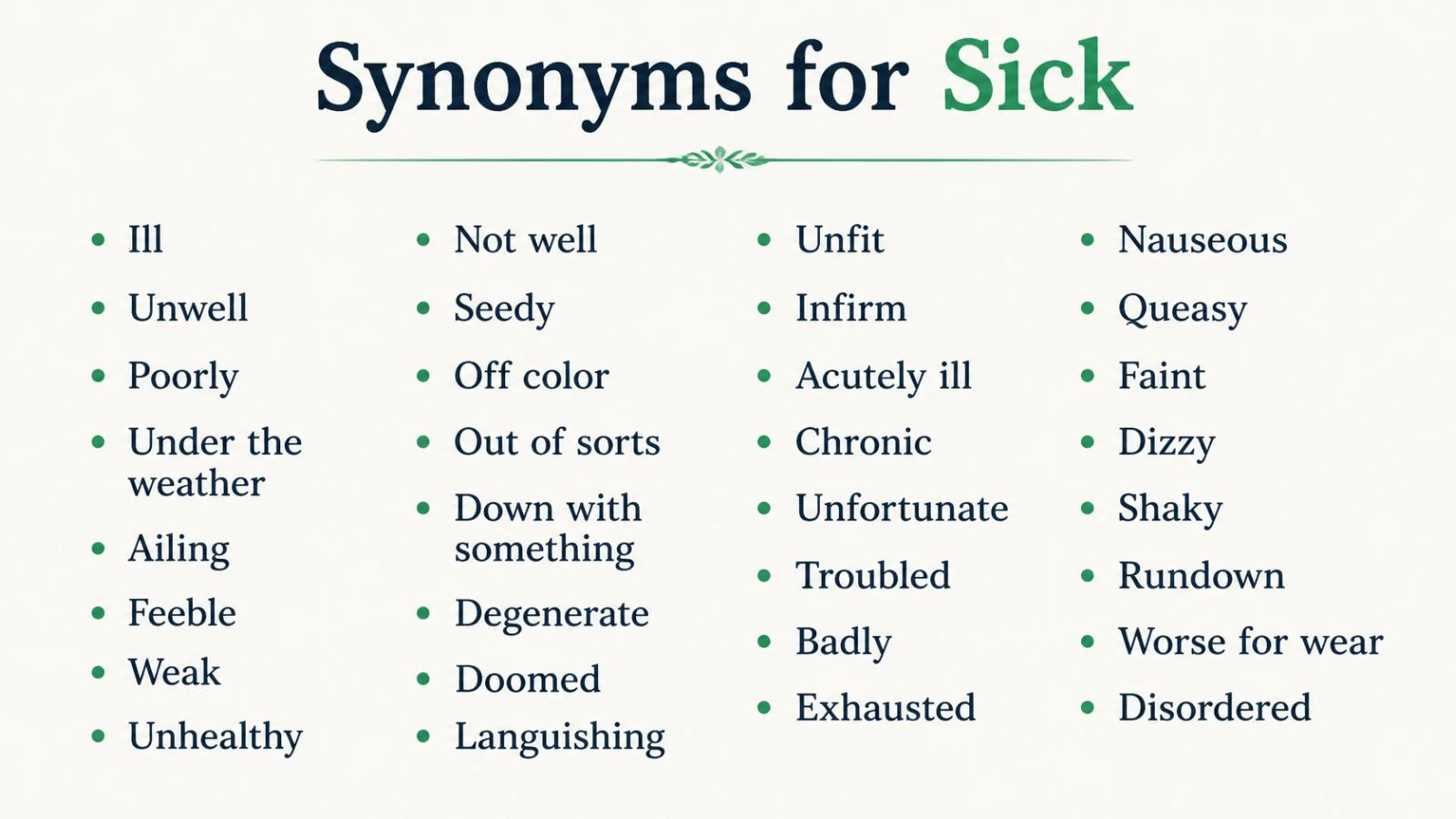
The closest everyday words for sick are ill and unwell they fit most cases of poor health. Poorly, ailing, and run-down also work in the right setting.
The best choice depends on meaning and context. Sick can mean unwell, queasy, fed up, or cruel in humor. Each sense has its own set of better words.
Quick list: ill, unwell, poorly, ailing, nauseous, queasy, run-down, fed up, disgusted, morbid
This article looks at 30 alternatives. Each one has a meaning, IPA, a usage note, and an example. You will also see which words are direct synonyms and which are only related.
At a Glance: Sick Synonyms and Related Alternatives
| Alternative | Part of Speech | Meaning | Register / Tone | Ideal Context |
| Ill | Adjective | Not in good health | Neutral | General health talk |
| Unwell | Adjective | Not feeling right | Polite | Work emails, notes |
| Poorly | Adjective | Sick, often mildly | Casual, British | Family and friends |
| Ailing | Adjective | Weak from ongoing illness | Formal | News, writing |
| Nauseous | Adjective | Ready to vomit | Neutral | Travel, stomach upset |
| Queasy | Adjective | Mildly sick in the stomach | Casual | Boats, smells, rides |
| Run-down | Adjective | Tired and in weak health | Casual | Stress, lack of rest |
| Fed up | Adjective | Tired of something | Casual | Complaints |
| Disgusted | Adjective | Upset by something nasty | Neutral | Strong dislike |
| Morbid | Adjective | Too focused on death | Neutral | Dark humor, thoughts |
Which Word Should You Use?
| If you want to… | Use | Why |
| Say you are not well, politely | Unwell | It sounds calm and gives no details. |
| Talk about general illness | Ill | It is clear and works almost everywhere. |
| Describe a sick child in a kind way | Poorly | It sounds gentle and caring. |
| Describe a stomach upset | Queasy | It points to the stomach, not the whole body. |
| Say you are tired of something | Fed up | It matches “sick of” in meaning. |
| Show strong dislike | Disgusted | It shows a strong reaction. |
| Describe dark humor | Morbid | It fits jokes about death. |
| Write about long illness | Ailing | It suggests weakness over time. |
Exploring the Multiple Meanings of “Sick”
1. Not Well in the Body
- Meaning: Sick means not in good health. It often points to a cold, flu, or other illness.
- Explanation: This is the main sense of the word. It fits people, pets, and plants.
- Example: My sister stayed home because she was sick with a cold.
2. Feeling Ready to Vomit
- Meaning: Sick can mean ready to throw up.
- Explanation: In British English, being sick often means vomiting. In American English, feeling sick means you have nausea.
- Example: The bumpy bus ride made him feel sick.
3. Fed Up or Disgusted
- Meaning: Sick can mean tired of something or upset by it.
- Explanation: People say “sick of” or “sick and tired of” in this sense. It can also show disgust.
- Example: I am sick of waiting for this slow train.
4. Dark or Cruel Humor
- Meaning: Sick can describe jokes or ideas that are cruel or morbid.
- Explanation: The word shows shock or disapproval. Some people also use it as a joking label.
- Example: He told a sick joke, and nobody in the room laughed.
5. Slang for Excellent
- Meaning: In young people’s slang, sick can mean very cool.
- Explanation: This sense is informal. It depends on the tone, so use it with friends.
- Example: Did you see that sick trick he did on his board?
6. Weak or Not Working Well
- Meaning: Sick can describe a business or system in poor shape.
- Explanation: Writers use it in phrases like “a sick economy.” This sense is figurative.
- Example: Experts said the sick company needed help to survive.
Sources: Merriam-Webster, Collins Dictionary, Dictionary.com, Cambridge Dictionary.
Analyzing 30 Sick Alternatives in Detail
Some alternatives below are direct synonyms. Others are related words that fit only one sense of sickness.
Core Synonyms
1. Ill
IPA: /ɪl/ (US and UK)
Definition: Ill means not in good health. It also shows up in the phrase “ill health.”
- Usage: Ill is the closest match to sick. However, in British English people often use it after a verb.
- Example: My brother stayed home because he felt ill all morning.
2. Unwell
IPA: /ʌnˈwɛl/ (US and UK)
Definition: Unwell means a little sick or not feeling right. It also sounds polite and calm.
- Usage: Unwell is softer than sick. For example, a boss may write, “She is unwell today.”
- Example: Our teacher looked pale and said she felt unwell.
3. Poorly
IPA: US /ˈpʊrli/ · UK /ˈpɔːli/
Definition: Poorly means sick, mostly in British English. It also fits small children well.
- Usage: Poorly is kind and light in tone. However, many Americans use it only as an adverb.
- Example: The baby is poorly today, so we stayed in bed.
4. Ailing
IPA: /ˈeɪlɪŋ/ (US and UK)
Definition: Ailing means weak from a long illness. It also fits things that are failing.
- Usage: Ailing is a bit formal. In fact, writers often use it for firms or the economy.
- Example: She visited her ailing grandfather every Sunday afternoon.
5. Sickly
IPA: /ˈsɪkli/ (US and UK)
Definition: Sickly means often ill or looking weak. It also can mean nasty, like a smell.
- Usage: Sickly is a related word, not an exact match. In fact, it shows a long habit of poor health.
- Example: He was a sickly child who missed many days of school.
Formal and Medical Alternatives
6. Infirm
IPA: US /ɪnˈfɜrm/ · UK /ɪnˈfɜːm/
Definition: Infirm means weak in body, often from age. It also suggests a slow decline.
- Usage: Infirm is a related word, not a direct synonym. However, it fits old age better than a quick cold.
- Example: The nurse helped the infirm man walk to his chair.
7. Indisposed
IPA: US /ˌɪndɪˈspoʊzd/ · UK /ˌɪndɪˈspəʊzd/
Definition: Indisposed means too sick to do something. It also can sound like a polite excuse.
- Usage: Indisposed is formal and a bit old-fashioned. For example, a host might use it to avoid details.
- Example: The singer was indisposed, so her understudy took the stage.
8. Diseased
IPA: /dɪˈziːzd/ (US and UK)
Definition: Diseased means hurt by a disease. It also fits plants, trees, and body parts.
- Usage: Diseased is a related word, not a direct synonym. Still, people rarely use it for mild colds.
- Example: The gardener cut down the diseased tree before spring.
9. Afflicted
IPA: /əˈflɪktɪd/ (US and UK)
Definition: Afflicted means hit hard by pain or illness. It also can mean troubled by a problem.
- Usage: Afflicted is a related word. For example, people say “afflicted with asthma.”
- Example: A harsh fever afflicted many people in the village.
10. Bedridden
IPA: /ˈbɛdˌrɪdn/ (US and UK)
Definition: Bedridden means too sick or weak to leave bed. It also suggests a long stay.
- Usage: Bedridden is a related word, not a plain synonym. In fact, it shows how bad the illness is.
- Example: The flu left her bedridden for nearly a week.
Nausea and Upset Stomach Alternatives
11. Nauseous
IPA: US /ˈnɔʃəs/ · UK /ˈnɔːsiəs/
Definition: Nauseous means feeling like you may vomit. It also can mean causing that feeling.
- Usage: Nauseous matches one’s sense of sickness. However, some writers prefer “nauseated” for the feeling.
- Example: The curvy mountain road made me feel nauseous.
12. Queasy
IPA: /ˈkwiːzi/ (US and UK)
Definition: Queasy means a little sick in the stomach. It also can show unease about something.
- Usage: Queasy is milder than nauseous. For example, it fits a boat ride or a bad smell.
- Example: The smell from the kitchen made her feel queasy.
13. Nauseated
IPA: US /ˈnɔziˌeɪtɪd/ · UK /ˈnɔːsieɪtɪd/
Definition: Nauseated means feeling the urge to vomit. It also fits strong disgust.
- Usage: Nauseated is a close match to feeling sick in the stomach. In fact, doctors often use it.
- Example: The strong odor left him nauseated for an hour.
14. Bilious
IPA: /ˈbɪljəs/ (US and UK)
Definition: Bilious means sick with a bad stomach, in an old sense. It also can mean grumpy.
- Usage: Bilious is a rare, related word, not a direct synonym. Still, writers use it for gloomy moods.
- Example: After the rough crossing, the captain looked bilious and pale.
15. Peaky
IPA: /ˈpiːki/ (US and UK)
Definition: Peaky means pale and a bit unwell. It also suggests low energy.
- Usage: Peaky is informal British English. For example, a friend might say, “You look peaky.”
- Example: You look a bit peaky, so please rest today.
Informal and Everyday Alternatives
16. Crook
IPA: /krʊk/ (US and UK)
Definition: Crook means ill, mainly in Australian and New Zealand speech. It also sounds casual.
- Usage: Crook is regional slang for sickness. However, many readers outside Australia may not know it.
- Example: I stayed home because I felt crooked all day.
17. Laid up
IPA: /ˌleɪd ˈʌp/ (US and UK)
Definition: Laid up means stuck in bed or at home. It also can come from an injury.
- Usage: Laid up is a related phrase, not a direct synonym. For example, a broken leg can leave you laid up.
- Example: He was laid up with the flu all weekend.
18. Run-down
IPA: /ˌrʌn ˈdaʊn/ (US and UK)
Definition: Run-down means tired and in poor health. It also suggests your body needs rest.
- Usage: Run-down is a related word, not an exact match. In fact, it often shows up before a cold.
- Example: I felt run-down after weeks of late nights.
19. Rough
IPA: /rʌf/ (US and UK)
Definition: Rough, in casual speech, means feeling bad or unwell. It also can mean having a hard day.
- Usage: Rough is informal and often follows “feel” or “look.” For example, “You look rough today.”
- Example: I felt rough this morning, so I skipped breakfast.
20. Lousy
IPA: /ˈlaʊzi/ (US and UK)
Definition: Lousy means feeling poor or unwell in casual talk. It also can mean low quality.
- Usage: Lousy is informal and strong. However, it tells you little about the cause.
- Example: I feel lousy, so I am going to bed early.
Disgusted and Fed Up Alternatives
21. Disgusted
IPA: /dɪsˈɡʌstɪd/ (US and UK)
Definition: Disgusted means very upset by something unpleasant. It also shows strong dislike.
- Usage: Disgusted matches the angry sense of sickness. However, it never means ill in the body.
- Example: She felt disgusted by the dirty state of the kitchen.
22. Revolted
IPA: US /rɪˈvoʊltɪd/ · UK /rɪˈvəʊltɪd/
Definition: Revolted means filled with strong disgust. It also is the past form of “revolt.”
- Usage: Revolted is a related word and stronger than disgusted. For example, rotten food can leave you revolted.
- Example: The rotten smell left everyone in the room revolted.
23. Fed up
IPA: /ˌfɛd ˈʌp/ (US and UK)
Definition: Fed up means tired of something and annoyed. It also shows you have had enough.
- Usage: Fed up matches “sick of” in meaning. In fact, “fed up with” is very common.
- Example: I am fed up with this noisy traffic.
24. Weary
IPA: US /ˈwɪri/ · UK /ˈwɪəri/
Definition: Weary means tired in body or mind. It also can mean being bored with something.
- Usage: Weary is a related word, not an exact match. For example, “weary of waiting” is close to “sick of waiting.”
- Example: She grew weary of the long, slow meeting.
25. Appalled
IPA: US /əˈpɔld/ · UK /əˈpɔːld/
Definition: Appalled means shocked and upset by something bad. It also shows deep dismay.
- Usage: Appalled is a related word for the shocked sense of sickness. However, it carries no sense of illness.
- Example: The cruel remark left the whole room appalled.
Dark Humor and Twisted Taste Alternatives
26. Morbid
IPA: US /ˈmɔrbɪd/ · UK /ˈmɔːbɪd/
Definition: Morbid means too interested in death or dark things. It also can mean disease in medical use.
- Usage: Morbid fits “sick humor” in a mild way. Still, it is a related word, not an exact synonym.
- Example: Their morbid jokes about funerals made the guests uneasy.
27. Macabre
IPA: US /məˈkɑbrə/ · UK /məˈkɑːbrə/
Definition: Macabre means strange and scary in a way linked to death. It also suits dark art.
- Usage: Macabre is a related word. For example, people say “a macabre tale” or “a macabre sense of humor.”
- Example: The museum showed a macabre painting of a skeleton dance.
28. Twisted
IPA: /ˈtwɪstɪd/ (US and UK)
Definition: Twisted, in casual use, means odd and cruel in thought. It also can mean bent out of shape.
- Usage: Twisted is a close match to sick in a phrase like “sick mind.” However, it is a strong word.
- Example: The villain in the film had a twisted sense of humor.
29. Ghoulish
IPA: /ˈɡuːlɪʃ/ (US and UK)
Definition: Ghoulish means pleased by death or suffering. It also fits grim, scary jokes.
- Usage: Ghoulish is a related word and stronger than morbid. In fact, it feels harsh in everyday conversation.
- Example: The ghoulish crowd gathered to stare at the crash.
30. Gruesome
IPA: /ˈɡruːsəm/ (US and UK)
Definition: Gruesome means so horrible that it shocks you. It also fits harsh scenes of blood or pain.
- Usage: Gruesome is a related word, not a synonym. For example, a gruesome joke is very dark.
- Example: The film had a gruesome scene that made me look away.
Sources: Merriam-Webster, Collins Dictionary / Collins Thesaurus, Dictionary.com, Cambridge Dictionary.
Sick vs. Ill vs. Unwell: Which Is Best?
These three words overlap a lot. Still, they differ in tone and use. Region also plays a part.
| Word | Typical Use | Example |
| Sick | Common in American English, often before a noun | “A sick child needs rest.” |
| Ill | Often after a verb, more common in British English | “My uncle is ill.” |
| Unwell | Polite and neutral | “I feel unwell today.” |
| Poorly | Casual and British | “Mum is poor.” |
In British English, “be sick” often means to vomit. So “I was ill” is a safer choice when you mean illness. In American English, “I was sick” works well for both.
Sources: Collins Dictionary, Cambridge Dictionary, Merriam-Webster.
Sick and Opposite/Paired Word Pairs
| Word | Paired Word | Note |
| Sick | Healthy | The most common opposite for body health. |
| Sick | Well | It is common in speech and in phrases like “get well.” |
| Ill | Fit | Fit is common in British English. |
| Sickly | Robust | Robust means strong and healthy. |
| Fed up | Content | Content means being happy with things. |
| Disgusted | Delighted | Both show a strong reaction. |
| Morbid | Cheerful | Cheerful is the opposite in mood. |
| Sickness | Health | Both appear in “in sickness and in health.” |
Opposites for sickness depend on the sense. Healthy and well fit. Content and cheerful fit the mood senses.
Sources: Merriam-Webster, Collins Thesaurus, Dictionary.com.
Common Word Partners of “Sick”
| Pattern | Common Partners | Example |
| Verb + sick | feel, get, fall, call in, make someone | I felt sick after the long ride. |
| sick + noun | leave, day, note, bay, joke, child | She took a sick day on Monday. |
| sick + preposition | of, with, to | I am sick of this noise. |
| Adverb + sick | very, terribly, seriously | He was seriously sick last winter. |
| Adjective + sick | worried, homesick, seasick | We were worried sick about her. |
| off sick | off sick (mostly British) | Tom is off sick this week. |
Sources: Collins Dictionary, Cambridge Dictionary, Merriam-Webster.
Idiomatic Phrases Featuring “Sick”
1. Sick as a dog
- Meaning: Very ill, often with vomiting.
- Example: I was sick as a dog after the picnic.
2. Sick and tired
- Meaning: Fed up with something and ready for it to stop.
- Example: She is sick and tired of the constant delays.
3. Worried sick
- Meaning: Very worried, so much that you feel unwell.
- Example: We were worried sick when you did not call.
4. Sick as a parrot
- Meaning: Very disappointed. People use it mostly in British English.
- Example: He was sick as a parrot when the team lost.
Sources: Merriam-Webster, Collins Dictionary, Cambridge Dictionary.
Word Formation of “Sick”
Etymology & Structure
Sick is a short base word with one syllable. It comes from Old English seoc. Similar words exist in other Germanic languages, such as Dutch ziek and German siech.
Date and History
The word appears in Old English as seoc. It first meant ill or weak. Other senses, such as fed up and dark humor, grew later.
Word Class Variations
- Adjective: sick, sickly, sickening
- Noun: sickness, sickbed, “the sick” (people who are ill)
- Verb: sicken (to make or become ill or disgusted)
- Adverb: sickly (as in “sickly sweet”)
- Compounds: seasick, homesick, lovesick
Sources: Etymonline, Merriam-Webster, Collins Dictionary.
Common Word-Choice Mistakes
- “I am nauseous of this noise”: “I am sick of this noise.”
- “He was sick yesterday” (British, meaning ill): “He was ill yesterday.”
- “An ill child” before a noun: “A sick child.”
- “I am poor today” in American English: “I am sick today.”
- “I feel queasy on the boat”: “I feel queasy on the boat.”
- “A sick leave day”: “A sick day” or “sick leave.”
- “I am disgusted with a cold”: “I am sick with a cold.”
Frequently Asked Questions
What is the closest synonym for sick?
Ill is the closest synonym. Unwell is also a very good choice.
What is a polite word for sick?
Unwell is polite and calm. It works well in emails and notes.
What is the difference between sick and ill?
They mean almost the same. Ill is more common after a verb, and sick is more common before a noun.
What is a formal alternative to sickness?
Indisposed and ailing are formal choices. Both sound more serious than sick.
What word means sick to your stomach?
Nauseous, nauseated, and queasy fit best. Queasy is the mildest of the three.
What word means sick of something?
Fed up is the closest match. Weary also works in some cases.
What is a word for a sick joke?
Morbid, macabre, and twisted all fit. Ghoulish is stronger and harsher.
What is the opposite of sick?
Healthy and well are the main opposites. Fit is common in British English.
Does sick mean vomit?
In British English, “be sick” often means to vomit. In American English, it usually means feeling ill.
Can sick mean cool?
Yes, in informal slang it can. Use it only with friends and in casual talk.
Conclusion
Ill and unwell are the closest everyday words for sick. Poorly, ailing, and run-down add shades of tone and time. Nauseous and queasy fit the stomach sense.
Context matters most. Sick can mean ill, fed up, or dark in humor. So a word that fits one sense may not fit another.
Start by asking what you want to say. Then pick the word that matches that sense. Use the tables and examples above to choose with care.

Emily Davis is a passionate writer who enjoys exploring English vocabulary, synonyms, and language tips to help readers improve their communication skills.
At PressivoMedia.com, she focuses on creating simple, engaging, and informative content that makes learning English easier and more enjoyable.