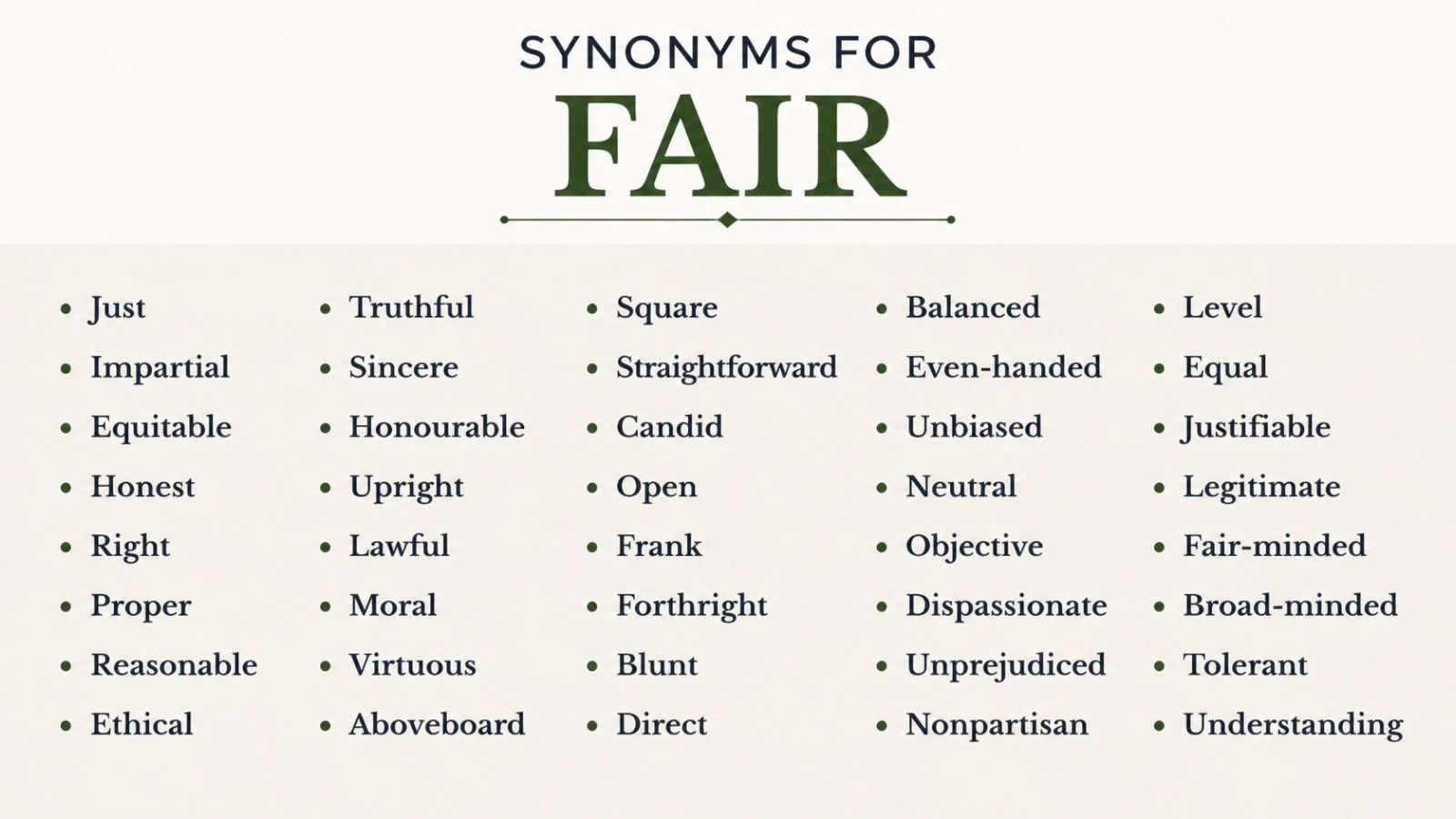
Another word for fair is just, honest, or reasonable. These words fit the most common sense of fair, which is right and equal treatment. For average quality, decent and adequate also work well.
The best choice depends on the meaning you need. Fair can talk about justice, average quality, weather, light skin, or beauty. So the right word changes with the sentence.
Quick list: just, impartial, even-handed, unbiased, equitable, reasonable, decent, adequate, sunny, pale
This article looks at 30 alternatives. Each one has a meaning, IPA, a usage note, and an example. You will also see which senses of fair each word can replace.
At a Glance: Fair Synonyms and Related Alternatives
| Alternative | Part of Speech | Meaning | Register / Tone | Ideal Context |
| Just | Adjective | Right and fair | Formal | Law, ethics, rulings |
| Impartial | Adjective | Not taking sides | Formal | Judges, referees, reports |
| Equitable | Adjective | Fair in sharing | Formal | Policy, money, law |
| Honest | Adjective | Truthful and open | Neutral | Deals, prices, people |
| Reasonable | Adjective | Sensible, not too much | Neutral | Prices, requests |
| Decent | Adjective | Good enough | Informal | Quality, everyday review |
| Adequate | Adjective | Enough for a need | Formal | Reports, grades |
| Clear | Adjective | Free from clouds | Neutral | Weather |
| Pale | Adjective | Light in color | Neutral | Skin tone |
| Lovely | Adjective | Very pleasing | Warm | Looks, places, days |
Which Word Should You Use?
| If you want to… | Use | Why |
| Describe a judge or referee | Impartial | It means no side is favored. |
| Describe a fair split of money | Equitable | It stresses balance in sharing. |
| Describe a fair price | Reasonable | It means the cost is sensible. |
| Say a result is okay | Decent | It sounds natural and a little warm. |
| Write a school or work report | Satisfactory | It sounds official and clear. |
| Describe good weather | Clear or sunny | Both show a dry, bright sky. |
| Describe light hair | Blond | It names hair color directly. |
| Write in a poetic way | Lovely or comely | Both match the old sense of beautiful. |
Exploring the Multiple Meanings of “Fair”
1. Just and Equal Treatment
- Meaning: Treating people in a right way, with no unfair favor.
- Explanation: This is the most common sense. It also works as an adverb, as in “play fair.”
- Example: It is not fair to blame her for the mistake.
2. Average or Fairly Good
- Meaning: Neither poor nor excellent.
- Explanation: It sits between poor and good. It can also mean fairly large, as in “a fair amount.”
- Example: My French is only fair, so I speak slowly.
3. Clear and Dry Weather
- Meaning: Bright, with few clouds and no rain.
- Explanation: Weather reports use this sense. Sailors also use it for good winds.
- Example: Tomorrow looks fair, so we will hold the picnic outside.
4. Light in Skin or Hair
- Meaning: Having a pale skin tone or light hair.
- Explanation: This sense talks about color only. It does not judge looks.
- Example: Her fair skin burns quickly in strong sun.
5. Beautiful, in an Old or Poetic Way
- Meaning: Pleasing to see.
- Explanation: This sense is now rare. Poems and old stories still use it.
- Example: The poem praised the fair maiden of the valley.
6. A Market or Show (Noun)
- Meaning: An event with stalls, rides, or displays.
- Explanation: This noun has a different origin from the adjective. It also sounds the same.
- Example: We rode the Ferris wheel at the county fair.
Sources: Merriam-Webster; Collins English Dictionary; Dictionary.com; Etymonline
Analyzing 30 Fair Alternatives in Detail
Some alternatives below are direct synonyms. Others are related words that fit only one sense of fair.
Just and Impartial Alternatives
1. Just
IPA: /dʒʌst/ (US and UK)
Definition: Just means right and fair under a rule or moral law. It also fits rulings and punishments.
- Usage: This is the closest match for the “right” sense of fair. However, it sounds formal in daily talk.
- Example: The judge gave a just ruling after hearing both sides.
2. Impartial
IPA: US /ɪmˈpɑːrʃəl/ · UK /ɪmˈpɑːʃəl/
Definition: Impartial means not taking one side. It also shows that a person has no stake in the result.
- Usage: Use it for judges, referees, and reports. In fact, it is a strong match for fair.
- Example: The referee stayed impartial during the whole heated match.
3. Even-handed
IPA: /ˌiːvənˈhændɪd/ (US and UK)
Definition: Even-handed means treating each side the same way. It also suggests calm, steady judgment.
- Usage: People use it for leaders and teachers. However, it is less common in speech than fair.
- Example: The teacher was even-handed when she settled the argument.
4. Unbiased
IPA: /ʌnˈbaɪəst/ (US and UK)
Definition: Unbiased means free from a fixed lean for or against something. It also suits news, advice, and tests.
- Usage: It is a plain synonym of fair in the sense of “no bias.” For example, you can say an unbiased review.
- Example: She wanted unbiased advice before she bought the house.
5. Equitable
IPA: /ˈɛkwɪtəbəl/ (US and UK)
Definition: Equitable means fair in a way that gives each person what they need. It also stresses balance in sharing.
- Usage: This word is formal. In fact, it often appears in law and money.
- Example: The two partners agreed on an equitable split of the profits.
6. Objective
IPA: /əbˈdʒɛktɪv/ (US and UK)
Definition: Objective means based on facts, not feelings. It also describes a view free of personal taste.
- Usage: This is a related alternative, not an exact synonym. However, it works well for fair reports.
- Example: A good reviewer gives an objective view of the film.
7. Balanced
IPA: /ˈbælənst/ (US and UK)
Definition: Balanced means giving each side its proper share of attention. It also shows a view with no strong lean.
- Usage: This is a related alternative. For example, people say a balanced report.
- Example: The article gave a balanced look at both sides of the debate.
Honest and Sporting Alternatives
8. Honest
IPA: US /ˈɑːnɪst/ · UK /ˈɒnɪst/
Definition: Honest means telling the truth and not cheating. It also fits people who play by the rules.
- Usage: Honest is related, not an exact synonym. Still, it works for fair dealing.
- Example: He gave me an honest price for the old car.
9. Sporting
IPA: US /ˈspɔːrtɪŋ/ · UK /ˈspɔːtɪŋ/
Definition: Sporting means polite and fair when you play or compete. It also shows kindness to a rival.
- Usage: This word is a good choice for games. However, it feels a little dated.
- Example: It was sporting of her to praise the winner.
10. Above-board
IPA: US /əˌbʌv ˈbɔːrd/ · UK /əˌbʌv ˈbɔːd/
Definition: Above-board means open and honest, with nothing hidden. It also shows that people followed the rules.
- Usage: Use it for deals and money matters. In short, it means fair and open.
- Example: The contract looked above-board to everyone who read it.
11. Reasonable
IPA: /ˈriːzənəbəl/ (US and UK)
Definition: Reasonable means sensible and not too much. It also fits prices, offers, and demands.
- Usage: This word suits prices and requests. For example, a fair price is often a reasonable price.
- Example: The shop charged a reasonable price for the repair.
Average and Moderate Alternatives
12. Decent
IPA: /ˈdiːsənt/ (US and UK)
Definition: Decent means good enough and often a little better. It also shows a fair level of quality.
- Usage: It matches the “average” sense of fair. However, it sounds warmer and more positive.
- Example: We found a decent hotel near the train station.
13. Acceptable
IPA: /əkˈsɛptəbəl/ (US and UK)
Definition: Acceptable means good enough to be allowed. It also shows that something meets the basic need.
- Usage: This is a fair match for “not bad.” Still, it sounds cooler than decent.
- Example: Her essay was acceptable but needed a stronger ending.
14. Passable
IPA: US /ˈpæsəbəl/ · UK /ˈpɑːsəbəl/
Definition: Passable means just good enough to pass. It also hints that the result is not great.
- Usage: It is close to fair in the sense of “so-so.” However, it can sound harsh.
- Example: The soup was passable, but it needed more salt.
15. Adequate
IPA: /ˈædɪkwət/ (US and UK)
Definition: Adequate means enough for a need. It also shows that the quality is fine but not special.
- Usage: This is a formal match for fair as “average.” For example, you may see it on school reports.
- Example: His savings were adequate for a short trip abroad.
16. Middling
IPA: /ˈmɪdlɪŋ/ (US and UK)
Definition: Middling means of medium size or quality. It also hints at results that are neither bad nor good.
- Usage: This word is a little old. However, it lives on in “fair to middling.”
- Example: The film earned middling reviews from most critics.
17. Satisfactory
IPA: /ˌsætɪsˈfæktəri/ (US and UK)
Definition: Satisfactory means good enough to meet a need. It also fits grades and test results.
- Usage: It is a formal match for fair as “average.” Teachers also use it in reports.
- Example: The inspector found the repair work satisfactory and signed the form.
18. Tolerable
IPA: US /ˈtɑːlərəbəl/ · UK /ˈtɒlərəbəl/
Definition: Tolerable means bearable or fairly good. It also shows that you accept something with little joy.
- Usage: This is a weak match for fair. For example, you might call a meal tolerable.
- Example: The heat was tolerable once we sat in the shade.
Weather Alternatives
19. Clear
IPA: US /klɪr/ · UK /klɪə/
Definition: Clear means free from clouds. It also describes weather with a bright, open sky.
- Usage: Clear matches fair in weather talk. However, it does not fit other senses of fair.
- Example: Tomorrow will be clear and dry across the whole region.
20. Sunny
IPA: /ˈsʌni/ (US and UK)
Definition: Sunny means full of bright sun. It also describes a day with few clouds.
- Usage: It is a related word for fair weather. However, fair can also mean dry without full sun.
- Example: We hope for a sunny afternoon at the park.
21. Fine
IPA: /faɪn/ (US and UK)
Definition: Fine means pleasant and dry. It also fits days with no rain.
- Usage: British speakers often say “a fine day.” In fact, it is a plain match for fair weather.
- Example: It stayed fine all week, so we walked outside daily.
22. Mild
IPA: /maɪld/ (US and UK)
Definition: Mild means gentle and not harsh. It also describes weather that is not too hot or cold.
- Usage: Mild is a related alternative. For example, a mild day may be fair but cloudy.
- Example: The mild weather let us eat dinner outside.
Light Skin and Hair Alternatives
23. Pale
IPA: /peɪl/ (US and UK)
Definition: Pale means light in color. It also describes skin with little color.
- Usage: Pale matches fair for skin. However, pale can also suggest illness.
- Example: Her pale skin burns quickly in strong sun.
24. Light
IPA: /laɪt/ (US and UK)
Definition: Light means not dark in shade. It also fits skin and hair with a soft tone.
- Usage: Light is a plain match for fair in looks. For example, you can say light hair.
- Example: He has light hair and blue eyes like his mother.
25. Blond
IPA: US /blɑːnd/ · UK /blɒnd/
Definition: Blond means pale yellow or golden in color. It also names a person with such hair.
- Usage: Use it only for hair. In fact, it never describes skin.
- Example: The little boy had blond curls and a big smile.
26. Flaxen
IPA: /ˈflæksən/ (US and UK)
Definition: Flaxen means pale yellow, like flax fibers. It also gives hair a soft, poetic look.
- Usage: This is a literary word. However, you may still see it in stories and poems.
- Example: The girl tied her flaxen hair with a red ribbon.
Beautiful and Literary Alternatives
27. Lovely
IPA: /ˈlʌvli/ (US and UK)
Definition: Lovely means very pleasing to see or feel. It also fits people, places, and days.
- Usage: Lovely matches the old sense of fair as beautiful. Still, people use it in daily talk.
- Example: We had a lovely walk along the river.
28. Comely
IPA: /ˈkʌmli/ (US and UK)
Definition: Comely means pleasing to look at. It also has an old-fashioned feel.
- Usage: This is a rare, dated word. However, it suits poems and period stories.
- Example: The village was home to a comely young weaver.
29. Beautiful
IPA: /ˈbjuːtɪfəl/ (US and UK)
Definition: Beautiful means very pleasing to the eye or mind. It also fits sounds, ideas, and acts.
- Usage: It matches the old, poetic sense of fair. For example, a “fair maiden” was a beautiful young woman.
- Example: The beautiful garden bloomed across the hillside in spring.
30. Attractive
IPA: /əˈtræktɪv/ (US and UK)
Definition: Attractive means pleasing and able to draw interest. It also fits people, offers, and designs.
- Usage: Attractive is a plain match for fair as good-looking. However, modern speakers rarely use fair this way.
- Example: She wore an attractive blue coat to the party.
Sources: Merriam-Webster; Collins English Dictionary and Thesaurus; Dictionary.com; Oxford Learner’s Dictionaries
Fair vs. Just vs. Impartial vs. Equitable
These four words overlap, but each has its own focus. Pick the one that matches your point.
| Word | Core Idea | Best For | Example |
| Fair | Right and balanced | Everyday talk | It is fair to share the cake. |
| Just | Right by law or morals | Rulings, causes | The court made a just choice. |
| Impartial | No side is favored | Judges, referees | An impartial panel read the case. |
| Equitable | Fair by need | Policy, money | The plan gives an equitable share. |
In short, fair is the all-purpose word. The other three are narrower and more formal.
Sources: Merriam-Webster; Collins English Dictionary; Dictionary.com
Fair and Opposite/Paired Word Pairs
| Word | Paired Word | Note |
| Fair | Unfair | The standard opposite for the “just” sense. |
| Fair | Biased | Fits judgments and reports. |
| Fair | Foul | An old pair, as in “fair or foul weather.” |
| Fair | Poor | Fits the “average quality” sense. |
| Fair | Dark | Fits skin and hair color. |
| Fair | Stormy | Fits weather. |
Fair has no single opposite. The right pair depends on the sense. So check the meaning before you pick a contrast.
Sources: Merriam-Webster; Collins English Dictionary; Dictionary.com
Common Word Partners of “Fair”
| Pattern | Common Partners | Example |
| fair + noun (justice) | fair trial, fair share, fair price, fair treatment, fair chance | Everyone deserves a fair trial. |
| fair + noun (weather) | fair weather, fair skies | Fair weather is likely this weekend. |
| fair + noun (looks) | fair skin, fair hair, fair complexion | He has fair hair and green eyes. |
| a fair + noun (amount) | a fair amount, a fair number, a fair distance | We drove a fair distance before lunch. |
| adverb + fair | only fair, perfectly fair, completely fair | It seems only fair to share the cost. |
| verb + fair | play fair, fight fair, be fair | Please play fair in the game. |
Sources: Collins English Dictionary; Oxford Learner’s Dictionaries; Merriam-Webster
Idiomatic Phrases Featuring “Fair”
1. Fair and square
- Meaning: In an honest way, with no cheating.
- Example: She won the race fair and square.
2. Fair game
- Meaning: A person or thing that people may rightly attack or tease.
- Example: Public leaders are fair game for sharp questions.
3. Fair to middling
- Meaning: Neither good nor bad, just average.
- Example: “How was the trip?” “Fair to middling, thanks.”
4. Fair enough
- Meaning: A phrase that shows you accept a point.
- Example: “I will pay next time.” “Fair enough.”
Sources: Merriam-Webster; Collins English Dictionary; Cambridge Dictionary
Word Formation of “Fair”
Etymology & Structure
Fair is a short base word with one syllable. It comes from Old English fæger, which meant pleasing or beautiful. The noun for a market is a different word. It comes from Old French feire and Latin feria, meaning a holy day.
Date and History
The adjective dates back to Old English. Later, in Middle English, it also took on the senses of just, clear, and light in color.
Word Class Variations
- Adjective: fair, fairer, fairest
- Adverb: fair (as in “play fair”) and fairly
- Noun: fair (an event) and fairness
- Verb: fair, a rare trade term for making a surface smooth
- Derivatives: unfair, unfairly, unfairness, fairground
Sources: Etymonline; Merriam-Webster; Oxford English Dictionary
Common Word-Choice Mistakes
Impartial price: fair price.
Just weather: fair weather.
Blond skin: fair skin.
Sporting price: reasonable price.
Comely phone: attractive phone.
She is fair skin: she has fair skin.
Frequently Asked Questions
What is the closest synonym for fair?
Just is the closest match for the main sense. Impartial also fits well.
What is a formal alternative to fair?
Equitable and impartial are formal choices. They suit law, policy, and reports.
What is a poetic word for fair?
Comely and flaxen are poetic. Lovely also works in a softer, modern way.
What is the difference between fair and equal?
Equal means the same for all. Fair means right for each case.
What is the opposite of fair?
Unfair is the main opposite. For skin, the pair is dark. For weather, it is stormy.
Can fair mean average?
Yes, it can. In ratings, fair sits between poor and good.
Can fair describe a person?
Yes, it can. It may mean just, light-skinned, or, in old writing, beautiful.
What does fair mean in weather talk?
It means clear and dry. Sunny and fine are close words.
Is fair the same as fairly?
No. Fair is an adjective, while fairly is an adverb. Fairly also means “quite,” as in “fairly good.”
Why does the county fair share the same spelling?
It comes from a different word. The noun traces back to Latin feria, meaning a holy day.
Conclusion
The closest everyday alternatives for fair are just, honest, and reasonable. For average quality, decent and adequate work well. For weather, clear and sunny are the best picks.
Context matters most. Fair can mean right, average, dry, light, or beautiful. Each sense has its own set of better words.
To choose the right alternative, first find the sense. Next, match the tone, whether formal or casual. Finally, check the example sentences to see how the word sounds in use.

Emily Davis is a passionate writer who enjoys exploring English vocabulary, synonyms, and language tips to help readers improve their communication skills.
At PressivoMedia.com, she focuses on creating simple, engaging, and informative content that makes learning English easier and more enjoyable.