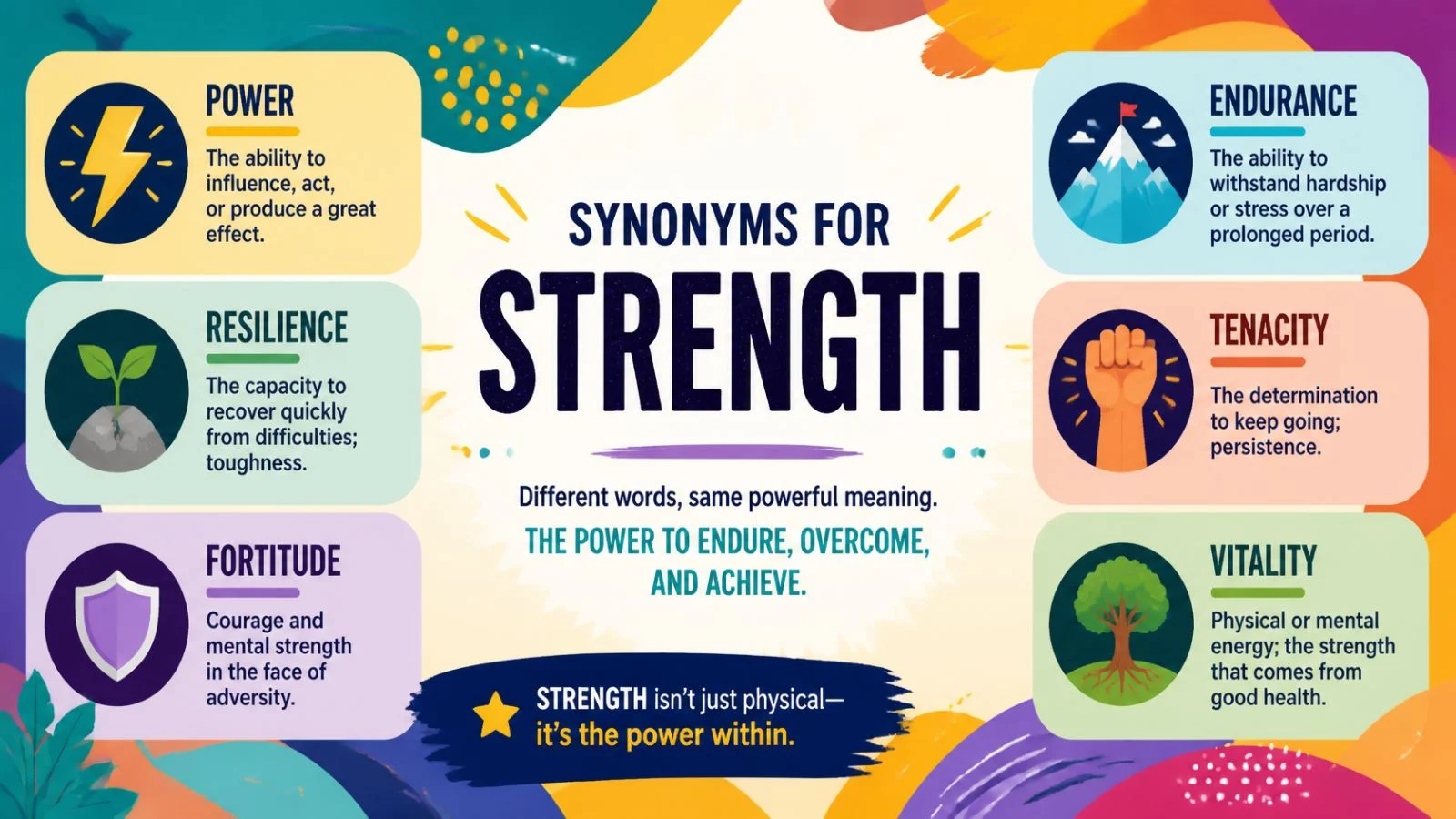
Strength has many close synonyms. The most common are power, might, and toughness. You can also use stamina, courage, or force. Each word fits a different meaning.
Strength can mean body power, a tough build, or a strong mind. It can also mean a skill, a strong point, or the force of a thing. So the best word depends on context.
Quick list: power, might, stamina, toughness, durability, courage, resilience, fortitude, forte, force
This article looks at 30 alternatives. You will find meanings, IPA, usage notes, and examples. You will also see which word fits which situation.
At a Glance: Strength Synonyms and Related Alternatives
| Alternative | Part of Speech | Meaning | Register / Tone | Ideal Context |
| Power | Noun | Ability to move things or act | Neutral | Body, machines, control |
| Might | Noun | Great physical force | Formal, literary | Stories, effort |
| Stamina | Noun | Power to keep going | Neutral | Sport, long tasks |
| Toughness | Noun | Power to take stress | Neutral | People, materials |
| Durability | Noun | Power to last | Neutral, technical | Products, tools |
| Courage | Noun | Power to face fear | Neutral, warm | Hard choices |
| Resilience | Noun | Power to recover | Neutral, formal | Loss, change |
| Forte | Noun | What you do best | Formal, slightly dated | Skills, jobs |
| Potency | Noun | Strength of effect | Formal, technical | Medicine, drinks |
| Influence | Noun | Power to shape others | Neutral | Leaders, groups |
Which Word Should You Use?
| If you want to… | Use | Why |
| Talk about lifting or pushing | Power | It fits body force and machines. |
| Praise lasting effort | Stamina | It shows you can keep going. |
| Describe a strong object | Durability | It shows the thing will last. |
| Praise a brave person | Courage | It focuses on facing fear. |
| Talk about bouncing back | Resilience | It shows recovery after hard times. |
| Name a skill in a job talk | Strong point | It sounds plain and clear. |
| Describe a drug or drink | Potency | It shows how strong the effect is. |
| Talk about respect and control | Clout | It shows power in a group. |
Exploring the Multiple Meanings of “Strength”
1. Physical Power
- Meaning: The body’s ability to lift, push, or carry things.
- Explanation: This is the most common sense. It also covers the power of animals.
- Example: He used all his strength to move the heavy sofa.
2. Toughness of Objects
- Meaning: The ability of a thing to resist breaking or damage.
- Explanation: Builders and makers use this sense often. It often appears in words like “steel strength.”
- Example: The strength of this rope is enough for climbing.
3. Inner Strength
- Meaning: The mental power to handle fear, pain, or hard times.
- Explanation: This sense is about the mind and heart. It also shows firm character.
- Example: She found the strength to start over after the move.
4. A Strong Point
- Meaning: A skill or quality that helps you do well.
- Explanation: People usually say “strengths” in this sense. You often hear it in job talks.
- Example: Clear writing is one of my biggest strengths.
5. Intensity or Concentration
- Meaning: How strong a feeling, light, drink, or drug is.
- Explanation: This sense is about degree. It also fits the force of wind or heat.
- Example: The doctor checked the strength of the new medicine.
6. Size or Force of a Group
- Meaning: The number or power of people in a team or army.
- Explanation: This sense often appears in the phrase “at full strength.” It also fits sports teams.
- Example: The team played at full strength for the final match.
Sources: Merriam-Webster; Collins English Dictionary; Dictionary.com
Analyzing 30 Strength Alternatives in Detail
Some of these words are direct synonyms. Others are related alternatives that fit only one sense.
Physical Power
1. Power
IPA: US /ˈpaʊɚ/ · UK /ˈpaʊə/
Definition: It means the ability to do work or move things. It also shows control over people.
- Usage: Power is a close synonym for physical strength. However, it also fits energy, machines, and rules.
- Example: Her arm power helped her throw the ball across the field.
2. Might
IPA: /maɪt/ (US and UK)
Definition: It means great physical power. It also shows strong effort.
- Usage: Might is formal and literary. For example, people say “with all his might.”
- Example: She pushed the heavy door with all her might.
3. Muscle
IPA: /ˈmʌsəl/ (US and UK)
Definition: It means body power from strong muscles. It also shows force used to win.
- Usage: Muscle is informal and often means raw power. Still, it fits the body or force, not the mind.
- Example: The team needs more muscle on the front line.
4. Brawn
IPA: /brɔːn/ (US and UK)
Definition: It means big, strong muscles. It also suggests power without much thought.
- Usage: Brawn is a related word, not a full synonym. For example, people often pair it with brains.
- Example: He had the brawn to lift the old piano alone.
5. Vigor
IPA: US /ˈvɪɡɚ/ · UK /ˈvɪɡə/
Definition: It means strong energy and health. It also shows a lively, forceful way of acting.
- Usage: Vigor is formal and mixes strength with energy. Writers also use it for ideas and efforts.
- Example: Even at ninety, she walked with vigor every morning.
Stamina and Energy
6. Stamina
IPA: /ˈstæmɪnə/ (US and UK)
Definition: It means the power to keep going for a long time. It also covers mind and body.
- Usage: Stamina is a close match when strength means lasting power. However, it does not mean raw force.
- Example: Marathon runners build stamina through months of slow, steady training.
7. Endurance
IPA: US /ɪnˈdʊrəns/ · UK /ɪnˈdjʊərəns/
Definition: It means the power to last through hard or long tasks. It also means the power to bear pain.
- Usage: Endurance is a good choice for long effort. However, it is less about force and more about lasting.
- Example: Her endurance helped her finish the long hike in the heat.
8. Energy
IPA: US /ˈenɚdʒi/ · UK /ˈenədʒi/
Definition: It means the power to be active. It also means the drive to work or play.
- Usage: Energy is a related word, not an exact synonym. For example, you can have energy but little strength.
- Example: The kids ran around the yard with endless energy.
9. Vitality
IPA: /vaɪˈtæləti/ (US and UK)
Definition: It means life force and good health. It also shows a lively, strong spirit.
- Usage: Vitality is a formal, warm word. Still, it fits health and spirit better than muscle.
- Example: The doctor praised her vitality after the long illness.
10. Hardiness
IPA: US /ˈhɑːrdinəs/ · UK /ˈhɑːdinəs/
Definition: It means the power to survive rough times or weather. It also shows a tough body.
- Usage: Hardiness is a related word that suits plants, animals, and people. For example, gardeners check a plant’s hardiness.
- Example: The hardiness of these plants helps them survive the winter.
Toughness and Durability
11. Toughness
IPA: /ˈtʌfnəs/ (US and UK)
Definition: It means the power to take stress without breaking. It also shows a strong, hard mind.
- Usage: Toughness is a near synonym for objects and people. However, it can also sound harsh.
- Example: The toughness of this leather makes it perfect for work boots.
12. Sturdiness
IPA: US /ˈstɜːrdinəs/ · UK /ˈstɜːdinəs/
Definition: It means a strong, solid build. It also shows that something will not break easily.
- Usage: Sturdiness fits chairs, bridges, and shoes. However, it rarely fits a person’s mind.
- Example: I chose the table for its sturdiness and simple look.
13. Durability
IPA: US /ˌdʊrəˈbɪləti/ · UK /ˌdjʊərəˈbɪləti/
Definition: It means the power to last a long time. It also means the power to resist wear.
- Usage: Durability is a close synonym for the strength of things. In fact, shoppers often look for it.
- Example: Customers praise the durability of this backpack after years of daily use.
14. Robustness
IPA: US /roʊˈbʌstnəs/ · UK /rəʊˈbʌstnəs/
Definition: It means strength with the power to handle stress. It also shows a healthy, solid state.
- Usage: Robustness is a formal choice. For example, experts use it for systems, plans, and health.
- Example: The robustness of the software surprised the whole team.
15. Solidity
IPA: /səˈlɪdəti/ (US and UK)
Definition: It means a firm, hard, and stable form. It also shows trust and reliability.
- Usage: Solidity is a related word, not a direct synonym. Still, it fits walls and money plans.
- Example: Everyone trusted the solidity of the bank’s long record.
Inner Strength
16. Courage
IPA: US /ˈkɜːrɪdʒ/ · UK /ˈkʌrɪdʒ/
Definition: It means the power to face fear or danger. It also shows a brave heart.
- Usage: Courage fits inner strength well. However, it does not suit physical power or objects.
- Example: It took courage to speak up in front of the crowd.
17. Resilience
IPA: /rɪˈzɪliəns/ (US and UK)
Definition: It means the power to recover after hard times. It also shows how fast something returns to shape.
- Usage: Resilience is a strong match for emotional strength. For example, people use it after loss or failure.
- Example: Her resilience helped her start again after losing her job.
18. Fortitude
IPA: US /ˈfɔːrtɪtuːd/ · UK /ˈfɔːtɪtjuːd/
Definition: It means calm strength in pain or trouble. It also shows deep self-control.
- Usage: Fortitude is formal and often appears in writing. However, it fits hard times more than daily tasks.
- Example: He faced the long illness with great fortitude.
19. Grit
IPA: /ɡrɪt/ (US and UK)
Definition: It means firm will and the drive to keep going. It also shows toughness under stress.
- Usage: Grit is informal and warm. In fact, many coaches and teachers praise it.
- Example: The young player showed real grit in the final match.
20. Backbone
IPA: US /ˈbækboʊn/ · UK /ˈbækbəʊn/
Definition: It means the nerve to stand up for what is right. It also shows firm character.
- Usage: Backbone is informal and figurative. It also appears in the phrase “show some backbone.”
- Example: The manager had the backbone to admit her mistake.
Skills and Advantages
21. Forte
IPA: US /ˈfɔːrteɪ/ · UK /ˈfɔːteɪ/
Definition: It means the thing a person does best. It also shows a special talent.
- Usage: Forte matches strength in the sense of a strong point. However, it never means physical power.
- Example: Public speaking is not my forte, but I am learning.
22. Strong Point
IPA: US /ˌstrɔːŋ ˈpɔɪnt/ · UK /ˌstrɒŋ ˈpɔɪnt/
Definition: It means a good quality or skill. It also shows what gives someone an edge.
- Usage: Strong point is a plain, everyday phrase. For example, people use it in job talks.
- Example: Her strong point is solving problems under pressure.
23. Asset
IPA: /ˈæset/ (US and UK)
Definition: It means a useful skill or quality. It also means something of value that you own.
- Usage: Asset is a related word, not an exact synonym. However, it fits a person’s strengths at work.
- Example: Speaking two languages is a big asset in this job.
24. Talent
IPA: /ˈtælənt/ (US and UK)
Definition: It means a natural skill. It also means a person with such skill.
- Usage: Talent is a related word, not an exact synonym. Strengths can also be learned, but talent comes naturally.
- Example: He has a talent for fixing old radios.
25. Advantage
IPA: US /ədˈvæntɪdʒ/ · UK /ədˈvɑːntɪdʒ/
Definition: It means a good condition that puts you ahead. It also means a benefit.
- Usage: Advantage is a related word for a helpful edge. For example, height gives players an advantage in basketball.
- Example: Her wide experience gave her an advantage in the interview.
Force, Intensity, and Influence
26. Force
IPA: US /fɔːrs/ · UK /fɔːs/
Definition: It means power that makes things move or change. It also means strong effect.
- Usage: Force is close to strength when you talk about power in action. However, it can sound hard or rough.
- Example: The force of the wind knocked down several old trees.
27. Potency
IPA: US /ˈpoʊtnsi/ · UK /ˈpəʊtnsi/
Definition: It means the power of a drug, drink, or idea. It also shows how strong an effect is.
- Usage: Potency is a formal word for strength of effect. For example, doctors use it for medicine.
- Example: Doctors tested the potency of the new medicine last week.
28. Intensity
IPA: /ɪnˈtensəti/ (US and UK)
Definition: It means how strong a feeling, light, or action is. It also shows great focus.
- Usage: Intensity matches strength as a degree of force. For example, you can talk about the intensity of heat.
- Example: The intensity of the storm surprised everyone on the coast.
29. Influence
IPA: /ˈɪnfluəns/ (US and UK)
Definition: It means the power to shape what others think or do. It also shows quiet control.
- Usage: Influence is a related word, not a direct synonym. However, it fits the strength of a leader or group.
- Example: Her influence in the town grew after she ran the school.
30. Clout
IPA: /klaʊt/ (US and UK)
Definition: It means power and respect in a group. It also shows the ability to get results.
- Usage: Clout is informal and fits business and politics. In fact, it often means power from status.
- Example: The new director has enough clout to change the plan.
Sources: Merriam-Webster; Collins English Dictionary; Collins Thesaurus; Dictionary.com
Strength vs. Power vs. Force vs. Might
These four words overlap, but they are not the same. Strength is about what a person or thing can do. Power and force are about action and effect.
| Word | Core Idea | Best For | Example |
| Strength | Ability to bear or apply effort | Body, objects, character | The rope has great strength. |
| Power | Ability to act or control | Machines, rule, energy | The engine has great power. |
| Force | Power in action | Movement, impact, pressure | The force of the wave hit the rocks. |
| Might | Great power, often grand | Stories, formal writing | The army showed its might. |
In short, strength is what you have. Force is what you apply. Power can mean either one. Might sound bigger and more formal.
Sources: Merriam-Webster; Collins English Dictionary
Strength and Opposite/Paired Word Pairs
| Word | Paired Word | Note |
| Strength | Weakness | The most direct opposite. |
| Strength | Frailty | Often used for age or health. |
| Strength | Fragility | Often used for objects and plans. |
| Strength | Vulnerability | Often used for risk and emotion. |
| Strength | Flexibility | A common pair in fitness, not an opposite. |
| Strength | Speed | A common pair in sport, not an opposite. |
Weakness is the true opposite in almost every sense. Frailty and fragility are narrower opposites. Words like flexibility and speed are partners, not opposites. In fact, people often train them together.
Sources: Merriam-Webster; Collins Thesaurus
Common Word Partners of “Strength”
| Pattern | Common Partners | Example |
| Adjective + strength | inner, sheer, physical, emotional | She showed sheer strength in the final lift. |
| Verb + strength | build, gain, regain, show | He is trying to regain his strength. |
| Strength + noun | strength training, strength test | I do strength training twice a week. |
| Strength + of + noun | strength of character, strength of evidence | His strength of character impressed everyone. |
| Preposition phrase | at full strength, draw strength from | Players draw strength from the cheering fans. |
Sources: Collins English Dictionary; Oxford Collocations Dictionary
Idiomatic Phrases Featuring “Strength”
1. Strength in numbers
- Meaning: A large group has more power than one person.
- Example: Workers joined the union because there is strength in numbers.
2. From strength to strength
- Meaning: To keep getting more successful over time.
- Example: The small shop has gone from strength to strength each year.
3. On the strength of
- Meaning: Because of or based on something.
- Example: She got the job on the strength of her references.
4. A tower of strength
- Meaning: A person who gives steady help and support to others.
- Example: My sister was a tower of strength during the move.
Sources: Merriam-Webster; Collins English Dictionary; Cambridge Dictionary
Word Formation of “Strength”
Etymology & Structure
Strength comes from the word strong plus the noun ending -th. The same pattern gives us length from long and width from wide. Etymonline traces it to Proto-Germanic and Old English.
Date and History
The word is very old. Merriam-Webster dates it to before the 12th century. It appears in Old English as strengthu.
Word Class Variations
- Noun: strength
- Verb: strengthen
- Adjective: strong
- Adverb: strongly
- Related forms: strengthening, strengthener
Sources: Etymonline; Merriam-Webster
Common Word-Choice Mistakes
- Strongness: strength.
- He is strong: He is strong.
- My biggest strength is that I work hard: My biggest strength is that I work hard.
- The bridge has great force: The bridge has great strength.
- She showed great fortitude in the gym: She showed great strength or stamina in the gym.
- The tea has high potency: The tea is strong.
- On the strength from his work: On the strength of his work.
Frequently Asked Questions
What is the closest synonym for strength?
Power is the closest everyday synonym. It fits body force best.
What is a formal alternative to strength?
Fortitude and robustness are formal choices. Fortitude fits hard times, while robustness fits systems and plans.
What is a good word for inner strength?
Courage, resilience, and grit all work. Resilience fits recovery, and courage fits facing fear.
What is the opposite of strength?
Weakness is the main opposite. Frailty and fragility are narrower opposites.
Can I use strength for objects?
Yes, it fits ropes, walls, and tools. Durability and sturdiness are also good choices.
What is the difference between strength and stamina?
Strength is the power to lift or push. Stamina is the power to keep going.
What is another word for a person’s strengths?
You can say strong points, assets, or talents. Forte also works but sounds formal.
Is strength the same as power?
Not always. Strength is what you have, while power is also about control and action.
What word means strength of a drink or drug?
Potency is the most exact word. You can also say strength or concentration.
What does “at full strength” mean?
It means a team or group is complete and ready. Nobody is missing or hurt.
Conclusion
Power, might, and toughness are the closest everyday words for strength. Stamina, courage, and resilience cover lasting power and inner strength. Forte and strong point cover skills.
Context is the key. Strength can mean body power, a tough object, or a strong mind. It can also mean a skill, a strong effect, or the size of a group. Each meaning has its own best word.
To choose well, first ask what kind of strength you mean next, pick the word that fits that sense. Finally, check the tone. Formal words like fortitude suit writing, while grit and clout suit casual talk.

Olivia Martin is a passionate writer who enjoys exploring English vocabulary, synonyms, and language tips to help readers improve their writing skills.
At PressivoMedia.com, Olivia shares helpful language resources and easy-to-understand content to make communication clearer and more effective.