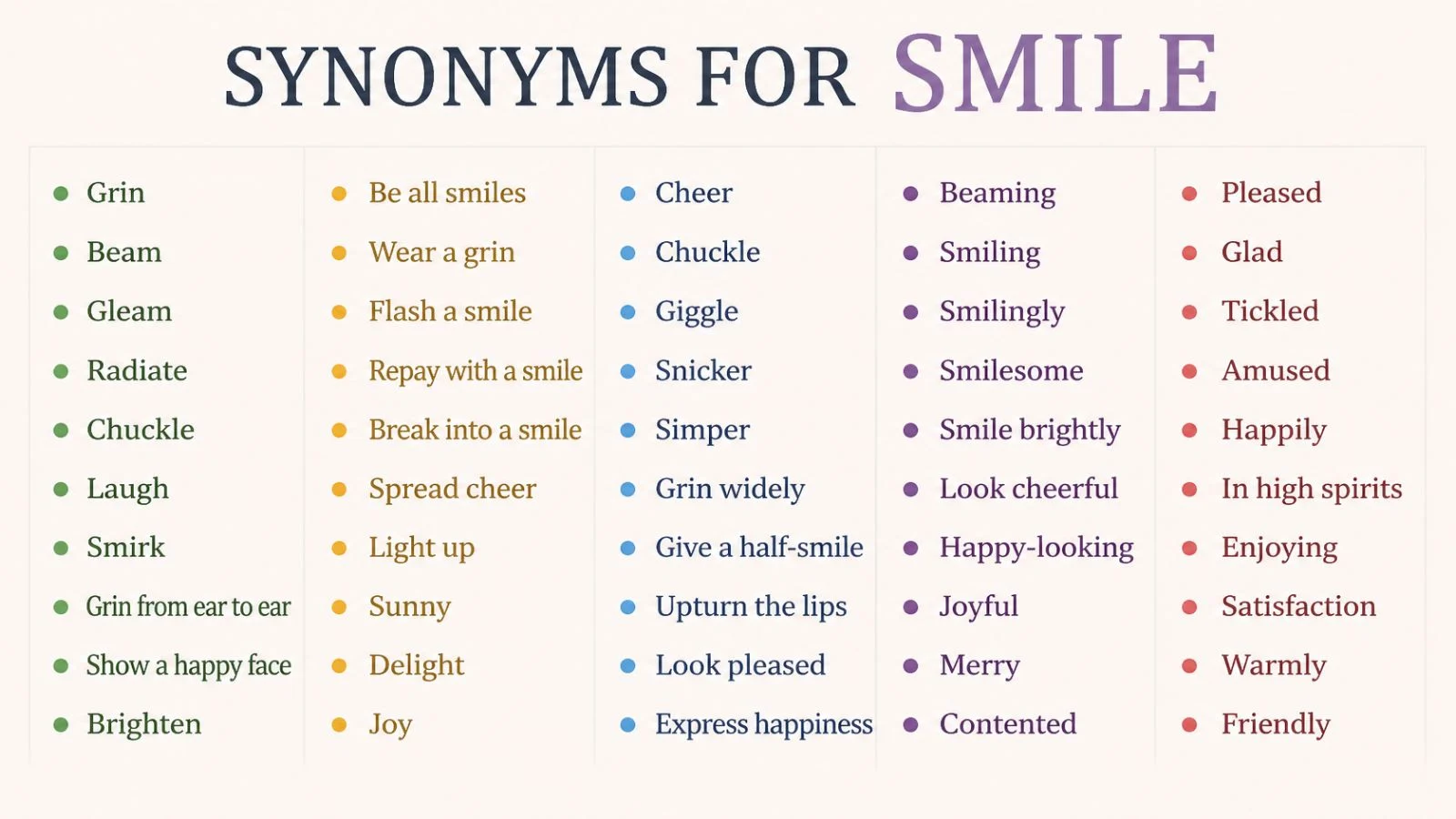
Another word for smile is grin, beam, or smirk. Grin is the closest everyday choice. Beam shows bright joy. Smirk shows a smug or sly look. The best word depends on the feeling behind the smile.
A smile can also mean to greet someone or to approve of something. In figurative use, fortune can “smile on” you. So the right synonym changes with the sense. Some words also add sound, such as chuckle or giggle.
Quick list: grin, beam, smirk, simper, half-smile, light up, glow, chuckle, giggle, flash
This article looks at 30 alternatives. Each one has a meaning, IPA, a usage note, and an example. You will also see tables, word pairs, idioms, and common mistakes.
At a Glance: Smile Synonyms and Related Alternatives
| Alternative | Part of Speech | Meaning | Register / Tone | Ideal Context |
| Grin | verb, noun | A wide, open smile | Informal, warm | Fun, excitement |
| Beam | verb, noun | A bright smile of joy | Neutral, warm | Pride, happiness |
| Smirk | verb, noun | A smug or sly smile | Negative | Teasing, pride |
| Simper | verb, noun | A silly or fake smile | Negative, rare | Forced charm |
| Half-smile | noun | A small, partial smile | Neutral | Doubt, mild humor |
| Light up | phrasal verb | Show sudden joy | Informal | Good news |
| Glow | verb | Look warm and happy | Warm, figurative | Pride, love |
| Chuckle | verb, noun | Laugh softly | Friendly | Quiet humor |
| Giggle | verb, noun | Laugh in short, high sounds | Informal | Children, nerves |
| Flash | verb | Show a smile quickly | Informal | Brief greetings |
Which Word Should You Use?
| If you want to… | Use | Why |
| Show a wide, happy smile | Grin | It is common and shows teeth. |
| Show pride or deep joy | Beam | It suggests a bright, warm face. |
| Show a smug look | Smirk | It adds a sly or proud tone. |
| Show a very small smile | Half-smile | It signals a faint or partial smile. |
| Show a smile with a soft sound | Chuckle | It adds quiet laughter. |
| Show a sudden happy change | Light up | It shows joy that comes fast. |
| Show a smile that is fake | Simper | It suggests trying too hard. |
| Say luck helped someone | Favor | It matches “fortune smiled on” them. |
Exploring the Multiple Meanings of “Smile”
1. To Show Pleasure With Your Face (Verb)
- Meaning: To turn up the corners of your mouth to show joy, kindness, or amusement.
- Explanation: This is the main sense. It can also show nerves or politeness.
- Example: She smiled when she saw her old friend.
2. The Expression Itself (Noun)
- Meaning: The look on a face when the mouth curves up.
- Explanation: Here, a smile names the look, not the act. Adjectives like warm or faint often go with it.
- Example: He had a warm smile that put everyone at ease.
3. To Greet or Approve of Someone
- Meaning: To show welcome or approval with a smile.
- Explanation: This sense often uses “at” or “on”. It can also show kindness.
- Example: The teacher smiled at the nervous new student.
4. To Be Favored by Luck (Figurative)
- Meaning: To bring good fortune to someone.
- Explanation: Fortune or fate is usually the subject. The phrase is common in writing.
- Example: Fortune smiled on the team in the final minute.
5. To Hide Another Feeling
- Meaning: To smile while you feel pain, worry, or anger.
- Explanation: This smile may be polite or forced. Still, the face and the feeling do not match.
- Example: He smiled politely, but he was clearly upset.
Sources: Merriam-Webster; Collins English Dictionary; Dictionary.com
Analyzing 30 Smile Alternatives in Detail
Some of these words are direct synonyms. Others are related alternatives for one context, and the notes say which is which.
Core Synonyms
1. Grin
IPA: /ɡrɪn/ (US and UK)
Definition: A grin is a wide smile that often shows teeth. It also suggests fun or mischief.
- Usage: Grin is the closest everyday synonym. However, it shows more teeth and energy than a plain smile.
- Example: He grinned when he saw the birthday cake.
2. Beam
IPA: /biːm/ (US and UK)
Definition: To beam means to smile very brightly. It also shows pride or joy.
- Usage: Beam is a warm, happy synonym. For example, parents often beam at a graduation.
- Example: She beamed as her daughter walked across the stage.
3. Smirk
IPA: US /smɜːrk/ · UK /smɜːk/
Definition: A smirk is a smug or sly smile. It also hints at private amusement.
- Usage: Smirk is a related word, not a plain synonym. It often shows pride or mockery, so use it with care.
- Example: He smirked after he won the argument.
4. Simper
IPA: US /ˈsɪmpər/ · UK /ˈsɪmpə/
Definition: To simper is to smile in a silly or fake way. It also suggests trying too hard to please.
- Usage: Simper is a rare word with a bad tone. Also, writers use it for forced charm.
- Example: The clerk simpered and praised every coat I tried on.
5. Radiate
IPA: /ˈreɪdieɪt/ (US and UK)
Definition: To radiate joy means to show it so clearly that others feel it. It also fits a glowing smile.
- Usage: Radiate is a related word, not an exact synonym. However, it works best with feelings like joy.
- Example: Her face radiated joy when the results came in.
Soft and Subtle Alternatives
6. Glow
IPA: US /ɡloʊ/ · UK /ɡləʊ/
Definition: To glow is to look warm and happy. It also hints at a soft, calm smile.
- Usage: Glow is a related word. In fact, people often say someone glows with pride.
- Example: He glowed with pride at his son’s recital.
7. Twinkle
IPA: US /ˈtwɪŋkəl/ · UK /ˈtwɪŋkl/
Definition: Twinkle means to shine in a lively way, like eyes during a smile. It also shows playfulness.
- Usage: Twinkle is a related word, not a synonym. Still, it often pairs with a smile.
- Example: Her eyes twinkled as she tried not to smile.
8. Brighten
IPA: /ˈbraɪtn/ (US and UK)
Definition: To brighten means to look happier all of a sudden. It also covers a face that lights up.
- Usage: Brighten is a related word. For example, a face can brighten into a smile.
- Example: Her face brightened when she heard his voice.
9. Dimple
IPA: US /ˈdɪmpəl/ · UK /ˈdɪmpl/
Definition: To dimple is to form small dents in the cheeks. It also happens when you smile.
- Usage: Dimple is a related word that is mostly literary. However, it fits a soft, sweet smile.
- Example: Her cheeks dimpled as she tried to hide a smile.
10. Light Up
IPA: /laɪt ʌp/ (US and UK)
Definition: To light up means to show sudden joy on your face. It also works for a smile that comes fast.
- Usage: Light up is a common phrasal verb. In everyday English, people say a face lights up.
- Example: His whole face lit up when she walked in.
Laughter-Linked Alternatives
11. Chuckle
IPA: US /ˈtʃʌkəl/ · UK /ˈtʃʌkl/
Definition: To chuckle means to laugh softly. It also suggests quiet amusement.
- Usage: Chuckle is a related word, not a synonym. However, it adds a small sound to a smile.
- Example: Dad chuckled at the old photo of himself.
12. Giggle
IPA: US /ˈɡɪɡəl/ · UK /ˈɡɪɡl/
Definition: To giggle is to laugh in short, high sounds. It also often happens when you feel shy or nervous.
- Usage: Giggle is a related word. Also, it fits children and light moments better than formal ones.
- Example: The kids giggled behind their hands during the quiet lesson.
13. Titter
IPA: US /ˈtɪtər/ · UK /ˈtɪtə/
Definition: To titter means to laugh in a quiet, nervous way. It also can sound a little rude.
- Usage: Titter is a dated, related word. However, writers still use it for muffled laughs at a mistake.
- Example: A few people tittered when the speaker dropped his notes.
14. Snicker
IPA: US /ˈsnɪkər/ · UK /ˈsnɪkə/
Definition: To snicker is to laugh in a sly or mean way. It also is often done quietly.
- Usage: Snicker is a related word with a bad tone. In fact, it is closer to mockery than to a smile.
- Example: Two boys snickered at the back of the class.
15. Laugh
IPA: US /læf/ · UK /lɑːf/
Definition: To laugh means to make sounds that show you find something funny. It also often comes with a smile.
- Usage: Laugh is a related word, not a synonym. However, a smile is silent and a laugh is not.
- Example: We all laughed at the joke he told at dinner.
Literary and Figurative Alternatives
16. Shine
IPA: /ʃaɪn/ (US and UK)
Definition: To shine means to look bright with joy. It also works for eyes or faces.
- Usage: Shine is a figurative, related word. For example, a face can shine with happiness.
- Example: Her face shone with happiness at the wedding.
17. Sparkle
IPA: US /ˈspɑːrkəl/ · UK /ˈspɑːkl/
Definition: To sparkle means to look lively and bright. It also fits eyes that show fun.
- Usage: Sparkle is a related word. However, it points to the eyes more than the mouth.
- Example: Her eyes sparkled as she told the funny story.
18. Gleam
IPA: /ɡliːm/ (US and UK)
Definition: A gleam is a short flash of light or feeling. It also can show up on a face.
- Usage: Gleam is a literary, related word. Still, writers use it for a hint of delight.
- Example: A gleam of joy crossed his face.
19. Flash
IPA: /flæʃ/ (US and UK)
Definition: To flash a smile means to show it quickly. It also suggests the smile fades fast.
- Usage: Flash works in the phrase “flash a smile”. However, it is not a plain synonym on its own.
- Example: He flashed a smile and hurried out the door.
20. Glimmer
IPA: US /ˈɡlɪmər/ · UK /ˈɡlɪmə/
Definition: A glimmer is a faint sign of a feeling. It also fits a very small smile.
- Usage: Glimmer is a literary, related word. For example, a glimmer of a smile shows slight joy.
- Example: A glimmer of a smile crossed her tired face.
Smiling at Others and Showing Approval
21. Greet
IPA: /ɡriːt/ (US and UK)
Definition: To greet means to welcome someone with words or a smile. It also is a polite act.
- Usage: Greet is a related word. However, you can greet someone without a smile.
- Example: She greeted every guest with a warm smile.
22. Welcome
IPA: /ˈwelkəm/ (US and UK)
Definition: To welcome means to receive someone with kindness. It also often includes a friendly smile.
- Usage: Welcome is a related word. In fact, a smile is a common sign of welcome.
- Example: The host welcomed us at the door with a smile.
23. Approve
IPA: /əˈpruːv/ (US and UK)
Definition: To approve means to think something is good. It also fits the sense of “smile on” an idea.
- Usage: Approve matches the phrase “smile on a plan”. However, it is a plain, formal word.
- Example: The manager approved our plan with a nod and a smile.
24. Favor
IPA: US /ˈfeɪvər/ · UK /ˈfeɪvə/
Definition: To favor means to treat someone with kindness or support. It also covers luck that helps you.
- Usage: Favor matches “fortune smiles on you”. However, it has no link to a real smile.
- Example: Luck seemed to favor our team all season.
25. Bless
IPA: /bles/ (US and UK)
Definition: To bless means to ask for good fortune for someone. It also means to give approval.
- Usage: Bless works in “blessed with luck”. However, it is not a synonym for the facial act.
- Example: The weather blessed the picnic with a sunny afternoon.
Mocking and Mixed Expressions
26. Leer
IPA: US /lɪr/ · UK /lɪə/
Definition: To leer means to look at someone in a sly or unkind way. It also often has a rude tone.
- Usage: Leer is not a synonym for smile. However, a leer can include an unpleasant grin.
- Example: The man leered at her from across the room.
27. Sneer
IPA: US /snɪr/ · UK /snɪə/
Definition: To sneer means to curl your lip to show scorn. It also can come with cruel words.
- Usage: Sneer is the opposite of a warm smile. Still, it can look like a smirk.
- Example: He sneered at their weak attempt to help.
28. Grimace
IPA: US /ˈɡrɪməs/ · UK /ɡrɪˈmeɪs/
Definition: A grimace is a twisted face that shows pain or disgust. It also can hide a forced smile.
- Usage: Grimace is a related word, not a synonym. However, people may mistake it for a smile.
- Example: He gave a grimace and swallowed the bitter medicine.
29. Scoff
IPA: US /skɑːf/ · UK /skɒf/
Definition: To scoff means to mock something with words or sound. It also can come with a smile.
- Usage: Scoff is a related word with a harsh tone. In fact, it shows scorn, not joy.
- Example: Critics scoffed at the idea, but he kept smiling.
30. Half-Smile
IPA: US /ˈhæf smaɪl/ · UK /ˈhɑːf smaɪl/
Definition: A half-smile is a small or partial smile. It also can show doubt or mild humor.
- Usage: Half-smile is a close synonym for a faint smile. For example, it fits a polite reaction.
- Example: She gave him a half-smile and turned away.
Sources: Merriam-Webster; Collins English Dictionary and Collins Thesaurus; Dictionary.com
Smile vs. Grin vs. Beam vs. Smirk
These four words are the most common choices. They differ in size, feeling, and tone. The table shows the main gaps.
| Word | Size | Main Feeling | Tone |
| Smile | Small to medium | Kindness, joy, politeness | Neutral |
| Grin | Wide, shows teeth | Fun, mischief | Informal, warm |
| Beam | Wide and bright | Pride, deep joy | Warm |
| Smirk | Small, one-sided | Smugness, teasing | Negative |
A smile fits almost any case. A grin adds energy. A beam adds light. A smirk adds attitude, so check your tone before you use it.
Sources: Merriam-Webster; Collins English Dictionary
Smile and Opposite/Paired Word Pairs
| Word | Paired Word | Note |
| Smile | Frown | The most common opposite. It shows worry or dislike. |
| Smile | Scowl | A scowl is a harsher, angry frown. |
| Smile | Grimace | A grimace shows pain or disgust. |
| Smile | Cry | People pair them to show mixed feelings. |
| Smile | Laugh | Not opposites. A laugh is a smile with sound. |
| Grin | Sneer | A grin is friendly. A sneer shows scorn. |
A smile has a clear opposite in frown. Other pairs show contrast in feeling or sound. For example, “smile and cry” shows a mix of joy and sadness.
Sources: Merriam-Webster; Collins Thesaurus
Common Word Partners of “Smile”
| Pattern | Common Partners | Example |
| Adjective + smile | warm, broad, faint, wry, forced | She gave a faint smile. |
| Verb + smile | give, flash, force, return, hide | He returned her smile. |
| Smile + preposition | at, about, with | They smiled at each other. |
| Smile + adverb | politely, shyly, warmly, sadly | He smiled shyly at the crowd. |
| Smile + of + noun | relief, joy, pleasure | She wore a smile of relief. |
| Smile + on + face | on his face, on her lips | A smile played on her lips. |
Sources: Collins English Dictionary; Oxford Collocations Dictionary
Idiomatic Phrases Featuring “Smile”
1. Crack a smile
- Meaning: To smile slightly, often when you feel serious or tired.
- Example: He was so tense that he barely cracked a smile.
2. Put a smile on someone’s face
- Meaning: To make someone happy.
- Example: The surprise party put a smile on her face.
3. Wipe the smile off someone’s face
- Meaning: To end someone’s good mood or smug pride.
- Example: The bad news quickly wiped the smile off his face.
4. Fortune smiles on someone
- Meaning: An established expression meaning luck favors a person.
- Example: Fortune smiled on her, and she won the prize.
Sources: Merriam-Webster; Collins English Dictionary; Cambridge Dictionary
Word Formation of “Smile”
Etymology & Structure
Smile is a short root word. It entered Middle English, probably from a Scandinavian or Middle Low German source. It links to an old root meaning “to laugh or smile.”
Date and History
Etymonline places the verb in the early Middle English period, around 1300. The noun came later. Check the current entry before you cite an exact date.
Word Class Variations
- Verb: smile, smiles, smiled, smiling
- Noun: smile, smiler, smiley
- Adjective: smiling, smiley
- Adverb: smilingly
Sources: Etymonline; Merriam-Webster; Collins English Dictionary
Common Word-Choice Mistakes
- She smirked warmly at me: she beamed warmly at me.
- He simpered with real joy: he beamed with real joy.
- They giggled quietly in their heads: they smiled quietly to themselves.
- She smiled at him: she smiled at him.
- The man leered kindly: the man grinned kindly.
- He chuckled without a sound: he smiled without a sound.
- Fortune grinned on me: fortune smiled on me.
Frequently Asked Questions
What is the closest synonym for smile?
Grin is the closest everyday synonym. It means a wide smile and often shows teeth.
What is a word for a bright, happy smile?
Beam is the best choice. It shows pride or deep joy.
What is a negative word for smile?
Smirk is a common one. It shows a smug or sly smile.
What is the difference between a smile and a grin?
A grin is wider and shows more energy. A smile can be small and quiet.
What is a literary alternative to smile?
Glimmer and gleam work well in writing. Both show a faint sign of joy.
Is chuckle the same as a smile?
No. A chuckle adds soft laughter. A smile is silent.
What does “fortune smiles on you” mean?
It means luck is helping you. The phrase is figurative.
What is the opposite of a smile?
Frown is the most common opposite. Scowl is a stronger, angry one.
Can you smile at an idea?
Yes. People smile on or at an idea to show approval.
What is a formal word for smile?
Beam and approve both sounds polished. Beam fits the face, and approval fits the sense of “smile on.”
Conclusion
The closest everyday words for smile are grin and beam. Grin shows a wide, playful smile. Beam shows bright joy or pride.
Context matters most. Smirk and simper have a bad tone. Chuckles and giggles add sound. Words like favor and approve fit the figurative senses.
To choose well, ask three questions. What feeling do you want to show? Is there sound? Is the tone kind or unkind? Your answers point to the right word.

Olivia Martin is a passionate writer who enjoys exploring English vocabulary, synonyms, and language tips to help readers improve their writing skills.
At PressivoMedia.com, Olivia shares helpful language resources and easy-to-understand content to make communication clearer and more effective.