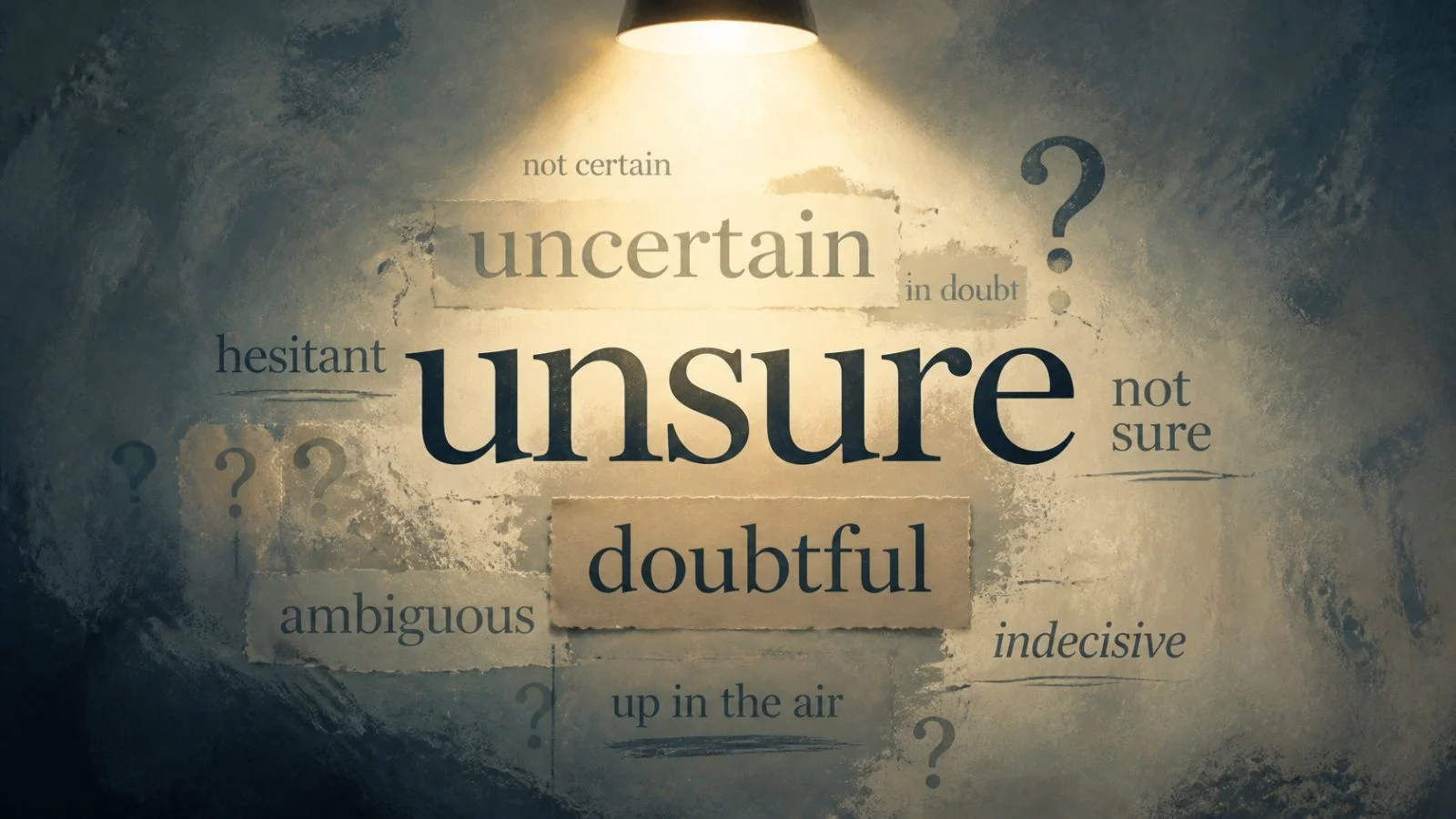
Another word for unsure is uncertain. Doubtful, undecided, and hesitant also fit in many cases. The best choice depends on meaning and context.
Some words show doubt about a fact. Others show low confidence, mixed feelings, or a missing plan. So the right word depends on what the person doubts.
Quick list: uncertain, doubtful, undecided, hesitant, skeptical, unconvinced, insecure, ambivalent, tentative, wary
This article looks at 30 alternatives. Each one has a meaning, IPA, a usage note, and an example. You will also see tables, word pairs, and common mistakes.
At a Glance: Unsure Synonyms and Related Alternatives
| Alternative | Part of Speech | Meaning | Register / Tone | Ideal Context |
| uncertain | adjective | Not sure about a fact or result | Neutral | Daily talk and writing |
| doubtful | adjective | Thinking something may not be true | Neutral | Claims and outcomes |
| undecided | adjective | Not yet picked a choice | Neutral | Votes, plans, options |
| hesitant | adjective | Slow to act because of doubt | Neutral | Speaking or acting |
| skeptical | adjective | Doubting a claim without proof | Neutral to formal | News, ads, science |
| unconvinced | adjective | Not yet persuaded | Neutral | After an argument |
| insecure | adjective | Lacking trust in yourself | Neutral | Feelings about self |
| ambivalent | adjective | Holding opposite feelings | Neutral to formal | Hard personal choices |
| tentative | adjective | Not final or fully sure | Neutral | Plans and guesses |
| wary | adjective | Careful because of possible risk | Neutral | Risky people or deals |
Which Word Should You Use?
| If you want to… | Use | Why |
| Say you lack facts | uncertain | It works in most writing. |
| Say you cannot pick an option | undecided | It points to a choice not yet made. |
| Show a pause before acting | hesitant | It focuses on slow action. |
| Doubt that a claim is true | skeptical | It shows careful questioning. |
| Say a speaker did not persuade you | unconvinced | It fits after an argument. |
| Describe low self-belief | insecure | It points to trust in yourself. |
| Offer a cautious plan | tentative | It signals that the plan may change. |
| Show two opposite feelings | ambivalent | It names mixed emotions. |
| Sound casual | iffy | It fits relaxed speech. |
Exploring the Multiple Meanings of “Unsure”
1. Not certain of a fact
- Meaning: You do not know something for sure.
- Explanation: This is the most common sense. It often takes “about,” “of,” or “whether.”
- Example: I’m unsure whether the store opens before nine on Sundays.
2. Not sure what to do
- Meaning: You cannot make up your mind.
- Explanation: Here the doubt is about a choice, not a fact. Words like undecided also fit.
- Example: She felt unsure which job offer to accept.
3. Lacking confidence
- Meaning: You do not trust your own skill or worth.
- Explanation: This sense often follows “of yourself.” It describes a trait or a mood.
- Example: He sounded unsure when he spoke in front of the class.
4. Unsteady or unreliable
- Meaning: Something is not firm or not safe to count on.
- Explanation: This sense is less common today. You still see it in “unsure footing.”
- Example: The hiker moved on unsure footing across the wet rocks.
Sources: Merriam-Webster; Collins Dictionary; Dictionary.com
Analyzing 30 Unsure Alternatives in Detail
Some alternatives are direct synonyms. Others are related words that fit only certain contexts.
Core Synonyms
1. uncertain
IPA: US /ʌnˈsɝːtn/ · UK /ʌnˈsɜːtn/
Definition: Means you do not know something for sure. It also fits events that have no clear outcome.
- Usage: This is the closest synonym to unsure. However, it sounds a bit more formal in daily talk.
- Example: The weather is uncertain, so we may move the picnic indoors.
2. doubtful
IPA: /ˈdaʊtfəl/ (US and UK)
Definition: Means you think something may not be true. It also shows low hope about a result.
- Usage: This is a direct synonym. However, it leans toward doubt more than simply not knowing.
- Example: I am doubtful that the train will arrive on time.
3. undecided
IPA: /ˌʌndɪˈsaɪdɪd/ (US and UK)
Definition: Means you have not yet picked an option. It also fits votes, plans, and results.
- Usage: This is a direct synonym for choices. Still, there is no doubt about the facts.
- Example: Many voters stayed undecided until the final week.
4. hesitant
IPA: /ˈhɛzɪtənt/ (US and UK)
Definition: Means you pause because you feel unsure or worried. It also shows slow action.
- Usage: This word is about acts, not facts. For example, you can be hesitant to speak.
- Example: Tom was hesitant to ask his boss for a day off.
5. dubious
IPA: US /ˈduːbiəs/ · UK /ˈdjuːbiəs/
Definition: Means you have doubts about whether something is good or true. It also means not trustworthy.
- Usage: It is a close but stronger choice. It also often judges a claim or a plan.
- Example: Lena felt dubious about the offer because the price seemed too low.
Doubt and Distrust
6. skeptical
IPA: /ˈskɛptɪkəl/ (US and UK)
Definition: Means you doubt that a claim is true. It also shows you want proof.
- Usage: This is a related alternative. In fact, it shows active doubt, not just missing knowledge.
- Example: I’m skeptical about ads that promise instant results.
7. unconvinced
IPA: /ˌʌnkənˈvɪnst/ (US and UK)
Definition: Means someone’s words did not change your mind. It also shows you still have doubts.
- Usage: It is a related alternative that fits after an argument. For example, you stay unconvinced after a long talk.
- Example: The jury seemed unconvinced by the lawyer’s long speech.
8. wary
IPA: US /ˈwɛri/ · UK /ˈweəri/
Definition: Means you stay careful because you sense a risk. It also shows mild doubt.
- Usage: This is a related alternative. However, it stresses caution more than not knowing.
- Example: Jim was wary of strangers who asked for his password.
9. leery
IPA: US /ˈlɪri/ · UK /ˈlɪəri/
Definition: Means you feel careful or doubtful about something. It also sounds informal.
- Usage: It is a related alternative. However, it often shows distrust of a person or a deal.
- Example: She grew leery of the salesman after his third promise.
10. suspicious
IPA: /səˈspɪʃəs/ (US and UK)
Definition: Means you think something may be wrong or false. It also shows distrust.
- Usage: It is a related alternative. Still, it goes beyond being unsure because it points to possible bad acts.
- Example: Dad grew suspicious when the door stood open at midnight.
Low Confidence
11. insecure
IPA: US /ˌɪnsɪˈkjʊr/ · UK /ˌɪnsɪˈkjʊə/
Definition: Means you do not feel safe in your own worth. It also shows steady self-doubt.
- Usage: It is a related alternative about self-image. For example, an insecure person may doubt every choice.
- Example: He felt insecure about his accent at the new school.
12. diffident
IPA: /ˈdɪfɪdənt/ (US and UK)
Definition: Means you are shy and slow to share your views. It also shows low self-belief.
- Usage: This is a formal, related alternative. However, it describes a trait more than a short mood.
- Example: The diffident intern waited before offering her idea.
13. tentative
IPA: /ˈtɛntətɪv/ (US and UK)
Definition: Means not final or not fully sure. It also fits plans made with care.
- Usage: It is a related alternative. In everyday English, people use it for plans, guesses, and first steps.
- Example: We made a tentative plan to meet on Friday.
14. apprehensive
IPA: /ˌæprɪˈhɛnsɪv/ (US and UK)
Definition: Means you feel a little afraid about what may happen. It also shows unease.
- Usage: This is a related alternative. However, it adds fear, so it fits worry more than doubt.
- Example: Mia felt apprehensive before her first day at work.
15. unsettled
IPA: /ʌnˈsɛtəld/ (US and UK)
Definition: Means you feel uneasy or unsure about a change. It also fits matters not yet fixed.
- Usage: It is a related alternative. For example, you can feel unsettled after bad news.
- Example: The team felt unsettled after hearing about the new boss.
Not Knowing or Not Clear
16. unclear
IPA: US /ʌnˈklɪr/ · UK /ʌnˈklɪə/
Definition: Means a thing is hard to understand or see. It also fits a person who cannot see the answer.
- Usage: It is a related alternative. In fact, people often use it for facts or plans, not feelings.
- Example: I am unclear about what the teacher wants us to do.
17. clueless
IPA: /ˈkluːləs/ (US and UK)
Definition: Means you have no idea about something. It also sounds casual.
- Usage: This is a related alternative. However, it is stronger than unsure and can sound rude.
- Example: I was clueless about how the new phone worked.
18. unaware
IPA: US /ˌʌnəˈwɛr/ · UK /ˌʌnəˈweə/
Definition: Means you do not know something exists. It also shows you never noticed it.
- Usage: It is not a true synonym. However, unsure shows doubt while unaware shows no knowledge.
- Example: She was unaware that the meeting had moved to noon.
19. unresolved
IPA: US /ˌʌnrɪˈzɑːlvd/ · UK /ˌʌnrɪˈzɒlvd/
Definition: Means a question or problem has no answer yet. It also fits feelings that stay mixed.
- Usage: It is a related alternative. However, it describes issues, not people.
- Example: The question of who pays remains unresolved.
20. vague
IPA: /veɪɡ/ (US and UK)
Definition: Means not clear or not exact. It also fits a person who gives no firm answer.
- Usage: It is a related alternative. For example, a vague reply often hides that you are unsure.
- Example: His vague answer made me think he did not know.
Mixed Feelings and Wavering
21. ambivalent
IPA: /æmˈbɪvələnt/ (US and UK)
Definition: Means you have opposite feelings about one thing. It also shows you cannot pick a side.
- Usage: This is a related alternative. However, it shows mixed feelings, not simple doubt.
- Example: Sam felt ambivalent about moving to a bigger city.
22. torn
IPA: US /tɔːrn/ · UK /tɔːn/
Definition: Means two choices pull you in different ways. It also shows a hard feeling inside.
- Usage: It is a related alternative. In everyday English, people say “torn between” two options.
- Example: She was torn between staying home and joining the trip.
23. wavering
IPA: /ˈweɪvərɪŋ/ (US and UK)
Definition: Means you keep changing your mind. It also shows weak resolve.
- Usage: It is a related alternative. Still, it fits a choice that shifts over time.
- Example: Wavering voters made the final result hard to predict.
24. irresolute
IPA: /ɪˈrɛzəluːt/ (US and UK)
Definition: Means you find it hard to act on a choice. It also sounds formal.
- Usage: This is a formal, related alternative. In fact, you will see it mostly in books and news.
- Example: The irresolute leader delayed the vote for weeks.
25. vacillating
IPA: /ˈvæsɪleɪtɪŋ/ (US and UK)
Definition: Means you swing back and forth between choices. It also shows you cannot commit.
- Usage: It is a formal, related alternative. However, it sounds harsh when you use it for a person.
- Example: Her vacillating stance on the budget frustrated the whole committee.
Informal and Casual
26. iffy
IPA: /ˈɪfi/ (US and UK)
Definition: Means not certain or not safe to trust. It also sounds very casual.
- Usage: This is a casual, related alternative. For example, people say a plan or a forecast is iffy.
- Example: The forecast looks iffy, so bring a jacket.
27. shaky
IPA: /ˈʃeɪki/ (US and UK)
Definition: Means weak or not steady. It also shows low confidence.
- Usage: It is a related alternative. In fact, it can describe a voice, a plan, or a belief.
- Example: He gave a shaky answer because he had not studied.
28. wishy-washy
IPA: US /ˈwɪʃi ˌwɑːʃi/ · UK /ˈwɪʃi ˌwɒʃi/
Definition: Means a person gives weak answers and will not commit. It also sounds informal.
- Usage: It is a casual, related alternative. However, it often sounds like a mild insult.
- Example: Stop being wishy-washy and tell me what you want.
29. at a loss
IPA: US /æt ə ˈlɔːs/ · UK /æt ə ˈlɒs/
Definition: Means you do not know what to do or say. It also shows you feel stuck.
- Usage: This is a related phrase, not a single word. Still, it fits when facts fail you.
- Example: I am at a loss about how to fix this leak.
30. up in the air
IPA: US /ʌp ɪn ðə ˈɛr/ · UK /ʌp ɪn ðə ˈeə/
Definition: Means a plan or result is not yet fixed. It also shows that no one is sure.
- Usage: It is a related phrase for events, not people. For example, we say the plan is up in the air.
- Example: Our travel dates are still up in the air.
Sources: Merriam-Webster; Collins Thesaurus; Dictionary.com
Unsure vs. Uncertain vs. Doubtful
These three words overlap, but each has a main focus.
| Word | Main Focus | Example |
| unsure | A person’s feeling in daily talk | I’m unsure about the route. |
| uncertain | Facts or outcomes, a bit more formal | The outcome is uncertain. |
| doubtful | A low chance that something is true | It is doubtful that he will win. |
Unsure usually describes a person. Uncertainty can describe a person or a thing. For example, “an uncertain future” sounds more natural than “an unsure future.”
Sources: Merriam-Webster; Collins Dictionary
Unsure and Opposite/Paired Word Pairs
| Word | Paired Word | Note |
| unsure | sure | The plain opposite |
| unsure | certain | A bit more formal than sure |
| unsure | confident | Fits doubt about yourself |
| unsure | decided | Fits doubt about a choice |
| unsure | convinced | Fits doubt about a belief |
| unsure | positive | Informal, as in “I’m positive” |
The best opposite depends on the sense. Sure works almost everywhere. However, I was confident and decided it would fit only in some cases.
Sources: Merriam-Webster; Collins Thesaurus
Common Word Partners of “Unsure”
| Pattern | Common Partners | Example |
| unsure about | the details, the future | I’m unsure about the details. |
| unsure of | myself, the answer | She is unsure of the answer. |
| unsure + whether / how / what | whether to go, how to start | He is unsure how to start. |
| adverb + unsure | still, a little, quite | I’m still unsure. |
| verb + unsure | feel, seem, sound, remain | You seem unsure. |
| unsure + noun | footing, voice | She spoke in an unsure voice. |
Sources: Merriam-Webster; Collins Dictionary
Idiomatic Phrases Featuring “Unsure”
Unsure has few true idioms. These are established expressions, not fixed idioms.
1. Unsure of yourself
- Meaning: Lacking trust in your own skill or worth.
- Example: Ben felt unsure of himself on his first day.
2. Unsure footing
- Meaning: A shaky position, either in a literal or a figurative sense.
- Example: The new company stands on unsure footing after the loss.
3. Unsure what to make of (something)
- Meaning: Not knowing how to judge or understand it.
- Example: I’m unsure what to make of his strange message.
Sources: Merriam-Webster; Collins Dictionary
Word Formation of “Unsure”
Etymology & Structure
Unsure is built from the prefix un-, meaning “not,” and the word sure. Sure comes from Old French sur, which comes from Latin securus. That Latin word means “free from care.”
Date and History
Dictionaries date to the 1500s. It has stayed in steady use since then.
Word Class Variations
- Adjective: unsure
- Adverb: unsurely (rare)
- Noun: unsureness (rare)
- Related base forms: sure (adjective), surely (adverb), surety (noun)
Sources: Etymonline; Merriam-Webster
Common Word-Choice Mistakes
- Unsure to go: write “unsure whether to go.”
- Unsure with the answer: write “unsure about” or “unsure of the answer.”
- Unsure of the danger, when you never knew about it: write “unaware of the danger.”
- Undecisive: write “indecisive” for the trait or “undecided” for one choice.
- Skeptic about the claim: write “skeptical about the claim.”
- Hesitant to going: write “hesitant to go.”
- Unsure future in formal writing: write “uncertain future.”
Frequently Asked Questions
What is the closest synonym for unsure?
Uncertain is the closest synonym. It works in nearly every context.
What is the difference between unsure and uncertain?
Unsure usually describes a person. Uncertainty also fits facts and outcomes.
What is a formal alternative to unsure?
Uncertain suits most formal writing. Irresolute and diffident also work for formal descriptions of people.
What is a casual alternative?
Iffy and wishy-washy sound relaxed. Use them in speech or informal writing.
What is the opposite of unsure?
Sure is the plain opposite. Certain and confident also work in the right cases.
Can unsure describe things?
Rarely. Most of the time it describes people, but “unsure footing” is a set phrase.
Is unsure the same as unaware?
No. Unsure means you have doubt. Unaware means you do not know something exists.
Is skeptical the same as unsure?
No. Skeptical shows active doubt about a claim. Unsure only means you are not certain.
Which word fits when you cannot pick between options?
Undecided fits best. Torn also works when both choices pull at you.
Should I use “unsure of” or “unsure about”?
Both are correct. “Unsure of” often fits answers and yourself, while “about” fits topics.
Conclusion
The closest alternatives to unsure are uncertain, doubtful, undecided, and hesitant. They cover most daily cases. Words like iffy and wishy-washy add a casual tone.
Context matters because each word points to a different kind of doubt. Skeptical and wary show distrust. Insecure and diffident show low confidence. Ambivalent and torn show mixed feelings.
To choose well, first ask what the doubt is about. Then pick the word that fits a fact, a choice, or a feeling. Finally, check the tone to see whether it suits your reader.

Emily Davis is a passionate writer who enjoys exploring English vocabulary, synonyms, and language tips to help readers improve their communication skills.
At PressivoMedia.com, she focuses on creating simple, engaging, and informative content that makes learning English easier and more enjoyable.