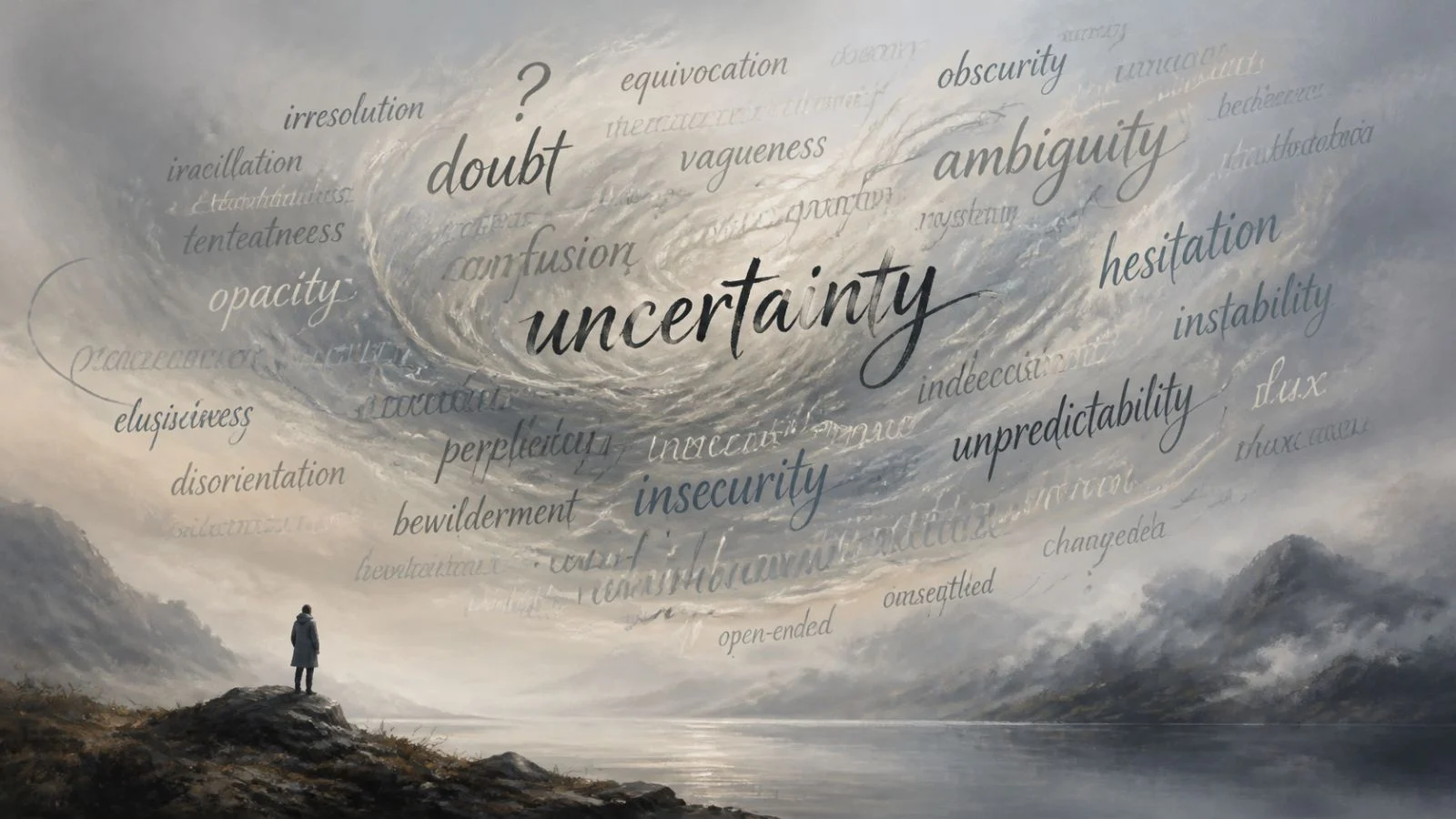
Another word for uncertainty is doubt. Other everyday choices are unsureness, ambiguity, and unpredictability. Each one points to a different kind of “not knowing.”
The best choice depends on meaning and context. Doubt fits a personal feeling. Ambiguity fits unclear words. Unpredictability fits future events. Instability and insecurity fit money, jobs, and politics.
Quick list: doubt, unsureness, hesitation, indecision, ambiguity, vagueness, unpredictability, insecurity, instability, apprehension.
This article covers 30 alternatives. Each one has a meaning, IPA, a usage note, and an example. You will also see tables, word pairs, word partners, and common mistakes.
At a Glance: Uncertainty Synonyms and Related Alternatives
| Alternative | Part of Speech | Meaning | Register / Tone | Ideal Context |
| Doubt | Noun | A feeling that something may not be true | Neutral | Personal choices and beliefs |
| Unsureness | Noun | Lack of confidence in an answer | Neutral | Everyday speech |
| Hesitation | Noun | A pause before acting | Neutral | Behavior and decisions |
| Ambiguity | Noun | More than one possible meaning | Formal | Language, contracts, rules |
| Vagueness | Noun | Lack of clear detail | Neutral | Speech and writing |
| Unpredictability | Noun | Not knowing what comes next | Neutral | Weather, markets, events |
| Instability | Noun | Likely to change or fail | Formal | Politics, prices, systems |
| Insecurity | Noun | Lack of safety or steady footing | Neutral | Jobs, money, feelings |
| Apprehension | Noun | Worry about what may happen | Formal | Waiting for news |
| Limbo | Noun | Waiting with no clear result | Informal | Stalled plans and cases |
Which Word Should You Use?
| If you want to… | Use | Why |
| Show a personal feeling of not being sure | Doubt | It is short and natural in daily speech. |
| Talk about unclear words or rules | Ambiguity | It means a text can be read in two ways. |
| Describe the future as hard to guess | Unpredictability | It focuses on what will happen next. |
| Describe shaky money or jobs | Insecurity | It adds a sense of lost safety. |
| Write about shaky markets or governments | Instability | It fits systems that may fail. |
| Describe a long wait for a result | Limbo | It sounds casual and shows a stalled state. |
| Show worry about a coming event | Apprehension | It adds fear to the doubt. |
| Write in a formal or literary tone | Dubiety | It is rare and sounds old. |
Exploring the Multiple Meanings of “Uncertainty”
1. Not knowing the facts
- Meaning: The state of lacking knowledge about something.
- Explanation: Here, the facts are missing or unclear. Nobody can give a sure answer yet.
- Example: There is still uncertainty about what caused the power cut.
2. Personal doubt or lack of confidence
- Meaning: A feeling of being unsure about a choice or a belief.
- Explanation: This sense is about a person’s mind. It often shows in words, looks, or a pause.
- Example: Her uncertainty showed when she paused before answering the question.
3. An unpredictable future
- Meaning: A situation where you cannot say what will happen.
- Explanation: People use this sense for money, health, and politics. It often appears in news reports.
- Example: Economic uncertainty made many families spend less this year.
4. Lack of clear meaning
- Meaning: Words or signs that are not clear.
- Explanation: Here, the problem lies in the message, not in the person. Ambiguity is the closest word.
- Example: The uncertainty in the rule confused every player on the team.
5. A range of possible error in a measure
- Meaning: The size of doubt around a measured number.
- Explanation: Scientists use this sense on purpose. It tells readers how far a result might be off.
- Example: The lab reported a measurement uncertainty of two percent.
Sources: Merriam-Webster; Collins Dictionary; Dictionary.com; NIST Technical Note 1297.
Analyzing 30 Uncertainty Alternatives in Detail
Some alternatives below are direct synonyms. Others are related words that fit only certain contexts.
Core Everyday Alternatives
1. Doubt
IPA: /daʊt/ (US and UK)
Definition: Doubt means a feeling that something may not be true. It also means you feel unsure about a choice.
- Usage: This is the closest everyday match. However, doubt is milder and more personal than uncertainty.
- Example: She felt no doubt about taking the new job last spring.
2. Unsureness
IPA: US /ʌnˈʃʊrnəs/ · UK /ʌnˈʃɔːnəs/
Definition: Unsureness means you lack confidence in an answer or plan. It also shows in a person’s voice.
- Usage: It is a direct synonym for personal feelings. Still, people use it less often than doubters.
- Example: His unsureness showed when the teacher asked him a hard question.
3. Hesitation
IPA: /ˌhɛzɪˈteɪʃən/ (US and UK)
Definition: Hesitation means a short pause before you act or speak. It also shows you are not sure yet.
- Usage: This word names an act, not a state. It is a related alternative, so use it for pauses.
- Example: He signed the form without any hesitation at the front desk.
4. Indecision
IPA: /ˌɪndɪˈsɪʒən/ (US and UK)
Definition: Indecision means you cannot pick between choices. It also means a long delay in choosing.
- Usage: It is only about decisions. In short, it is a related alternative, not an exact synonym.
- Example: Her indecision cost the team a full week of work.
5. Misgiving
IPA: /mɪsˈɡɪvɪŋ/ (US and UK)
Definition: A misgiving is a small worry that a plan may go wrong. It also often appears in the plural.
- Usage: Writers use it in formal or careful speech. However, it is narrower than uncertainty.
- Example: I had misgivings about driving through the storm that night.
Alternatives for Unclear Meaning
6. Ambiguity
IPA: US /ˌæmbɪˈɡjuːəti/ · UK /ˌæmbɪˈɡjuːɪti/
Definition: Ambiguity means words or facts can have more than one meaning. It also leaves readers unsure what is true.
- Usage: It fits unclear words or facts. For example, a vague rule creates ambiguity.
- Example: The ambiguity in the contract led to a long argument.
7. Vagueness
IPA: /ˈveɪɡnəs/ (US and UK)
Definition: Vagueness means a lack of clear detail. It also makes plans or answers hard to trust.
- Usage: It is a related alternative. However, it fits speech and writing better than feelings.
- Example: The vagueness of his reply left everyone with more questions.
8. Confusion
IPA: /kənˈfjuːʒən/ (US and UK)
Definition: Confusion means you cannot think clearly or tell things apart. It also means a state of mess.
- Usage: This is a related alternative. In fact, confusion often follows uncertainty.
- Example: Confusion spread through the crowd when the lights went out.
9. Haziness
IPA: /ˈheɪzinəs/ (US and UK)
Definition: Haziness means a lack of clear sight or memory. It also fits plans with few details.
- Usage: Writers use it in a figurative way. For example, they speak of a hazy memory.
- Example: The haziness of the plan worried the whole committee.
10. Obscurity
IPA: US /əbˈskjʊrəti/ · UK /əbˈskjʊərɪti/
Definition: Obscurity means the state of being hard to see or understand. It also means being little known.
- Usage: It is a related alternative. However, it fits unclear facts more than feelings.
- Example: The cause of the fire remains in obscurity to this day.
Alternatives for an Unsteady Future
11. Unpredictability
IPA: US /ˌʌnprɪˌdɪktəˈbɪləti/ · UK /ˌʌnprɪˌdɪktəˈbɪlɪti/
Definition: Unpredictability means you cannot say what will happen next. It also covers sudden change.
- Usage: This is a close synonym for future events. For example, people use it for weather and markets.
- Example: The unpredictability of the weather ruined our picnic plans.
12. Insecurity
IPA: US /ˌɪnsɪˈkjʊrəti/ · UK /ˌɪnsɪˈkjʊərɪti/
Definition: Insecurity means a lack of safety or steady footing. It also means a lack of self-trust.
- Usage: It fits jobs, money, and feelings. However, it is not a plain synonym, so use it with care.
- Example: Job insecurity kept many workers awake at night.
13. Instability
IPA: US /ˌɪnstəˈbɪləti/ · UK /ˌɪnstəˈbɪlɪti/
Definition: Instability means something can change or fall apart at any time. It also fits governments and prices.
- Usage: People use it for systems and places. Still, it is a related alternative.
- Example: Political instability scared investors away from the country.
14. Volatility
IPA: US /ˌvɑːləˈtɪləti/ · UK /ˌvɒləˈtɪlɪti/
Definition: Volatility means fast and sharp change. It also describes prices that jump up and down.
- Usage: It is common in finance news. However, it shows swings, no doubt.
- Example: Market volatility made many families delay buying a house.
15. Precariousness
IPA: US /prɪˈkɛriəsnəs/ · UK /prɪˈkeəriəsnəs/
Definition: Precariousness means a shaky state that could fail soon. It also shows a lack of safety.
- Usage: It is a related, formal alternative. For example, writers use it for a weak peace.
- Example: The precariousness of her position kept her from relaxing.
Alternatives for Facts, Data, and Results
16. Inconclusiveness
IPA: /ˌɪnkənˈkluːsɪvnəs/ (US and UK)
Definition: Inconclusiveness means facts do not give a clear answer. It also means a result that settles nothing.
- Usage: Scientists and lawyers use it. However, it is a related alternative, not an exact synonym.
- Example: The inconclusiveness of the test results frustrated the doctors.
17. Indeterminacy
IPA: US /ˌɪndɪˈtɜːrmɪnəsi/ · UK /ˌɪndɪˈtɜːmɪnəsi/
Definition: Indeterminacy means something has no fixed or exact value. It also means a result that cannot be set.
- Usage: It is a formal, technical choice. In fact, you see it in science and law.
- Example: The indeterminacy of the data made the report hard to finish.
18. Imprecision
IPA: /ˌɪmprɪˈsɪʒən/ (US and UK)
Definition: Imprecision means a lack of exact detail. It also means a small error in a number.
- Usage: It is a related alternative. For example, it fits measures and estimates well.
- Example: Imprecision in the survey weakened the final numbers.
19. Contingency
IPA: /kənˈtɪndʒənsi/ (US and UK)
Definition: A contingency is an event that may or may not happen. It also means a backup plan.
- Usage: It is a related alternative. First, it names the possible event, not the doubt.
- Example: We booked extra days as a contingency against bad weather.
20. Risk
IPA: /rɪsk/ (US and UK)
Definition: Risk means a chance that something bad will happen. It also covers the chance of loss.
- Usage: It is not an exact synonym. However, risk has odds you can name.
- Example: Starting a small business always comes with some real risk.
Alternatives for Feelings
21. Apprehension
IPA: /ˌæprɪˈhɛnʃən/ (US and UK)
Definition: Apprehension means a worried feeling about what may happen. It also carries a sense of fear.
- Usage: It is a feeling word. Still, it is a related alternative that adds worry.
- Example: She waited for the results with growing apprehension.
22. Unease
IPA: /ʌnˈiːz/ (US and UK)
Definition: Unease means a mild feeling of worry. It also appears when something seems off.
- Usage: People use it in daily speech. For example, it fits a vague bad feeling.
- Example: A quiet unease settled over the room before the vote.
23. Suspense
IPA: /səˈspɛns/ (US and UK)
Definition: Suspense means the tense of waiting for news or an outcome. It also drives many stories.
- Usage: It is a related alternative. However, suspense can feel exciting.
- Example: The suspense grew while the judges counted the final votes.
24. Skepticism
IPA: /ˈskɛptɪsɪzəm/ (US and UK; UK spelling: scepticism)
Definition: Skepticism means a habit of doubting claims until you see proof. It also means a doubtful mood.
- Usage: It is a related alternative. However, it shows a choice to doubt, not a lack of facts.
- Example: Many voters met the new promise with healthy skepticism.
25. Anxiety
IPA: US /æŋˈzaɪəti/ · UK /æŋˈzaɪɪti/
Definition: Anxiety means a strong feeling of worry or fear. It also can last for weeks.
- Usage: It is a related alternative. In short, anxiety is a feeling that uncertainty can cause.
- Example: Waiting for the exam results filled him with anxiety.
Formal, Literary, and State-Based Alternatives
26. Dubiety
IPA: US /duˈbaɪəti/ · UK /djuːˈbaɪəti/
Definition: Dubiety means a state of doubt. It also sounds formal and a bit old.
- Usage: It is a rare, formal synonym. However, most people prefer doubt in daily speech.
- Example: A note of dubiety crept into the judge’s voice.
27. Irresolution
IPA: /ɪˌrɛzəˈluːʃən/ (US and UK)
Definition: Irresolution means you cannot make up your mind. It also shows a weak will.
- Usage: It is a formal, related alternative. For example, writers use it for hesitant leaders.
- Example: His irresolution frustrated everyone waiting for a final plan.
28. Perplexity
IPA: US /pərˈplɛksəti/ · UK /pəˈplɛksɪti/
Definition: Perplexity means a puzzled state of mind. It also means a thing that is hard to grasp.
- Usage: It is a related alternative. However, it stresses confusion more than doubt.
- Example: She stared at the old map in total perplexity.
29. Limbo
IPA: US /ˈlɪmboʊ/ · UK /ˈlɪmbəʊ/
Definition: Limbo means a state of waiting with no clear result. It also fits a stalled plan.
- Usage: People use it in casual speech. For example, a visa case can stay in limbo.
- Example: Our travel plans remain in limbo until the border opens.
30. Flux
IPA: /flʌks/ (US and UK)
Definition: Flux means constant change. It also means a state where nothing is fixed.
- Usage: It is a related alternative. In fact, you often hear it in the phrase “in flux.”
- Example: The rules are still in flux, so nothing is final.
Sources: Merriam-Webster; Collins Dictionary and Collins Thesaurus; Dictionary.com; Cambridge Dictionary (IPA checks).
Uncertainty vs. Doubt vs. Ambiguity vs. Risk
These four words overlap, but they are not twins. Each one answers a different question.
| Word | Core idea | Where the problem sits | Example |
| Uncertainty | Not knowing | Facts, future, or feelings | There is uncertainty about next year’s budget. |
| Doubt | Not trusting a claim or choice | A person’s mind | I have doubts about this plan. |
| Ambiguity | More than one meaning | Words or signs | The sign’s ambiguity confused drivers. |
| Risk | A chance of loss | Odds you can often name | The trip carries some risk. |
The economist Frank Knight drew a famous line in 1921. He used risk for events with known odds. He used uncertainty for events with unknown odds. Many writers still follow this split in business texts.
Sources: Merriam-Webster; Frank H. Knight, Risk, Uncertainty, and Profit (1921), via the Library of Economics and Liberty.
Uncertainty and Opposite/Paired Word Pairs
| Word | Paired Word | Note |
| Uncertainty | Certainty | The plain opposite. It means being sure. |
| Uncertainty | Confidence | It shows a feeling of trust, not a fact. |
| Uncertainty | Clarity | It is the opposite when the problem has unclear meaning. |
| Uncertainty | Stability | It fits when the problem is a shaky situation. |
| Uncertainty | Predictability | It is the opposite when you talk about the future. |
| Doubt | Faith | This pair fits beliefs and trust. |
Certainty is the closest opposite. The other words fit only one sense of uncertainty. So pick the opposite that matches the sense you use.
Sources: Merriam-Webster; Collins Thesaurus; Dictionary.com.
Common Word Partners of “Uncertainty”
| Pattern | Common Partners | Example |
| Adjective + uncertainty | great, growing, economic, political | Economic uncertainty slowed hiring this year. |
| Verb + uncertainty | face, reduce, ease, create | Clear rules help reduce uncertainty. |
| Uncertainty + preposition | about, over, surrounding | Uncertainty over the vote lasted all night. |
| Noun + of + uncertainty | air, cloud, period, state | A period of uncertainty followed the merger. |
| Uncertainty + noun | principle, range, margin | The report shows a wide margin of uncertainty. |
Sources: Collins Dictionary; Cambridge Dictionary.
Idiomatic Phrases Featuring “Uncertainty”
Uncertainty has few true idioms. The items below are established expressions. They are not idioms in the strict sense.
1. Uncertainty principle
- Meaning: A rule in physics by Werner Heisenberg. It says you cannot know some pairs of facts, such as position and speed, with perfect accuracy at once.
- Example: Students often meet the uncertainty principle in a physics class.
2. Fear, uncertainty, and doubt
- Meaning: A tactic that spreads worry to sway people. Writers often shorten it to FUD.
- Example: The rival firm used fear, uncertainty, and doubt to win customers.
3. Margin of uncertainty
- Meaning: The range in which a true value may fall.
- Example: Pollsters report a margin of uncertainty beside each result.
4. Cloud of uncertainty
- Meaning: A figurative phrase for a mood of doubt that hangs over a group.
- Example: A cloud of uncertainty hung over the company after the news.
Sources: Merriam-Webster; Encyclopaedia Britannica; Collins Dictionary.
Word Formation of “Uncertainty”
Etymology and Structure
Uncertainty has three parts. The prefix un- means “not.” The base certainly comes from Old French, which took it from Latin certus, meaning “sure” or “settled.” The suffix -ty makes a noun that names a state.
Date and History
Etymonline lists the adjective uncertain in English from the late 14th century. The noun uncertainty came later from the same root. Check the Oxford English Dictionary for the exact first date of the noun.
Word Class Variations
- Noun: uncertainty (plural: uncertainties)
- Adjective: uncertain
- Adverb: uncertainly
- Related noun: uncertainness (rare)
- Verb: none exists
Sources: Etymonline; Merriam-Webster; Oxford English Dictionary.
Common Word-Choice Mistakes
- Uncertainty of the exam: uncertainty about the exam.
- Many uncertainty: many uncertainties.
- She is uncertain: she is uncertain.
- Ambiguity for a personal feeling: use doubt or unsureness.
- Volatility for a quiet doubt: use unsureness or unease.
- Skepticism for missing facts: skepticism means a choice to doubt.
- Risk and uncertainty as exact twins: risk has odds you can name.
Frequently Asked Questions
What is the closest synonym for uncertainty?
Doubt is the closest everyday synonym. Unsureness also works well for personal feelings.
What is a formal alternative to uncertainty?
Indeterminacy and dubiety are formal choices. Ambiguity also fits formal writing about unclear meaning.
What is a literary alternative?
Dubiety and irresolution sound literary. Writers use them in old-style or careful prose.
What is the opposite of uncertainty?
Certainty is the plain opposite. Confidence, clarity, and stability fit some senses.
Is uncertainty the same as doubt?
Not always. Doubt is a personal feeling. Uncertainty can also describe facts or events.
What is the difference between uncertainty and ambiguity?
Ambiguity means words can have two meanings. Uncertainty means you lack knowledge or sureness.
Can uncertainty describe the future?
Yes. People often speak of economic or political uncertainty. Unpredictability is a close match here.
Which word fits a long wait for news?
Limbo fits well in casual speech. Suspense fits when the wait feels tense.
Is risk a synonym for uncertainty?
Risk is only a related word. It usually has odds you can name.
Which word shows worry, not just doubt?
Apprehension and anxiety add fear. Unease shows a milder worry.
Conclusion
Doubt is the closest everyday alternative to uncertainty. Unsureness, ambiguity, and unpredictability also work well. Each one fits a different sense.
Context decides the best word. Use doubt for feelings and ambiguity for unclear words. Use unpredictability for the future and instability for shaky systems.
To choose well, ask one question first. Is the problem a feeling, a message, or the future? Then pick the word that matches. Use the tables above when you need a fast check.

Emily Davis is a passionate writer who enjoys exploring English vocabulary, synonyms, and language tips to help readers improve their communication skills.
At PressivoMedia.com, she focuses on creating simple, engaging, and informative content that makes learning English easier and more enjoyable.