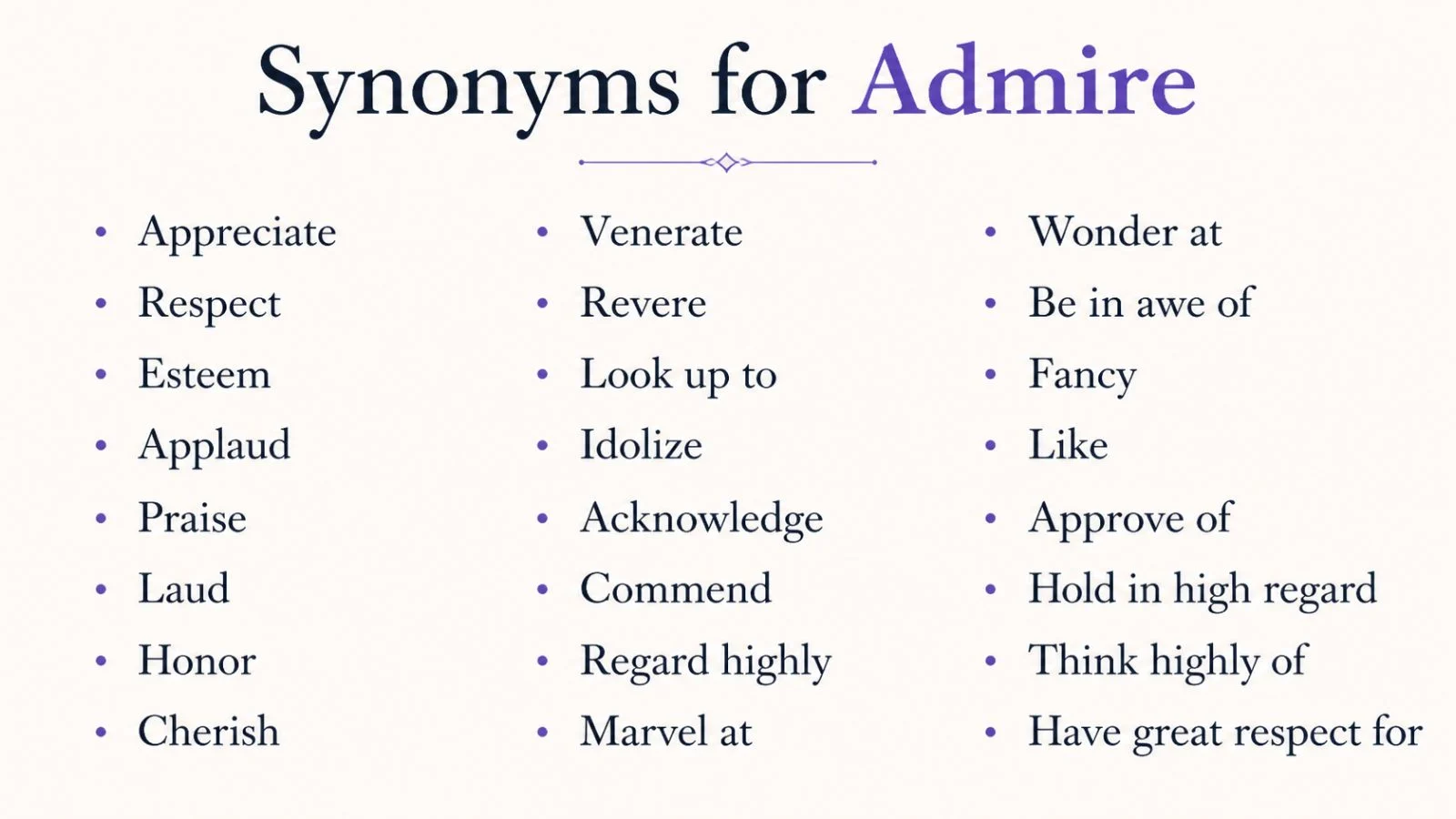
Another word for admiration is respect. Close choices include esteem, appreciation, and look up to. The right word depends on what you mean.
Admire can show respect for a person. It can also show pleasure in a view or praise in words. Some synonyms are strong, like revere and adore.
Others are mild, like value and enjoy. Praise words like applaud and commend focus on speech.
Quick list: respect, esteem, appreciate, look up to, revere, adore, praise, applaud, marvel, cherish
This article looks at 30 alternatives. Each one has a meaning, IPA, a usage note, and an example. You will also see which words are direct synonyms and which are only related.
At a Glance: Admire Synonyms and Related Alternatives
| Alternative | Part of Speech | Meaning | Register / Tone | Ideal Context |
| Respect | Verb | Think well of someone’s worth | Neutral | Work, school, daily talk |
| Esteem | Verb | Hold in deep, warm regard | Formal | Speeches, writing |
| Appreciate | Verb | See and enjoy good qualities | Neutral | Skills, art, effort |
| Look up to | Phrasal verb | Respect as a model | Casual | Family, mentors, heroes |
| Revere | Verb | Feel deep respect and awe | Formal, strong | Leaders, elders, teachers |
| Adore | Verb | Love or admire very much | Warm, strong | Close ties, fans |
| Praise | Verb | Say good things about | Neutral | Feedback, reviews |
| Applaud | Verb | Show approval, often aloud | Neutral | Choices, public acts |
| Marvel | Verb | Feel awe and surprise | Neutral, vivid | Talent, nature, progress |
| Cherish | Verb | Hold dear and protect | Warm | Memories, people, gifts |
Which Word Should You Use?
| If you want to… | Use | Why |
| Show calm respect for a coworker | Respect | It is plain and fits any setting. |
| Sound formal in a speech | Esteem | It has a polished, serious tone. |
| Name a person you want to copy | Look up to | It shows you see them as a model. |
| Show awe for a great leader | Revere | It adds deep honor and awe. |
| Show warm, strong feeling | Adore | It has more heart than admiration. |
| Say good things out loud | Praise | It is about speech, not just feeling. |
| Enjoy a skill or a view | Appreciate | It shows pleasure in good qualities. |
| Show surprise at a talent | Marvel | It adds wonder and disbelief. |
Exploring the Multiple Meanings of “Admire”
1. Respect a Person’s Qualities
- Meaning: To think highly of someone for what they are or do.
- Explanation: This is the most common sense. It also works for groups and ideas.
- Example: I admire my sister because she works hard and stays kind.
2. Look at Something With Pleasure
- Meaning: To enjoy the sight of something beautiful.
- Explanation: Here, admiration is about the eyes. It often goes with views, art, and gardens.
- Example: We stopped to admire the lights along the river.
3. Praise or Compliment Out Loud
- Meaning: To tell someone you think well of them or their work.
- Explanation: People often use this sense in polite speech. It can also be a gentle way to start a chat.
- Example: She admired my new coat as soon as I walked in.
4. Marvel at Something (Older Sense)
- Meaning: To feel wonder or surprise.
- Explanation: Dictionaries now mark this sense as old or rare. You may still see it in older books.
- Example: Old stories say travelers would admire the strange, tall towers.
Sources: Merriam-Webster, Collins English Dictionary, Dictionary.com, Etymonline.
Analyzing 30 Admire Alternatives in Detail
Some alternatives below are direct synonyms. Others are related words that fit only certain contexts.
Core Synonyms
1. respect
/rɪˈspɛkt/ (US and UK)
Respect means you think well of someone’s worth or skill. It also shows you treat them with care.
- Usage: This is the closest everyday synonym. However, it is calmer than admired and has less awe.
- Example: I respect my aunt because she never gave up on her dream.
2. esteem
/ɪˈstiːm/ (US and UK)
Esteem means you hold someone in deep, warm regard. It also shows you rank them high.
- Usage: Esteem is formal and a bit old-fashioned. Still, it works well in speeches and writing.
- Example: Her students esteem her as a fair and kind teacher.
3. appreciate
/əˈpriːʃieɪt/ (US and UK)
Appreciation means you see the value in something. It also means you enjoy its good points.
- Usage: This is a close synonym for skill, art, or effort. However, it is milder and less personal.
- Example: I truly appreciate how much work goes into fresh bread.
4. value
/ˈvæljuː/ (US and UK)
Value means you think something is important and worth keeping. It also covers people and ideas.
- Usage: Value is a related alternative, not an exact synonym. For example, you can value honesty without feeling awe.
- Example: She values her coach’s honest advice more than any praise.
5. prize
/praɪz/ (US and UK)
Prize means you hold something dear because it is rare or good. It also shows you guard it.
- Usage: Prize is a related alternative and mostly fits things. In fact, you often prize a gift or a rare skill.
- Example: Collectors prize this old guitar for its warm sound.
Warm and Emotional Alternatives
6. cherish
/ˈtʃɛrɪʃ/ (US and UK)
Cherish means you hold someone or something dear. It also shows a wish to protect it.
- Usage: Cherish is warm and emotional. However, it shows love more than respect, so it is a related alternative.
- Example: She cherishes the letters her grandfather wrote during the war.
7. treasure
US /ˈtrɛʒər/ · UK /ˈtrɛʒə/
Treasure means you keep something safe because it matters to you. It also shows deep care.
- Usage: Treasure is a related alternative. For example, it fits memories and friends but not skills.
- Example: I treasure the quiet mornings I spend with my grandmother.
8. adore
US /əˈdɔːr/ · UK /əˈdɔː/
Adore means you love or admire someone very much. It also shows a strong, happy feeling.
- Usage: Adore is stronger than admiration. In everyday English, it often shows love, so it is a related alternative.
- Example: The children adore their gentle, funny music teacher.
9. love
/lʌv/ (US and UK)
Love means you feel deep care or great joy about someone. It also works for things you enjoy.
- Usage: Love can replace admiration in casual speech. However, it sounds warmer and more personal.
- Example: I love how calmly she handles a crowded room.
Formal and Strong Alternatives
10. revere
US /rɪˈvɪr/ · UK /rɪˈvɪə/
Revere means you feel deep respect and awe for someone. It also suggests a kind of holy honor.
- Usage: Revere is formal and strong. For example, people revere a great leader or teacher.
- Example: Many singers revere her as the voice of a generation.
11. venerate
/ˈvɛnəreɪt/ (US and UK)
Venerate means you honor a person or thing with deep respect. It also often links to faith or age.
- Usage: Venerate is very formal. In fact, writers use it for saints, elders, and old customs.
- Example: Villagers venerate the old oak tree as a link to their past.
12. honor
US /ˈɑːnər/ · UK /ˈɒnə/ (UK spelling: honour)
Honor means you show great respect to someone in public. It also means you give them a prize or thanks.
- Usage: Honor is a related alternative. It shows an act, so it fits events and awards.
- Example: The school will honor her for forty years of service.
13. worship
US /ˈwɜːrʃɪp/ · UK /ˈwɜːʃɪp/
Worship means you show deep love and respect to a god. It also means you adore a person too much.
- Usage: As a synonym of admire, worship is extreme. However, people also use it for fun, so it is only a related alternative.
- Example: He worships his older brother and copies everything he does.
14. exalt
/ɪɡˈzɔːlt/ (US and UK)
Exalt means you lift someone up in rank or praise. It also means you praise them very highly.
- Usage: Exalt is formal and rare in daily speech. Still, it appears in speeches and old texts.
- Example: The poem exalts the farmers who fed the whole region.
Praise and Approval Alternatives
15. praise
/preɪz/ (US and UK)
Praise means you say good things about someone’s work. It also shows approval.
- Usage: Praise is the main word for admiring out loud. However, you can admire in silence, but you cannot praise in silence.
- Example: The coach praised the team for its steady effort.
16. applaud
/əˈplɔːd/ (US and UK)
Applaud means you clap or speak out to show approval. It also works for ideas and choices.
- Usage: Applaud is a figurative alternative in many cases. For example, you can applaud a brave decision.
- Example: Voters applauded the mayor for her honest answer.
17. compliment
US /ˈkɑːmplɪmənt/ · UK /ˈkɒmplɪmənt/
Compliment means you say something kind about someone. It also means you point out a good trait.
- Usage: Compliment is a related alternative. It shows the act of speaking, but it does not show deep feelings.
- Example: He complimented her on the clear, careful speech.
18. commend
/kəˈmɛnd/ (US and UK)
Commend means you speak well of someone in a formal way. It also often follows good work.
- Usage: Commend is formal and common at work. In fact, bosses often commend staff in reports.
- Example: The mayor commended the firefighters for their quick action.
19. laud
/lɔːd/ (US and UK)
Laud means you praise someone in a strong way. It also hints at a public, formal tone.
- Usage: News writers use laud often. However, it feels stiff in casual conversation.
- Example: Critics lauded the film for its bold, honest story.
20. extol
US /ɪkˈstoʊl/ · UK /ɪkˈstəʊl/
Extol means you praise something with great energy. It also shows long, warm praise.
- Usage: Extol is a related alternative with a formal tone. For example, a guide might extol a city’s food.
- Example: Travelers extol the quiet beaches along the southern coast.
Wonder and Pleasure Alternatives
21. marvel
US /ˈmɑːrvəl/ · UK /ˈmɑːvəl/
Marvel means you feel great surprise and joy at something. It also shows you can hardly believe it.
- Usage: Marvel is close to the older sense of admiration. Today, you use it with “at.”
- Example: We marvel at how fast the baby learns new words.
22. wonder
US /ˈwʌndər/ · UK /ˈwʌndə/
Wonder means you feel awe at something amazing. It also can mean you ask yourself a question.
- Usage: “Wonder at” is a related alternative. In fact, it matches the Latin root of admiration.
- Example: Visitors wonder at the huge stone arches of the old bridge.
23. enjoy
/ɪnˈdʒɔɪ/ (US and UK)
Enjoy means you get pleasure from something. It also means you like having it.
- Usage: Enjoy is a related alternative for the “look at with pleasure” sense. However, it lacks the feeling of respect.
- Example: We stopped to enjoy the view from the hilltop.
24. relish
/ˈrɛlɪʃ/ (US and UK)
Relish means you take great pleasure in something. It also shows you want more of it.
- Usage: Relish is a related alternative. For example, you relish a challenge, not a person.
- Example: He relished the quiet beauty of the lake at dawn.
25. behold
US /bɪˈhoʊld/ · UK /bɪˈhəʊld/
Behold means you look at something, often with awe. It also has an old, poetic tone.
- Usage: Behold is literary and rare. Still, it fits grand views, so it is only a related alternative.
- Example: Climbers paused to behold the sunrise over the snowy peaks.
Role-Model Alternatives
26. look up to
/lʊk ʌp tuː/ (US and UK)
Looking up means you respect someone and see them as a model. It also shows you want to follow them.
- Usage: This is a close, everyday synonym for people. In fact, it is warmer and more casual than respectful.
- Example: Kids often look up to older cousins who seem confident.
27. idolize
/ˈaɪdəlaɪz/ (US and UK)
Idolizing means you love and admire someone too much. It also means you see no faults in them.
- Usage: Idolizing is stronger than admiration. However, it can sound negative, so use it with care.
- Example: She idolized the pilot and read every book about him.
28. emulate
/ˈɛmjəleɪt/ (US and UK)
Emulate means you copy someone you respect. It also means you try to match their skill.
- Usage: Emulate is a related alternative. It shows action after admiration, so it is not an exact synonym.
- Example: Young chefs emulate the calm style of their head cook.
29. approve of
US /əˈpruːv ʌv/ · UK /əˈpruːv ɒv/
Approve means you think something is good or right. It also shows you support it.
- Usage: This is a mild, related alternative. For example, you may approve of a plan without feeling awe.
- Example: My parents approve of the way she runs her shop.
30. think highly of
US /θɪŋk ˈhaɪli ʌv/ · UK /θɪŋk ˈhaɪli ɒv/
Thinking highly means you have a very good view of someone. It also shows trust.
- Usage: This is a natural, everyday alternative. In short, it sounds friendly in both speech and writing.
- Example: Everyone at the office thinks highly of our new manager.
Sources: Merriam-Webster, Collins English Dictionary and Thesaurus, Dictionary.com, Oxford Learner’s Dictionaries.
Admire vs. Respect vs. Adore vs. Revere
These four words share a core idea, but they differ in strength and feeling. The table shows how.
| Word | Main Feeling | Strength | Example |
| Respect | Good opinion of worth | Mild to medium | I respect your honesty. |
| Admire | Respect plus pleasure | Medium | I admire your courage. |
| Adore | Love plus delight | Strong | I adore my little cousin. |
| Revere | Awe and deep honor | Very strong | They revere their founder. |
Pick respect for calm cases revere for awe as adore when love is part of the feeling.
Sources: Merriam-Webster, Collins English Dictionary.
Admire and Opposite/Paired Word Pairs
| Word | Paired Word | Note |
| Admire | Despise | Strong opposite. It shows deep dislike. |
| Admire | Disdain | Formal opposite. It shows proud scorn. |
| Admire | Look down on | Casual opposite. It shows you feel above someone. |
| Admire | Criticize | Contrast in speech. It shows faults, not strengths. |
| Admirer | Critic | A common pair of people. One praises and one judges. |
| Admire | Envy | Related pair. Envy adds a wish to have what others have. |
Admire has no single perfect opposite. Despise and disdain are the closest. Envy is not the opposite, but people often mix it up with admiration.
Sources: Merriam-Webster Thesaurus, Collins English Thesaurus.
Common Word Partners of “Admire”
| Pattern | Common Partners | Example |
| admire + noun | the view, courage, talent, work | We admired the view from the top. |
| admire + someone + for | her honesty, his skill, their effort | I admire him for his patience. |
| adverb + admire | greatly, truly, secretly, openly | She secretly admired her rival. |
| admire + from + place | afar, a distance | He admired the singer from afar. |
| widely/much + admired | leader, writer, design | She is a widely admired author. |
| admired + by | fans, critics, peers | The park is admired by visitors. |
Sources: Collins English Dictionary, Oxford Learner’s Dictionaries.
Idiomatic Phrases Featuring “Admire”
Admire has few true idioms. The items below are established expressions, not idioms in the strict sense.
1. Admire from afar
- Meaning: To like or respect someone from a distance, often without speaking to them.
- Example: For years, he admired the artist from afar.
2. Admire someone’s nerve (or guts)
- Meaning: To respect someone’s boldness, even when you doubt their choice.
- Example: I admire your nerve, but that plan sounds risky.
3. Something to admire
- Meaning: A good quality that deserves respect.
- Example: There is a lot to admire in her calm leadership.
Sources: Merriam-Webster, Collins English Dictionary.
Word Formation of “Admire”
Etymology & Structure
Admire comes from Latin admirari, which means “to wonder at.” It joins ad- (“at”) and mirari (“to wonder”). English took the word through French.
Date and History
The word entered English in the late 1500s. At first, it mostly meant “to wonder at.” Over time, the “respect” sense became the main one.
Word Class Variations
- Verb: admire, admires, admired, admiring
- Noun: admirer, admiration
- Adjective: admirable, admiring, admired
- Adverb: admirably, admiringly
Sources: Etymonline, Merriam-Webster.
Common Word-Choice Mistakes
- Admire him of his skill: admire him for his skill.
- Admire at the view: admire the view.
- I admire you (for romantic love): I adore you, or I love you.
- Admiration of my teacher: admiration for my teacher.
- I venerate my coach (in casual talk): I look up to my coach.
- I idolize my boss (as neutral respect): I respect my boss.
- I praise my teacher (for a silent feeling): I admire my teacher.
Frequently Asked Questions
What is the closest synonym for admire?
Respect is the closest everyday synonym. Esteem and look up to also work well.
What is a formal alternative to admire?
Esteem, reverence, and commend are formal choices. They fit speeches and formal writing.
What is a stronger word than admire?
Adore, revere, and idolize are stronger. They show more feeling or awe.
Is admire the same as respect?
Not quite. Respect is calm, while admiration often adds pleasure or praise.
Can admire mean to look at something?
Yes. You can admire a view, a painting, or a garden.
What is a literary alternative to admire?
Behold and exalt are literary. You will mostly see them in poems and old texts.
What is the opposite of admiration?
Despise and disdain are the closest opposites. Looking down is a casual choice.
Can you admire someone you do not like?
Yes. You can admire a rival’s skill and still dislike them.
Is admire the same as envy?
No. Envy adds a wish to have what the other person has.
Which word fits a role model best?
Look up to fit best. It shows you see the person as a model.
Conclusion
The closest alternatives to admire are respect, esteem, and look up to. These words fit most everyday cases. Appreciate and think highly of and also work well.
Context matters. Revere and adore add strong feelings. Praise, applaud, and commend focus on words. Marvel and enjoy fit the sense of looking with pleasure.
To choose the right word, ask what you mean. Do you feel respect, love, awe, or pleasure? Do you want to speak the praise out loud? Your answer will point you to the best word.

Emily Davis is a passionate writer who enjoys exploring English vocabulary, synonyms, and language tips to help readers improve their communication skills.
At PressivoMedia.com, she focuses on creating simple, engaging, and informative content that makes learning English easier and more enjoyable.