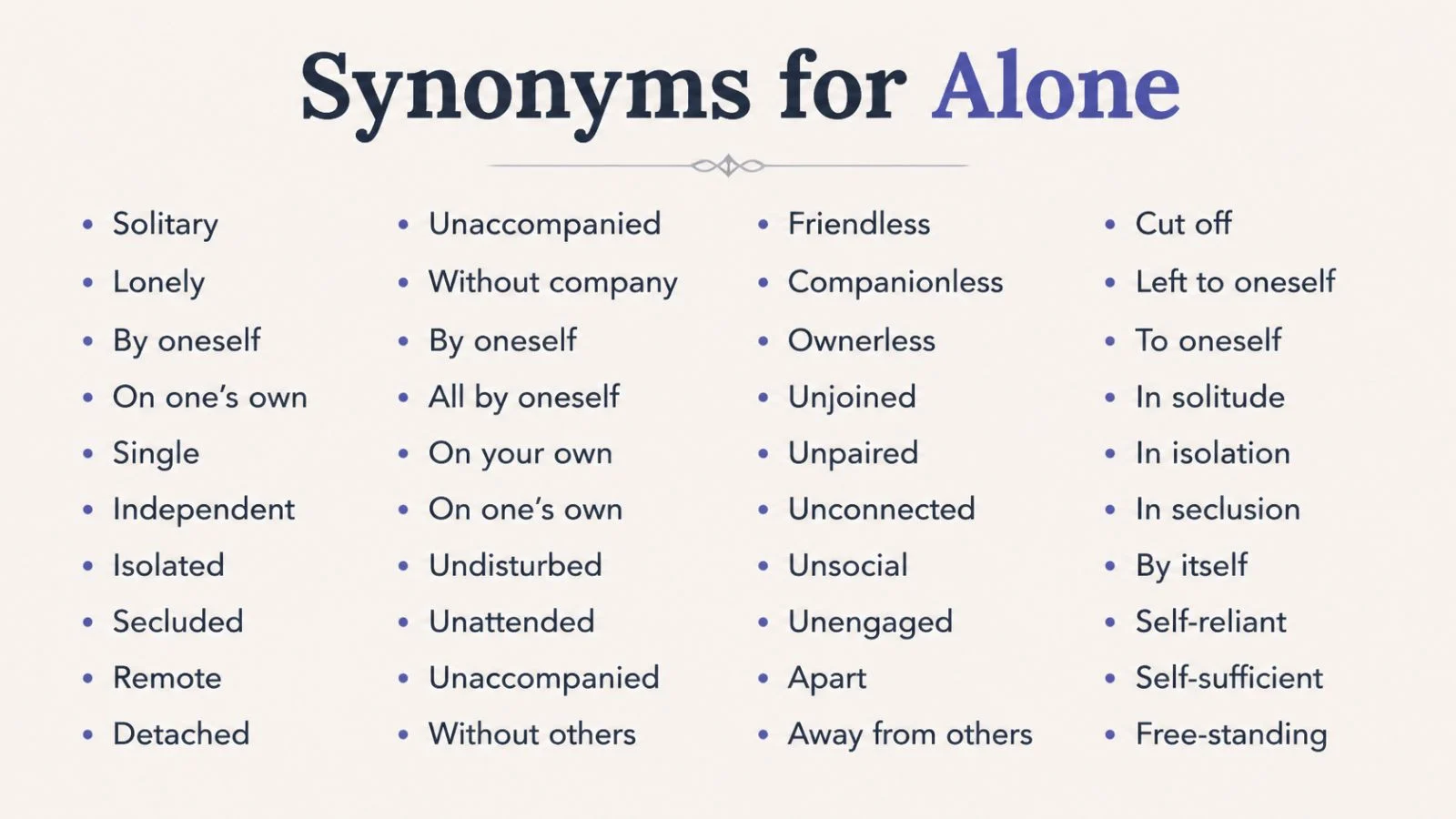
The closest everyday word for alone is “by yourself.” You can also say “on your own,” “solo,” or “lonely.” The best choice depends on meaning and context.
Alone can mean apart from people, sad without company, or without help. It can also mean “only.” Each sense needs a different word, so a plain swap does not always work.
Quick list: by yourself, on your own, solo, solitary, lonely, isolated, unaided, only, lone, unique
This guide looks at 30 alternatives. Each one has a meaning, IPA, a usage note, and an example. You will also see tables, word pairs, idioms, and common mistakes.
At a Glance: Alone Synonyms and Related Alternatives
| Alternative | Part of Speech | Meaning | Register / Tone | Ideal Context |
| By yourself | adverb phrase | with no one else | casual | daily speech |
| On your own | adverb phrase | alone or without help | casual, warm | life choices |
| Solo | adjective, adverb | done by one person | casual | trips, music |
| Solitary | adjective | being alone, often by choice | calm, neutral | people, nature |
| Lonely | adjective | sad from lack of company | emotional | feelings |
| Isolated | adjective | kept apart | neutral | places, social life |
| Unaided | adjective, adverb | without help | formal | skills, the body |
| Only | adverb, adjective | no one or nothing else | neutral | limits |
| Lone | adjective | being the single one | literary | before a noun |
| Unique | adjective | one of a kind | neutral | praise |
Which Word Should You Use?
| If you want to… | Use | Why |
| Say someone has no company | by yourself | It is the plainest match. |
| Show that someone needs no help | on your own | It sounds warm and capable. |
| Name a sad feeling | lonely | It shows emotion, not just fact. |
| Talk about a far-off place | isolated or secluded | Both fit places well. |
| Limit a point to one thing | only or solely | Both mean “and nothing else.” |
| Write a sign or rule | unaccompanied | It sounds formal and exact. |
| Name one item before a noun | lone or sole | These words only come before nouns. |
| Praise something with no equal | unmatched or peerless | Both mean “better than all.” |
Exploring the Multiple Meanings of “Alone”
1. Apart From Others
- Meaning: With no other people nearby.
- Explanation: This is the most common sense. It states a fact and carries no feeling.
- Example: He likes to walk alone before work.
2. Feeling Lonely
- Meaning: Sad because you have no company.
- Explanation: People use alone this way in casual speech. However, being alone and feeling lonely are not the same.
- Example: She felt alone in the new city.
3. Without Help
- Meaning: Doing something with no aid from others.
- Explanation: Here alone often follows a verb. It also shows strength or pride.
- Example: The boy fixed the bike alone.
4. Only or Solely
- Meaning: Not including anyone or anything else.
- Explanation: It often comes right after a noun or pronoun. It sounds a bit formal.
- Example: You alone know the whole story.
5. Without Equal
- Meaning: Unique or beyond compare.
- Explanation: This sense is rare today. Writers use it mostly in the phrase “stand alone.”
- Example: Her skill as a pianist stands alone.
Sources: Merriam-Webster, “alone”; Collins Dictionary, “alone”; Dictionary.com, “alone.”
Analyzing 30 Alone Alternatives in Detail
Some alternatives are direct synonyms. Others are related words that fit only one sense of aloneness.
Everyday Alternatives
1. By Yourself
IPA: US /baɪ jɔːrˈsɛlf/ · UK /baɪ jɔːˈsɛlf/
Definition: Means with no one else around. It also means doing a task with no help.
- Usage: This is the closest everyday match. It works in most cases, so it suits speech and writing.
- Example: She likes to eat lunch by herself on Fridays.
2. On Your Own
IPA: US /ɑːn jɔːr oʊn/ · UK /ɒn jɔːr əʊn/
Definition: Means without company or help. It also hints at freedom.
- Usage: This phrase is warm and casual. It is a direct synonym, and it often sounds positive.
- Example: He moved to a new city on his own.
3. Solo
IPA: US /ˈsoʊloʊ/ · UK /ˈsəʊləʊ/
Definition: Means done by one person. It also names a single music part.
- Usage: People use it for trips, songs, and tasks. However, it feels casual in formal writing.
- Example: She took a solo trip to Spain last summer.
4. Unaccompanied
IPA: (US and UK) /ˌʌnəˈkʌmpənid/
Definition: Means having no one with you. It also fits music with no backing.
- Usage: Signs and rules use it often. However, it does not mean lonely.
- Example: Unaccompanied children must wait at the front desk.
5. Solitary
IPA: US /ˈsɑːləteri/ · UK /ˈsɒlɪtri/
Definition: Means being alone, often by choice. It also means with no others of its kind.
- Usage: It often comes before a noun. Still, it can sound calm instead of sad.
- Example: A solitary hiker crossed the quiet ridge.
Feeling-Based Alternatives
6. Lonely
IPA: US /ˈloʊnli/ · UK /ˈləʊnli/
Definition: Means sad because you lack company. It also means a place with few people.
- Usage: This is a related word, not an exact match. For example, you can feel lonely in a crowd.
- Example: He felt lonely after his friends moved away.
7. Lonesome
IPA: US /ˈloʊnsəm/ · UK /ˈləʊnsəm/
Definition: Means sad because you miss other people. It also suggests a deep wish for company.
- Usage: This word is related, not exact. It sounds old-fashioned, so writers use it for mood.
- Example: The old song sounds lonesome on a quiet night.
8. Isolated
IPA: (US and UK) /ˈaɪsəleɪtɪd/
Definition: Means kept apart from others. It also means far from other places.
- Usage: This is a related alternative. For example, a remote village can feel isolated.
- Example: The cabin sits in an isolated spot near the lake.
9. Forlorn
IPA: US /fərˈlɔːrn/ · UK /fəˈlɔːn/
Definition: Means sad, alone, and left behind. It also carries a sense of loss.
- Usage: This literary word is related, not exact. It fits poems better than daily talk.
- Example: A forlorn dog waited at the empty bus stop.
10. Friendless
IPA: (US and UK) /ˈfrɛndləs/
Definition: Means having no friends. It also suggests having no support.
- Usage: This word is about people, not places. So it is a related alternative.
- Example: He arrived in town friendless and short of money.
11. Companionless
IPA: (US and UK) /kəmˈpænjənləs/
Definition: Means without a partner or friend nearby. It also sounds formal.
- Usage: This word is rare, so save it for careful writing. Still, plain “alone” works better in speech.
- Example: The companionless traveler ate dinner at a small table.
Without-Help Alternatives
12. Independently
IPA: (US and UK) /ˌɪndɪˈpɛndəntli/
Definition: Means without help from others. It also shows freedom from control.
- Usage: This adverb fits only the “without help” sense. For example, students can study independently.
- Example: The students worked independently while the teacher walked around the room.
13. Unaided
IPA: (US and UK) /ʌnˈeɪdɪd/
Definition: Means with no help. It also fits the body, like sight without glasses.
- Usage: It is a formal word. In fact, it often praises a hard feat.
- Example: She walked up the stairs unaided after her surgery.
14. Unassisted
IPA: (US and UK) /ˌʌnəˈsɪstɪd/
Definition: Means done with no help from people or tools. It also names a sports play with no teammate help.
- Usage: It is a bit formal. However, it fits reports and sports well.
- Example: He finished the form unassisted in ten minutes.
15. Single-Handedly
IPA: (US and UK) /ˌsɪŋɡəlˈhændɪdli/
Definition: Means by one person’s own effort. It also hints that the task was big.
- Usage: People use it to praise hard work. For example, one player can win a game single-handedly.
- Example: She single-handedly cleaned the whole house before the guests came.
16. Autonomously
IPA: US /ɔːˈtɑːnəməsli/ · UK /ɔːˈtɒnəməsli/
Definition: Means acting on your own with no outside control. It also fits machines that run themselves.
- Usage: This formal word is related, not exact. It only fits the “without help” sense.
- Example: The robot works autonomously in the warehouse all night.
“Only” Alternatives
17. Only
IPA: US /ˈoʊnli/ · UK /ˈəʊnli/
Definition: Means no one or nothing else. It also limits a point to one thing.
- Usage: This is the plainest swap for the “and nothing else” sense. However, it never means “by yourself.”
- Example: Only you can answer that question for me.
18. Solely
IPA: US /ˈsoʊlli/ · UK /ˈsəʊlli/
Definition: Means for one reason or person and no other. It also sounds firm.
- Usage: It is more formal than “only.” For example, a rule may depend solely on age.
- Example: The decision rests solely with the manager.
19. Exclusively
IPA: (US and UK) /ɪkˈskluːsɪvli/
Definition: Means with no one or nothing else included. It also shows a strict limit.
- Usage: Shops and clubs use it a lot, so it sounds like business English. It is a related word.
- Example: This lounge is open exclusively to hotel guests.
20. Just
IPA: (US and UK) /dʒʌst/
Definition: Means nothing more than. It also helps people downplay a thing.
- Usage: This is a loose match, so check the meaning first. In fact, it fits only the “only” sense.
- Example: It was just a joke, so please do not worry.
Descriptive and Literary Alternatives
21. Lone
IPA: US /loʊn/ · UK /ləʊn/
Definition: Means being the only one in a place. It also means having no partner.
- Usage: It comes only before a noun. For example, you say “a lone tree,” not “a tree is lone.”
- Example: A lone tree stood in the middle of the field.
22. Sole
IPA: US /soʊl/ · UK /səʊl/
Definition: Means being the only one of its kind. It also means not shared.
- Usage: This is a related word because it points to one item. It does not mean lonely.
- Example: She is the sole owner of the small bakery.
23. Secluded
IPA: (US and UK) /sɪˈkluːdɪd/
Definition: Means private and out of sight. It also means quiet, with few people near.
- Usage: It fits places more than people. Still, it often sounds peaceful.
- Example: They found a secluded beach away from the crowds.
24. Apart
IPA: US /əˈpɑːrt/ · UK /əˈpɑːt/
Definition: Means away from others. It also means set to one side.
- Usage: It often follows a verb, such as “stand” or “live.” However, it is only a related word.
- Example: He stood apart from the group at the party.
25. Reclusive
IPA: (US and UK) /rɪˈkluːsɪv/
Definition: Means choosing to live away from people. It also shows a love of privacy.
- Usage: This word is about habits, not one moment. So it is related, not exact.
- Example: The reclusive writer rarely leaves her home in the hills.
“Without Equal” Alternatives
26. Unique
IPA: US /juˈniːk/ · UK /juːˈniːk/
Definition: Means one of a kind. It also means nothing else.
- Usage: It fits the rare “without equal” sense of alone. However, it never means “by yourself.”
- Example: Her style is unique and easy to spot.
27. Unmatched
IPA: (US and UK) /ʌnˈmætʃt/
Definition: Means better than all others. It also means having no equal.
- Usage: People use it for skill and quality. For example, a coach may have an unmatched record.
- Example: His speed in the final lap was unmatched.
28. Peerless
IPA: US /ˈpɪrləs/ · UK /ˈpɪələs/
Definition: Means having no equal. It also has a formal tone.
- Usage: This is a literary word. Still, it can praise a star or a work.
- Example: She gave a peerless show on the stage that night.
29. Unrivaled
IPA: (US and UK) /ʌnˈraɪvəld/
Definition: Means with no rival. It also means best in its field.
- Usage: British spelling is “unrivalled.” In fact, both forms are correct.
- Example: The hotel offers an unrivaled view of the bay.
30. Singular
IPA: US /ˈsɪŋɡjələr/ · UK /ˈsɪŋɡjʊlə/
Definition: Means one of a kind or very unusual. It also means a single thing.
- Usage: It is formal and literary. However, it is a distant match, so use it with care.
- Example: The painter had a singular talent for color.
Sources: Merriam-Webster; Collins Dictionary and Collins Thesaurus; Dictionary.com; Cambridge Dictionary (pronunciation checks).
Alone vs. Lonely vs. Lonesome vs. Solitary
These four words share a root idea. They differ in feeling and tone.
| Word | Core Idea | Feeling | Example |
| Alone | No one else is there | Neutral | She sat alone on the porch. |
| Lonely | Sad about having no company | Sad | He felt lonely at the party. |
| Lonesome | Sad, with a longing for others | Sad, old-fashioned | The lonesome cowboy sang softly. |
| Solitary | Being apart, often by choice | Calm | A solitary monk lived on the hill. |
Alone states a fact. Lonely names a feeling. As a result, a person can be alone and happy, or lonely in a crowd.
Sources: Merriam-Webster; Collins Dictionary; Dictionary.com.
Alone and Opposite/Paired Word Pairs
| Word | Paired Word | Note |
| Alone | Together | The most common opposite. |
| Alone | Accompanied | A formal opposite. |
| Alone | With others | A plain, everyday contrast. |
| Solo | Group | Used for music and sports. |
| On your own | With help | Used for tasks. |
Together is the best natural opposite for alone. Other pairs depend on the sense. For example, “with help” only fits the “without help” meaning.
Sources: Merriam-Webster; Collins Thesaurus.
Common Word Partners of “Alone”
| Pattern | Common Partners | Example |
| verb + alone | live, work, travel, sit, stand | She lives alone in a small flat. |
| all + alone | all alone | The child sat all alone in the dark. |
| alone + with | alone with my thoughts | He wanted to be alone with his thoughts. |
| alone + noun | alone time | I need some alone time after work. |
| noun/pronoun + alone | you alone, money alone | Money alone cannot fix this problem. |
| not + alone | you are not alone | You are not alone in this. |
Sources: Collins Dictionary; Merriam-Webster; Cambridge Dictionary.
Idiomatic Phrases Featuring “Alone”
These are established expressions. “Let alone” and “go it alone” are true idioms.
- Leave alone
- Meaning: To stop bothering a person or to not touch a thing.
- Example: Please leave the dog alone while it eats.
- Let alone
- Meaning: And certainly not. It adds a stronger case to a negative point.
- Example: I cannot afford a bike, let alone a car.
- Go it alone
- Meaning: To act without help or support from others.
- Example: After the split, she decided to go it alone.
- Stand alone
- Meaning: To be unique or to need no support.
- Example: This film stands alone in its field.
Sources: Merriam-Webster; Collins Dictionary; Dictionary.com.
Word Formation of “Alone”
Etymology & Structure
Alone comes from Middle English “al one.” That means “all one.” The word joins “all” and “one.”
Date and History
Merriam-Webster dates alone to the 13th century. Etymonline dates the “and nothing else” sense to about 1200. It dates the “unaccompanied” sense to about 1300.
Word Class Variations
- Adjective: alone (usually after a verb, as in “she is alone”)
- Adverb: alone (as in “he works alone”)
- Noun: aloneness (rare)
- Related words: lone, loner, lonely
Sources: Merriam-Webster; Etymonline, “alone.”
Common Word-Choice Mistakes
- She is alone: say “She is alone.” Lone only comes before a noun.
- An alone man: say “a lone man.”
- He lives lonely: say “He lives alone.”
- Leave me lonely: say “Leave me alone.”
- I cannot cook, leave alone bake: say “let alone bake.”
- I enjoy being lonely on Sundays: say “alone” if you mean no company.
- He went solitary: say “He went alone” or “He went solo.”
Frequently Asked Questions
What is the closest synonym for alone?
“By yourself” is the closest everyday match. “On your own” is a good second choice.
Is alone the same as lonely?
No. Alone is a fact, and loneliness is a feeling. You can be alone and happy.
What is a formal alternative to alone?
Unaccompanied, unaided, and solely are formal choices. Each fits a different sense.
What is a literary alternative?
Forlorn, lone, and solitary suit stories and poems. They add mood and tone.
What is the opposite of alone?
Together is the most common opposite. Accompanied is the formal choice.
Can alone mean only?
Yes. It can follow a noun or pronoun, as in “you alone know.”
What is the difference between alone and alone?
Alone usually follows a verb. Lone comes before a noun, as in “a lone tree.”
What word shows a sad kind of loneliness?
Lonely, lonesome, and forlorn all show sadness. Lonely is the most common.
What word means alone by choice?
Solitary and reclusive fit people who like to be alone. Solo fits trips and tasks.
What is another word for doing a task alone?
Independently, unaided, and single-handedly all fit. Each one shows work done without help.
Conclusion
The closest everyday alternatives to alone are “by yourself,” “on your own,” and “solo.” They fit most cases. Lonely, isolated, and solitary cover feelings and places.
Context decides the best word. Alone can mean apart, sad, without help, or only. Each sense has its own set of choices.
To pick the right word, first find the sense you mean. Next, check the tone you need. Finally, test the word in your sentence.

Emily Davis is a passionate writer who enjoys exploring English vocabulary, synonyms, and language tips to help readers improve their communication skills.
At PressivoMedia.com, she focuses on creating simple, engaging, and informative content that makes learning English easier and more enjoyable.