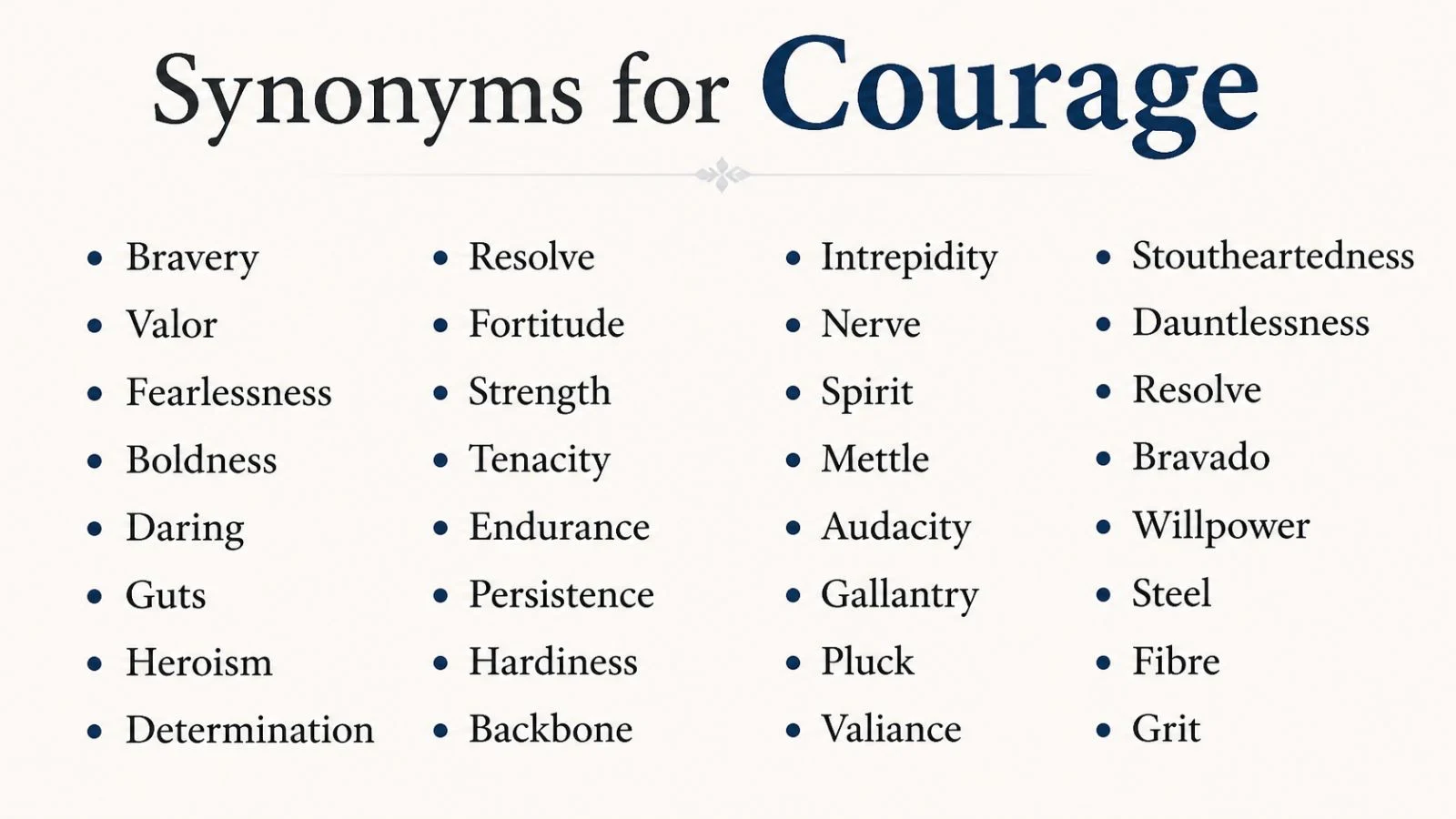
The closest another word for courage is bravery. Other common choices are valor, boldness, and fortitude. Each one fits a slightly different case.
The best choice depends on meaning and context. For example, courage can mean facing danger, speaking up, or enduring pain. It can also mean the spirit to try something new. So you need a word that fits the case.
Quick list: bravery, valor, boldness, fortitude, grit, guts, nerve, resolve, fearlessness, daring.
This article covers 30 alternatives. Each entry gives a meaning, IPA, a usage note, and an example. You will also find tables, word partners, and idioms.
At a Glance: Courage Synonyms and Related Alternatives
| Alternative | Part of Speech | Meaning | Register / Tone | Ideal Context |
| Bravery | noun | Facing danger without giving in | Neutral | Everyday and formal use |
| Valor | noun | Great bravery, often in battle | Formal | Military honors, history |
| Boldness | noun | Readiness to take risks | Neutral | Speaking up, new ventures |
| Fortitude | noun | Strength of mind in pain or loss | Formal | Illness, long hardship |
| Resolve | noun | Firm choice to keep going | Neutral | Goals, tough choices |
| Grit | noun | Courage plus staying power | Informal | Sports, hard work |
| Guts | noun | Plain, casual courage | Informal | Casual speech |
| Nerve | noun | Courage to do a risky thing | Informal | Daily life |
| Heroism | noun | Brave acts that help others | Formal | Rescues, sacrifice |
| Pluck | noun | Lively courage in a hard test | Dated, warm | Praise for underdogs |
Which Word Should You Use?
| If you want to… | Use | Why |
| Say it in plain, simple English | Bravery | It is the closest everyday match. |
| Honor a soldier | Valor | It carries a sense of honor and war. |
| Praise strength during long pain | Fortitude | It stresses patience over time. |
| Sound casual with friends | Guts | It is short and informal. |
| Praise someone who keeps trying | Grit | It stresses staying power. |
| Praise someone for speaking up | Backbone | It shows firm inner strength. |
| Write in a literary style | Intrepidity | It sounds formal and rich. |
| Warn about foolish risk | Rashness | It shows courage without thought. |
Exploring the Multiple Meanings of “Courage”
1. Facing Fear and Danger
- Meaning: The power to act when something scares you.
- Explanation: This is the main sense. It often involves risk to your body or life.
- Example: The lifeguard showed courage when she dove into the rough water.
2. Moral Courage
- Meaning: The will to do what is right, even when it costs you.
- Explanation: Here the risk is social or personal. It also means standing alone for a belief.
- Example: It took courage to report the problem to her own boss.
3. Strength in Pain or Hardship
- Meaning: The ability to bear pain, loss, or long trouble.
- Explanation: This sense is quiet. It is about enduring, not about a single brave act.
- Example: He faced his illness with courage and a calm smile.
4. Spirit to Try Something New
- Meaning: The nerve to take a first step.
- Explanation: The risk here is small. It also covers phrases like “take courage.”
- Example: She finally found the courage to apply for the job.
5. Heart or Spirit (Old Sense)
- Meaning: In older English, the heart as the seat of feelings and temper.
- Explanation: This sense is rare today. It is the root of the modern meaning.
- Example: Old texts use the word for a person’s inner mood.
Sources: Etymonline (etymonline.com/word/courage); Merriam-Webster; Collins Dictionary; Dictionary.com.
Analyzing 30 Courage Alternatives in Detail
Some alternatives are direct synonyms. Others are related words that fit only certain contexts.
Core Synonyms
1. Bravery
IPA: /ˈbreɪvəri/ (US and UK)
Definition: It means the ability to face danger without giving in. It also covers calm action when you feel afraid.
- Usage: This is the closest everyday match for courage. In fact, many people use the two words as twins.
- Example: The firefighter showed great bravery when she entered the burning house.
2. Valor
IPA: US /ˈvælər/ · UK /ˈvælə/
Definition: It means great bravery, often in a fight. It also suggests honor and pride.
- Usage: People use it in formal or war settings. For example, medals often honor valor. UK spelling is valour.
- Example: The soldier received a medal for his valor during the battle.
3. Boldness
IPA: US /ˈboʊldnəs/ · UK /ˈbəʊldnəs/
Definition: It means a willingness to take risks and act with confidence. It also shows a lack of shyness.
- Usage: This is a related alternative, not an exact match. However, it fits when someone takes a daring step.
- Example: Her boldness in speaking up surprised the whole team.
4. Fearlessness
IPA: US /ˈfɪrləsnəs/ · UK /ˈfɪələsnəs/
Definition: It means having no fear at all. It also suggests someone who never doubts a risk.
- Usage: Courage often means acting despite fear. So fearlessness is a slightly different idea.
- Example: The young climber’s fearlessness amazed everyone watching from the ground.
5. Daring
IPA: US /ˈdɛrɪŋ/ · UK /ˈdeərɪŋ/
Definition: It means a bold readiness to take risks. It also shows a love of adventure.
- Usage: It fits exciting or risky acts. Still, it is a related word because it can sound reckless.
- Example: The rescue was a daring act that saved three lives.
6. Heroism
IPA: US /ˈhɛroʊˌɪzəm/ · UK /ˈherəʊɪzəm/
Definition: It means brave acts that help others. It also carries a sense of great praise.
- Usage: It is stronger than courage in most cases. For example, people use it for rescues or sacrifice.
- Example: The town praised the nurse for her heroism during the flood.
Inner Strength Alternatives
7. Fortitude
IPA: US /ˈfɔrtɪˌtud/ · UK /ˈfɔːtɪtjuːd/
Definition: It means strength of mind during pain or hard times. It also shows calm patience.
- Usage: This is a formal word. However, it fits courage that lasts through long trouble.
- Example: He faced his long illness with quiet fortitude.
8. Resolve
IPA: US /rɪˈzɑlv/ · UK /rɪˈzɒlv/
Definition: It means a firm choice to keep going. It also shows a strong will.
- Usage: This is a related alternative. In fact, it stresses decision more than fear.
- Example: Her resolve grew stronger after each hard training day.
9. Backbone
IPA: US /ˈbækˌboʊn/ · UK /ˈbækbəʊn/
Definition: It means inner strength to stand firm. It also means the will to speak up or act.
- Usage: People use it in casual speech. For example, you might say a leader lacks backbone.
- Example: It took backbone to tell the boss the plan would fail.
10. Mettle
IPA: /ˈmɛtl/ (US and UK)
Definition: It means a person’s inner strength and spirit. It also shows how well someone handles a test.
- Usage: It often appears in the phrase “test your mettle.” However, it sounds formal and a bit old.
- Example: The long race tested her mettle in every way.
11. Grit
IPA: /ɡrɪt/ (US and UK)
Definition: It means firm courage and the will to keep trying. It also shows toughness when things get hard.
- Usage: Grit stresses staying power more than facing danger. Still, it is a popular modern word.
- Example: The team showed real grit and won in the final minute.
12. Determination
IPA: US /dɪˌtɜrməˈneɪʃən/ · UK /dɪˌtɜːmɪˈneɪʃən/
Definition: It means a strong wish to finish what you start. It also shows a firm mind.
- Usage: This is a related alternative. In short, it is about will rather than fear.
- Example: Her determination helped her finish the marathon despite the pain.
Informal and Everyday Alternatives
13. Guts
IPA: /ɡʌts/ (US and UK)
Definition: It means courage in plain, casual speech. It also suggests the nerve to do something tough.
- Usage: This word is informal. So avoid it in formal writing.
- Example: It takes guts to start a business with no money.
14. Nerve
IPA: US /nɜrv/ · UK /nɜːv/
Definition: It means the courage to do a hard or risky thing. It also can mean cheek.
- Usage: The word has two sides. However, in some phrases it shows rude boldness, not praise.
- Example: She finally found the nerve to ask for a raise.
15. Pluck
IPA: /plʌk/ (US and UK)
Definition: It means lively courage in a small or hard test. It also shows spirit.
- Usage: It sounds a bit old-fashioned. Still, people use it as warm praise, as in “a plucky kid.”
- Example: The little dog showed pluck and chased off the bigger one.
16. Spunk
IPA: /spʌŋk/ (US and UK)
Definition: It means spirit and courage in a lively way. It also suggests energy.
- Usage: It is informal and friendly in US English. However, in British slang it can sound rude.
- Example: The young actor showed real spunk on her first day.
17. Moxie
IPA: US /ˈmɑksi/ · UK /ˈmɒksi/
Definition: It means courage mixed with skill and energy. It also shows a confident, can-do attitude.
- Usage: This is an informal word, mostly from US English. For example, bosses may praise a worker with moxie.
- Example: The new manager has the moxie to fix this problem.
Formal and Literary Alternatives
18. Gallantry
IPA: /ˈɡæləntri/ (US and UK)
Definition: It means brave and noble conduct. It also can mean polite manners toward women.
- Usage: It is formal and often military. However, the polite-manners meaning is a different sense.
- Example: He earned a medal for gallantry under fire.
19. Intrepidity
IPA: US /ˌɪntrəˈpɪdəti/ · UK /ˌɪntrɪˈpɪdəti/
Definition: It means bold courage with no fear of danger. It also suggests a love of adventure.
- Usage: It is rare and formal. So use it in literary writing only.
- Example: The explorer’s intrepidity took her to the edge of the ice.
20. Hardihood
IPA: US /ˈhɑrdiˌhʊd/ · UK /ˈhɑːdihʊd/
Definition: It means tough courage in hard times. It also can mean bold daring.
- Usage: It is an old, literary word. Still, it shows courage mixed with toughness.
- Example: The settlers showed great hardihood during the long winter.
21. Valiance
IPA: /ˈvæljəns/ (US and UK)
Definition: It means brave and strong conduct. It also suggests noble effort.
- Usage: This is a literary word. In fact, valor is far more common today.
- Example: The poem praises the valiance of the knights.
22. Derring-do
IPA: US /ˌdɛrɪŋ ˈdu/ · UK /ˌderɪŋ ˈduː/
Definition: It means bold, adventurous action. It also has a playful, storybook feel.
- Usage: This is a related, playful term. For example, writers use it for adventure tales.
- Example: The movie is full of sword fights and old-fashioned derring-do.
Related Qualities (Not Exact Synonyms)
23. Tenacity
IPA: /təˈnæsəti/ (US and UK)
Definition: It means refusing to give up. It also shows a firm hold on a goal.
- Usage: It is a related alternative. However, it links to persistence, not fear.
- Example: Her tenacity won the case after three long years.
24. Resilience
IPA: /rɪˈzɪliəns/ (US and UK)
Definition: It means the power to recover after a hard time. It also shows flexible strength.
- Usage: It is a related alternative. In short, it names how you bounce back.
- Example: The town showed resilience after the storm destroyed many homes.
25. Confidence
IPA: US /ˈkɑnfɪdəns/ · UK /ˈkɒnfɪdəns/
Definition: It means trust in your own skills. It also shows a calm belief that you can act.
- Usage: It is related but not exact. For example, a confident person may still lack courage.
- Example: She spoke with confidence in front of the large crowd.
26. Composure
IPA: US /kəmˈpoʊʒər/ · UK /kəmˈpəʊʒə/
Definition: It means staying calm under stress. It also shows control of your feelings.
- Usage: It is a related alternative. Still, courage often needs composure.
- Example: The pilot kept his composure when the engine failed.
Risky or False Courage
27. Audacity
IPA: US /ɔˈdæsəti/ · UK /ɔːˈdæsəti/
Definition: It means bold daring that may ignore rules. It also can mean rude cheek.
- Usage: It can praise or blame. In fact, it often sounds negative today.
- Example: He had the audacity to ask for a free upgrade.
28. Bravado
IPA: US /brəˈvɑdoʊ/ · UK /brəˈvɑːdəʊ/
Definition: It means a show of courage that is not real. It also covers loud, boastful acts.
- Usage: This is not a true synonym. In fact, it is false courage.
- Example: His bravado faded when the real test began.
29. Temerity
IPA: /təˈmerəti/ (US and UK)
Definition: It means reckless boldness. It also shows a lack of care about risks.
- Usage: This is not a true synonym. However, writers use it for risky boldness, often with blame.
- Example: She had the temerity to challenge the champion.
30. Rashness
IPA: /ˈræʃnəs/ (US and UK)
Definition: It means acting fast without thought about risk. It also shows poor judgment.
- Usage: It is the other side of wise courage. So use it to warn, not to praise.
- Example: His rashness put the whole crew in danger.
Sources: Merriam-Webster; Collins Thesaurus; Dictionary.com; Etymonline.
Courage vs. Bravery vs. Fortitude
| Word | Main Focus | Best Use |
| Courage | Facing fear, danger, or pain | Everyday and formal writing |
| Bravery | Brave acts in the moment | Rescues, battles, short tests |
| Fortitude | Lasting strength in pain | Illness, loss, long hardship |
Dictionaries often treat courage and bravery as close synonyms. However, many writers use bravery for single acts. Courage can also cover quiet, long-term strength. Fortitude leans toward patience under pressure. So pick the word that matches the kind of test.
Sources: Merriam-Webster; Collins Dictionary.
Courage and Opposite/Paired Word Pairs
| Word | Paired Word | Note |
| Courage | Cowardice | The standard opposite. |
| Courage | Fear | A contrast. Courage often works with fear, not without it. |
| Bravery | Timidity | Timidity means being shy or easily scared. |
| Boldness | Caution | A mild contrast between risk and care. |
| Resolve | Hesitation | Hesitation means pausing from doubt. |
| Courage | Conviction | A common pair. People act on what they believe. |
Cowardice is the clearest opposite of courage. Fear is not a true opposite. In fact, many people say courage means acting even when you feel fear.
Sources: Merriam-Webster; Collins Thesaurus.
Common Word Partners of “Courage”
| Pattern | Common Partners | Example |
| verb + courage | show, find, summon, muster, lose, take | She had to summon courage before the speech. |
| adjective + courage | great, moral, physical, quiet, personal | Moral courage is rare in public life. |
| courage + to + verb | courage to speak, to ask, to try, to change | He had the courage to say no. |
| courage + in the face of | danger, fear, loss, doubt | They showed courage in the face of danger. |
| act / show of + courage | act of courage, show of courage | Saving the child was an act of courage. |
| courage and + noun | courage and determination, courage and honesty | The team won with courage and skill. |
Sources: Collins Dictionary; Merriam-Webster.
Idiomatic Phrases Featuring “Courage”
1. Dutch courage
- Meaning: Bold feeling that comes from drinking alcohol.
- Example: He needed some Dutch courage before he sang on stage.
2. The courage of one’s convictions
- Meaning: The will to act on what you believe.
- Example: She had the courage of her convictions and quit the firm.
3. Pluck up courage
- Meaning: To gather your nerve before doing something hard.
- Example: He plucked up courage and asked her to dance.
4. Screw up one’s courage
- Meaning: To force yourself to feel brave enough to act.
- Example: She screwed up her courage and knocked on the door.
Sources: Merriam-Webster; Collins Dictionary; Dictionary.com.
Word Formation of “Courage”
Etymology & Structure
Courage came into English from Old French corage. That word meant heart or inner feelings. It comes from Latin cor, which means heart. French built it from a word for heart plus the noun ending -age.
Date and History
Etymonline dates the English word to about 1300. At first it meant the heart as the seat of feelings. It later grew to mean spirit and mood. Over time it narrowed to mean bravery. The adjective courageous also dates to about 1300.
Word Class Variations
- Noun: courage, courageousness
- Adjective: courageous
- Adverb: courageously
- Related verbs: encourage, discourage (discourage dates to the mid-1400s)
- Related nouns: encouragement, discouragement
Sources: Etymonline (etymonline.com/word/courage); Merriam-Webster.
Common Word-Choice Mistakes
Do a courage: show courage.
Courage person: courageous person.
He courages me: he encourages me.
Very courage: very courageous.
Pluck up a courage: pluck up courage.
Praising someone’s bravado: use bravery or courage, because bravado means false courage.
Dutch courage as praise: it means bravery from alcohol, not true bravery.
Frequently Asked Questions
What is the closest synonym for courage?
Bravery is the closest. Most dictionaries list the two words together.
What is a formal alternative to courage?
Fortitude, valor, and gallantry are formal choices. Each fits a slightly different case.
What is a casual alternative to courage?
Guts and nerve are the most common. Moxie and spunk also work in friendly talk.
What is the opposite of courage?
Cowardice is the main opposite. Timidity is a softer contrast.
Is courage the same as bravery?
They are very close. However, bravery often points to a single act, while courage can be quiet and long-lasting.
What is a literary word for courage?
Intrepidity, hardihood, and valiance are literary choices. They suit poems and old-style stories.
Can courage mean strength in pain?
Yes. People often use courage for calm strength during illness or loss. Fortitude is a close match.
Is boldness a true synonym for courage?
Not always. Boldness stresses risk and confidence, while courage stresses facing fear.
Is bravado a form of courage?
No. Bravado is a show of courage that is not real.
Can you use courage for small acts?
Yes. It can mean the nerve to try something new, such as asking a question.
Conclusion
The closest words for courage are bravery, valor, and fortitude. Guts, nerve, and grit work well in casual speech. Many other words fit smaller shades of meaning.
Context matters most. Bravery fits quick acts, while fortitude fits long hardship. Also, some words, such as bravado and temerity, show risk or false courage.
To choose well, first ask what kind of courage you mean. Next, think about your tone. Then pick the word that fits the case.

Emily Davis is a passionate writer who enjoys exploring English vocabulary, synonyms, and language tips to help readers improve their communication skills.
At PressivoMedia.com, she focuses on creating simple, engaging, and informative content that makes learning English easier and more enjoyable.