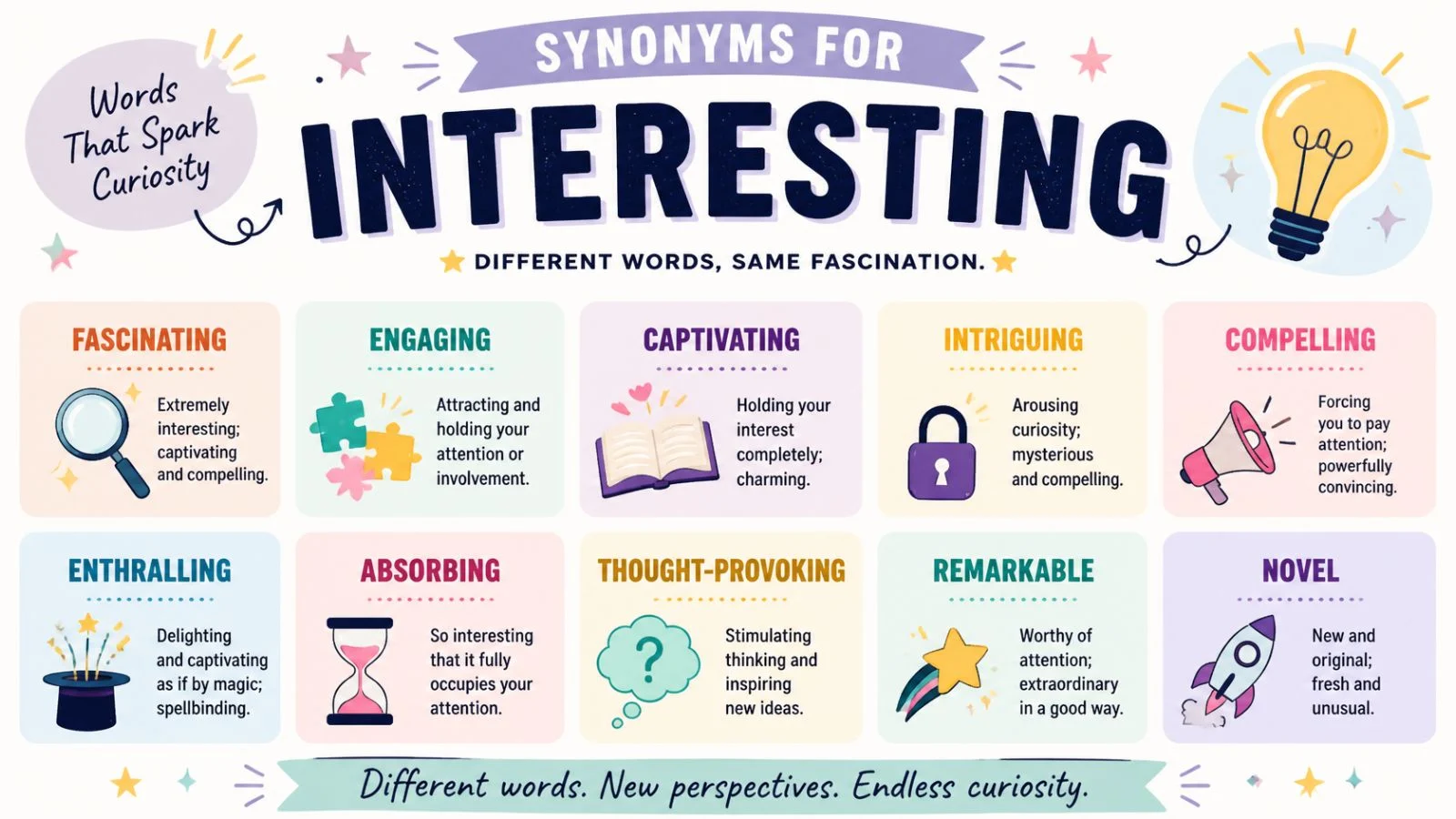
Another word for “interesting” is “engaging,” “fascinating,” or “intriguing.” These are the closest everyday choices. Each one holds your attention, but each does it in a slightly different way.
The best choice depends on meaning and context. “Interesting” can mean fun, odd, deep, or worth noticing. So you need a word that matches the exact feeling you want to show.
Quick list: engaging, fascinating, intriguing, absorbing, captivating, compelling, thought-provoking, stimulating, curious, entertaining
This article looks at 30 alternatives. Each one has a meaning, IPA, a usage note, and an example. You will also see which words are true synonyms and which are related choices.
At a Glance: Interesting Synonyms and Related Alternatives
| Alternative | Part of Speech | Meaning | Register / Tone | Ideal Context |
| Engaging | Adjective | Pleasant and good at holding attention | Neutral, warm | Talks, teachers, writing |
| Fascinating | Adjective | Very interesting, holds full attention | Neutral, strong | Facts, history, science |
| Intriguing | Adjective | Interesting because it is odd or mysterious | Neutral | Puzzles, secrets, ideas |
| Absorbing | Adjective | Takes all your focus | Neutral | Books, games, hobbies |
| Compelling | Adjective | Hard to ignore | Neutral, strong | Stories, arguments |
| Thought-provoking | Adjective | Makes you think hard | Neutral, formal | Essays, films, debates |
| Stimulating | Adjective | Full of ideas that wake the mind | Positive, formal | Classes, talks, places |
| Curious | Adjective | Odd in an interesting way | Neutral | Strange objects, details |
| Unusual | Adjective | Not common | Neutral | Habits, objects, events |
| Entertaining | Adjective | Fun to watch or read | Neutral, light | Shows, stories, videos |
Which Word Should You Use?
| If you want to… | Use | Why |
| Praise a speaker or teacher | Engaging | It shows warmth and skill. |
| Show strong delight in a fact | Fascinating | It is stronger than “interesting.” |
| Hint at a mystery | Intriguing | It adds curiosity. |
| Describe a book you can’t put down | Absorbing | It shows deep focus. |
| Praise an idea that makes people think | Thought-provoking | It points to new questions. |
| Describe something odd but charming | Quirky | It adds a fun, unique feel. |
| Describe a fun show | Entertaining | It points to fun, not depth. |
| Write in a formal report | Noteworthy | It sounds professional. |
Exploring the Multiple Meanings of “Interesting”
1. Holding Your Attention
- Meaning: Keeping your mind busy and engaged.
- Explanation: This is the most common sense. It also covers things you enjoy reading, hearing, or watching.
- Example: The museum has an interesting display about old trains.
2. Sparking Curiosity
- Meaning: Making you want to learn more.
- Explanation: Here the thing feels new or unclear. As a result, you ask questions.
- Example: Her plan sounds interesting, so I want to hear more.
3. Unusual or Odd
- Meaning: Different from what you expect.
- Explanation: The word can show a mild surprise. It can also hide a doubt.
- Example: He wore an interesting hat to the quiet meeting.
4. Worth Noticing
- Meaning: Important or worth your notice.
- Explanation: Etymonline lists an older sense of “that concerns, important.” Today people use “noteworthy” for this idea.
- Example: The report has one interesting point about sleep and memory.
5. A Polite, Vague Comment
- Meaning: A mild reply that hides your real opinion.
- Explanation: People say “That’s interesting” when they are unsure. However, the tone decides the meaning.
- Example: She said “interesting” when she saw my new haircut.
Sources: Merriam-Webster, Collins English Dictionary, Online Etymology Dictionary (Etymonline)
Analyzing 30 Interesting Alternatives in Detail
Some alternatives below are direct synonyms. Others are related words that fit only certain contexts.
Core Synonyms
1. Engaging
IPA: /ɪnˈɡeɪdʒɪŋ/ (US and UK)
Definition: Engaging means pleasant and good at holding your attention. It also shows a warm, friendly style.
- Usage: This is a close synonym. It works for people, stories, and talks. However, it sounds softer than “fascinating.”
- Example: The teacher gave an engaging talk that kept every student listening.
2. Fascinating
IPA: /ˈfæsɪneɪtɪŋ/ (US and UK)
Definition: Fascinating is about something so interesting that it holds your full attention. It also suggests deep curiosity.
- Usage: This is a close synonym with more force. For example, it fits science, history, and rare facts.
- Example: The guide shared fascinating facts about ancient Egypt.
3. Intriguing
IPA: /ɪnˈtriːɡɪŋ/ (US and UK)
Definition: Intriguing means interesting because it is odd or mysterious. It also makes you want to know more.
- Usage: This is a close synonym with a curious tone. In fact, it fits puzzles and secrets best.
- Example: The letter had an intriguing note about a hidden room.
4. Absorbing
IPA: US /əbˈsɔːrbɪŋ/ · UK /əbˈzɔːbɪŋ/
Definition: Absorbing shows something that takes all your focus. It also fits tasks and stories you cannot put down.
- Usage: People use it for books, games, and hobbies. However, it is less common for people.
- Example: She read an absorbing novel on the long train ride.
5. Captivating
IPA: /ˈkæptɪveɪtɪŋ/ (US and UK)
Definition: Captivating means very charming and hard to look away from. It also shows a strong pull on your attention.
- Usage: Use it for voices, smiles, and shows. Still, it sounds warmer than “interesting.”
- Example: The singer gave a captivating show to a packed hall.
Strong, Gripping Alternatives
6. Compelling
IPA: /kəmˈpelɪŋ/ (US and UK)
Definition: Compelling talks about something so strong that you must pay attention. It also can be very convincing.
- Usage: This is a related word, not an exact match. It fits stories and arguments. However, it is much stronger than “interesting.”
- Example: The film tells a compelling story about a young farmer.
7. Riveting
IPA: /ˈrɪvɪtɪŋ/ (US and UK)
Definition: Riveting means so exciting that you cannot look away. It also suggests fast, tense action.
- Usage: It is a strong related word. For example, people use it for thrillers and live games.
- Example: We watched a riveting match until the very last minute.
8. Gripping
IPA: /ˈɡrɪpɪŋ/ (US and UK)
Definition: Gripping means holding your attention in a tight, tense way. It also fits stories with high stakes.
- Usage: This is a related word for suspense. However, it does not suit quiet topics.
- Example: Her gripping account of the storm kept us on edge.
9. Enthralling
IPA: /ɪnˈθrɔːlɪŋ/ (US and UK)
Definition: Enthralling is about something so charming or exciting that it holds your mind. It also feels a bit like magic.
- Usage: It sounds rich and a little formal. In fact, writers use it more than speakers do.
- Example: The old tale proved enthralling for children and adults alike.
10. Spellbinding
IPA: /ˈspelbaɪndɪŋ/ (US and UK)
Definition: Spellbinding means so interesting that it feels like a spell. It also fits great speakers and tales.
- Usage: This is a strong, literary choice. For example, you might use it in a review.
- Example: The author gave a spellbinding talk about life at sea.
Thought and Idea Alternatives
11. Thought-provoking
IPA: US /ˈθɔːt prəˌvoʊkɪŋ/ · UK /ˈθɔːt prəˌvəʊkɪŋ/
Definition: Thought-provoking means making you think hard about an idea. It also leads to new questions.
- Usage: It is a related word, not an exact match. Still, it suits essays, films, and debates.
- Example: The documentary was thought-provoking and left us talking for hours.
12. Stimulating
IPA: /ˈstɪmjəleɪtɪŋ/ (US and UK)
Definition: Stimulating shows something full of ideas that wake up your mind. It also gives energy to your thinking.
- Usage: Use it for talks, classes, and places. In short, it is positive and a bit formal.
- Example: The class was stimulating and full of lively debate.
13. Enlightening
IPA: /ɪnˈlaɪtənɪŋ/ (US and UK)
Definition: Enlightening means giving you new and useful knowledge. It also helps you see a topic more clearly.
- Usage: This is a related word. However, it fits only things that teach you something.
- Example: Her speech was enlightening for everyone new to the topic.
14. Noteworthy
IPA: US /ˈnoʊtˌwɜːrði/ · UK /ˈnəʊtˌwɜːði/
Definition: Noteworthy means worth your notice because it is special or important. It also fits facts and results.
- Usage: It is a formal, related word. For example, reports and news use it often.
- Example: The study shared one noteworthy result about sleep.
15. Remarkable
IPA: US /rɪˈmɑːrkəbəl/ · UK /rɪˈmɑːkəbəl/
Definition: Remarkable is about something unusual enough that people take notice. It also can show high praise.
- Usage: This is a related word. However, it points to quality or surprise, not simple interest.
- Example: She made a remarkable recovery after a long illness.
Unusual or Odd Alternatives
16. Curious
IPA: US /ˈkjʊriəs/ · UK /ˈkjʊəriəs/
Definition: Curious means odd or strange in an interesting way. It also describes a person who wants to learn.
- Usage: As a synonym, it fits odd things and details. However, a curious person is eager to learn, not “interesting.”
- Example: We found a curious little shop at the end of the lane.
17. Peculiar
IPA: US /pɪˈkjuːliər/ · UK /pɪˈkjuːliə/
Definition: Peculiar means strange in a way that draws notice. It also can sound a little negative.
- Usage: This is a related word. In fact, it often hints at something slightly odd.
- Example: The soup had a peculiar taste that nobody could name.
18. Unusual
IPA: /ʌnˈjuːʒuəl/ (US and UK)
Definition: Unusual shows something not common or not what you expect. It also suits things that stand out.
- Usage: It is a related word for “different.” However, unusual things are not always pleasant.
- Example: He has an unusual hobby of collecting old keys.
19. Quirky
IPA: US /ˈkwɜːrki/ · UK /ˈkwɜːki/
Definition: Quirky means odd in a fun and charming way. It also fits people with unique habits.
- Usage: This is an informal, related word. For example, people use it for shops, films, and friends.
- Example: The café has a quirky style with mismatched chairs.
20. Offbeat
IPA: US /ˌɔːfˈbiːt/ · UK /ˌɒfˈbiːt/
Definition: Offbeat means different from the usual way. It also suggests a fresh, playful style.
- Usage: It is informal and related. Still, it shows “unusual” more than “interesting.”
- Example: We chose an offbeat film from a small studio.
Fun and Casual Alternatives
21. Entertaining
IPA: US /ˌentərˈteɪnɪŋ/ · UK /ˌentəˈteɪnɪŋ/
Definition: Entertaining means fun to watch, hear, or read. It also keeps people happy.
- Usage: This is a related word for fun. However, an entertaining thing may not teach you anything.
- Example: The magician gave an entertaining show for the kids.
22. Amusing
IPA: /əˈmjuːzɪŋ/ (US and UK)
Definition: Amusing means funny enough to make you smile. It also fits light, playful things.
- Usage: It is a related word. In fact, it points to humor, not deep interest.
- Example: He told an amusing story about his first job.
23. Appealing
IPA: /əˈpiːlɪŋ/ (US and UK)
Definition: Appealing shows something pleasant that attracts people. It also suggests something you would like to try.
- Usage: This is a related word. For example, you can call an offer or a plan appealing.
- Example: The new menu has many appealing choices for lunch.
24. Cool
IPA: /kuːl/ (US and UK)
Definition: Cool means great or impressive in a casual way. It also shows that you like something.
- Usage: This is a slang-like, related word. However, it fits friends and chats, not formal writing.
- Example: That is a cool idea for the school project.
25. Neat
IPA: /niːt/ (US and UK)
Definition: Neat means clever or pleasing in an informal way. It also shows mild delight.
- Usage: It is a casual, related word. Still, it sounds a bit old-fashioned to some people.
- Example: I found a neat trick for folding shirts quickly.
Formal, Literary, and Descriptive Alternatives
26. Engrossing
IPA: US /ɪnˈɡroʊsɪŋ/ · UK /ɪnˈɡrəʊsɪŋ/
Definition: Engrossing is about something that takes all of your attention. It also suggests long, deep focus.
- Usage: This is a close synonym of “absorbing.” Next, you can use it for books and tasks.
- Example: The engrossing mystery kept him awake well past midnight.
27. Arresting
IPA: /əˈrestɪŋ/ (US and UK)
Definition: Arresting means so striking that it stops you and draws your eyes. It also fits bold images.
- Usage: It is a formal, related word. For example, critics use it for art and design.
- Example: The poster had an arresting image of a lone tree.
28. Striking
IPA: /ˈstraɪkɪŋ/ (US and UK)
Definition: Striking means clearly noticeable and very impressive. It also fits looks, facts, and contrasts.
- Usage: This is a related word. However, it points to what you see more than what you think.
- Example: There is a striking difference between the two maps.
29. Alluring
IPA: US /əˈlʊrɪŋ/ · UK /əˈlʊərɪŋ/
Definition: Alluring means attractive in a way that tempts you. It also suggests mystery.
- Usage: This is a literary, related word. In fact, it adds a charm that “interesting” lacks.
- Example: The alluring smell of fresh bread filled the street.
30. Beguiling
IPA: /bɪˈɡaɪlɪŋ/ (US and UK)
Definition: Beguiling means charming in a way that holds your attention. It also can hint at trickery.
- Usage: This is a rare, literary, related word. Still, it suits writing about art or people.
- Example: The beguiling tune stayed in her head all day.
Sources: Merriam-Webster, Collins English Dictionary and Thesaurus, Dictionary.com
Interesting vs. Intriguing vs. Fascinating
These three words sit on a scale of strength. “Interesting” is the mildest. “Fascinating” is the strongest.
| Word | Strength | Feeling | Example |
| Interesting | Mild | You pay attention. | The book is interesting. |
| Intriguing | Medium | You want to solve something. | The clue is intriguing. |
| Fascinating | Strong | You are held by the topic. | The story is fascinating. |
So pick “interesting” for a plain, safe comment. Next, pick “intriguing” when a mystery is involved. Finally, pick “fascinating” when you feel real delight.
Sources: Merriam-Webster, Collins English Dictionary
Interesting and Opposite/Paired Word Pairs
| Word | Paired Word | Note |
| Interesting | Boring | The most common opposite. |
| Interesting | Dull | A softer opposite for weak topics. |
| Interesting | Uninteresting | The direct negative form. |
| Fascinating | Tedious | Shows a long, tiring task. |
| Engaging | Flat | Shows a lack of energy in a talk. |
| Interesting | Interested | A learner pair. The first describes the thing and the second describes the person. |
The first four pairs are true opposites. The last pair is a different kind of pair. It shows how “-ing” and “-ed” endings work. Etymonline also lists “uninteresting” as a word built from “un-” and “interesting.”
Sources: Merriam-Webster, Collins English Dictionary, Etymonline
Common Word Partners of “Interesting”
| Pattern | Common Partners | Example |
| Adverb + interesting | very, really, quite, rather, most | It was a really interesting trip. |
| Interesting + noun | fact, idea, story, question, person, point | That is an interesting question. |
| Find + something + interesting | find it, find them | I find her ideas interesting. |
| It is interesting + to / that | to note, to see, that | It is interesting that he left early. |
| Make for interesting | make for interesting reading | The old letters make for interesting reading. |
Sources: Collins English Dictionary, Merriam-Webster
Idiomatic Phrases Featuring “Interesting”
“Interesting” has few true idioms. The items below are established expressions, and the first is the best known.
1. May you live in interesting times
- Meaning: A wish that sounds kind but warns of trouble. People often call it a Chinese curse. However, no clear Chinese source has been confirmed.
- Example: With prices rising so fast, we live in interesting times.
2. In an interesting condition
- Meaning: A dated, polite way to say “pregnant.” Etymonline dates this use to 1748.
- Example: The old novel says the lady was in an interesting condition.
3. Make for interesting reading
- Meaning: To be worth reading because the content is rich or odd.
- Example: The court papers make for interesting reading.
4. That’s interesting
- Meaning: A polite reply that can show real interest or hidden doubt.
- Example: When I shared my plan, he just said, “That’s interesting.”
Sources: Etymonline, Merriam-Webster, Collins English Dictionary
Word Formation of “Interesting”
Etymology & Structure
“Interesting” is the present-participle adjective of the verb “interest.” The verb comes from Latin interesse, which means “to be between” or “to concern.” So the word has a base, “interest,” and the ending “-ing.”
Date and History
Etymonline dates “interesting” to 1711 with the sense “that concerns, important.” The sense “engaging the attention” appears by 1751.
Word Class Variations
- Verb: interest
- Noun: interest, interestedness
- Adjective: interesting, interested, uninteresting
- Adverb: interestingly
Sources: Etymonline
Common Word-Choice Mistakes
- “I am interested in art”: I am interested in art.
- “The movie was very interesting”: The movie was very interesting.
- “It is interesting for me”: It is interesting to me.
- “She is an interested speaker”: She is an interesting speaker.
- “He was disinterested in the show”: He was uninterested in the show. Careful writers use “disinterested” to mean “neutral.”
- “This is more interestinger”: This is more interesting.
- “The topic is fascinating”: The topic is fascinating.
Frequently Asked Questions
What is the closest synonym for interesting?
“Engaging” is the closest everyday synonym. “Fascinating” and “intriguing” are also very close.
What is a stronger word than interesting?
“Fascinating” is stronger. “Riveting” and “spellbinding” are stronger still.
What is a formal alternative to interesting?
“Noteworthy” and “stimulating” sound formal. Reports and essays often use them.
What is a literary alternative to interesting?
“Beguiling” and “alluring” feel literary. Writers use them in stories and reviews.
What is the difference between interesting and interesting?
“Interesting” describes the thing that holds attention. “Interested” describes the person who feels the attention.
What is the opposite of interesting?
“Boring” is the most common opposite. “Dull” and “uninteresting” also work.
Can it be interesting to describe a person?
Yes. It shows that the person is engaging or unusual. Context decides whether it is praise.
What does “that’s interesting” really mean?
It can show real interest. However, it can also be a polite way to hide doubt.
Is “intriguing” the same as “interesting”?
Not quite. “Intriguing” adds mystery and makes you want to know more.
Is “curious” a good synonym for interesting?
Yes, for odd things. However, “curious” for a person means eager to learn.
Conclusion
The closest alternatives to “interesting” are “engaging,” “fascinating,” and “intriguing.” They fit most everyday cases. Each one adds a small change in feeling.
Context matters most. “Quirky” suits odd and charming things. “Thought-provoking” suits ideas. “Entertaining” suits fun.
To choose well, ask what you want to show. Then pick the word that fits that feeling. In short, a precise word beats a vague one.

Emily Davis is a passionate writer who enjoys exploring English vocabulary, synonyms, and language tips to help readers improve their communication skills.
At PressivoMedia.com, she focuses on creating simple, engaging, and informative content that makes learning English easier and more enjoyable.