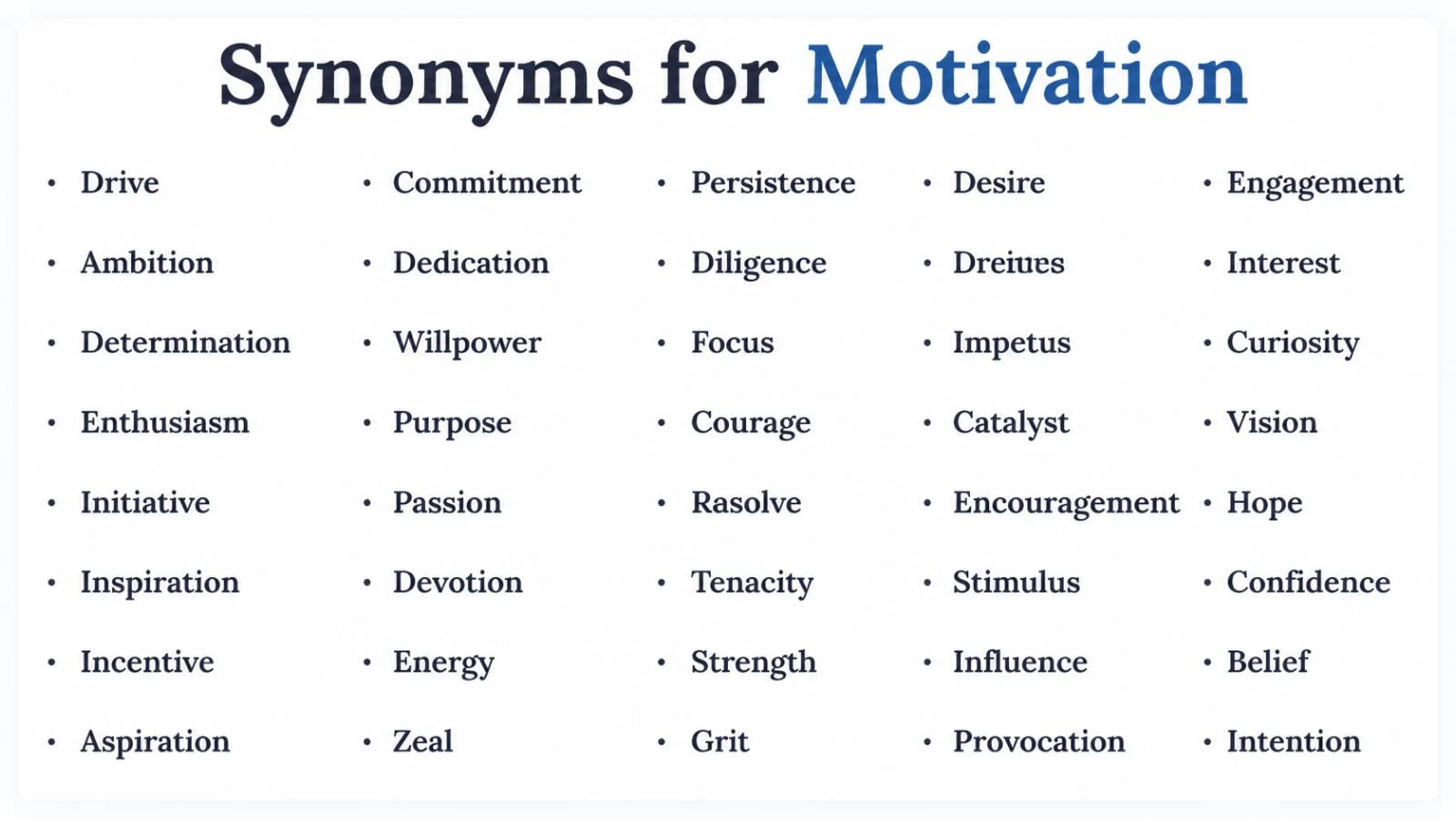
Another word for motivation is drive, incentive, or inspiration. These are the closest everyday choices.
The best choice depends on what you mean. Motivation can mean a reason, an inner push, or a reward.
Some words talk about reasons, such as motive and purpose. Others show energy, such as drive and zeal. A few names outside pushes, such as incentive and reward.
Quick list:
- Drive
- Incentive
- Inspiration
- Impetus
- Ambition
- Determination
- Enthusiasm
- Motive
- Encouragement
- Momentum
This article looks at 30 alternatives. Each one has a meaning, IPA, and an example. Each entry also has a usage note. You will see context tips and common mistakes as well.
At a Glance: Motivation Synonyms and Related Alternatives
| Alternative | Part of Speech | Meaning | Register / Tone | Ideal Context |
| Drive | noun | Inner push to reach a goal | Neutral | Work, sport, study |
| Incentive | noun | Reward that makes you act | Neutral, business | Pay, sales, school |
| Inspiration | noun | Spark of ideas or energy | Warm, positive | Art, writing, speeches |
| Impetus | noun | Force that starts an action | Formal | Change, policy, news |
| Ambition | noun | Strong wish to succeed | Neutral | Career, big goals |
| Determination | noun | Firm will to keep going | Neutral | Hard tasks |
| Enthusiasm | noun | Bright interest and energy | Upbeat | Hobbies, teamwork |
| Motive | noun | Reason behind an act | Neutral, formal | Law, stories, daily life |
| Encouragement | noun | Support that gives hope | Warm | School, coaching |
| Momentum | noun | Steady progress that builds | Neutral | Projects, teams, sport |
Which Word Should You Use?
| If you want to… | Use | Why |
| Name a prize or bonus | Incentive | It points to an outside reward. |
| Show energy from within | Drive | It stresses effort that starts inside you. |
| Describe a creative spark | Inspiration | It fits ideas and art. |
| Explain why someone acted | Motive | It answers the question “why?” |
| Describe what starts a change | Impetus | It sounds formal and fits reports. |
| Praise someone who will not quit | Determination | It shows firm effort in hard times. |
| Show support from other people | Encouragement | It names help that comes from outside. |
| Show progress that feeds itself | Momentum | It fits projects and teams. |
Exploring the Multiple Meanings of “Motivation”
1. Inner Drive
- Meaning: The inner wish that keeps you working toward a goal.
- Explanation: This is the most common sense. It shows effort that starts inside you.
- Example: Her motivation to learn English grew with every new friend.
2. Reason for Acting
- Meaning: The cause behind what a person does.
- Explanation: Here the word answers “why?” Writers and police also use it this way.
- Example: Police could not find a clear motivation for the crime.
3. Outside Reward or Push
- Meaning: Something that makes people want to act.
- Explanation: In this sense, the push comes from outside. A prize or praise can do this.
- Example: Free lunch was enough motivation to join the meeting.
4. The Act of Motivating
- Meaning: The act of making others want to do something.
- Explanation: Managers and teachers talk about this as a skill. It also takes time and trust.
- Example: Good teachers know that motivation takes patience and clear praise.
5. Motivation in Psychology
- Meaning: The forces that start and guide how living things act.
- Explanation: Researchers often split it into inner and outer types. They also study how it changes over time.
- Example: The class studied motivation and how rewards change daily habits.
Sources: Merriam-Webster; Collins English Dictionary; Dictionary.com; Cambridge Dictionary.
Analyzing 30 Motivation Alternatives in Detail
Some alternatives below are direct synonyms. Others are related words that fit only some contexts.
Core Synonyms
1. Incentive
IPA: /ɪnˈsentɪv/ (US and UK)
Definition: An incentive is something that makes you want to act. It also often comes as a prize or pay.
- Usage: This word is close to outside motivation. However, it always points to a reward.
- Example: The bonus gave the team a strong incentive to finish early.
2. Drive
IPA: /draɪv/ (US and UK)
Definition: Drive is a strong inner push to reach a goal. It also shows steady energy and effort.
- Usage: This is a direct match for inner motivation. In everyday English, people use it for work and sport.
- Example: Her drive to win kept her training before sunrise every day.
3. Inspiration
IPA: US /ˌɪnspəˈreɪʃən/ · UK /ˌɪnspɪˈreɪʃn/
Definition: Inspiration is a sudden spark of ideas or energy. It also can come from a person or place.
- Usage: Use it when motivation feels bright and new. However, it says less about steady effort.
- Example: Her grandmother’s story gave her the inspiration to start a business.
4. Impetus
IPA: US /ˈɪmpətəs/ · UK /ˈɪmpɪtəs/
Definition: Impetus is the force that starts or speeds up an action. It also fits plans and changes.
- Usage: This word is formal. For example, news reports use it for big shifts.
- Example: The new law gave schools the impetus to change their lunch menus.
5. Stimulus
IPA: US /ˈstɪmjələs/ · UK /ˈstɪmjʊləs/
Definition: A stimulus is something that sparks action or growth. It also can mean a plan that boosts the economy.
- Usage: This is a related word, not an exact synonym. In fact, it often means a trigger, not a feeling.
- Example: Praise from her coach was the stimulus she needed to try again.
Inner Energy and Goals
6. Ambition
IPA: /æmˈbɪʃn/ (US and UK)
Definition: Ambition is a strong wish to succeed or gain power. It also points to big goals.
- Usage: This is a related word. However, it names the goal more than the push behind it.
- Example: His ambition to become a doctor shaped every choice he made.
7. Determination
IPA: US /dɪˌtɝːməˈneɪʃən/ · UK /dɪˌtɜːmɪˈneɪʃn/
Definition: Determination means you keep going when things get hard. It also shows a firm choice to finish.
- Usage: It is a close match for motivation. However, it stresses effort more than the reason.
- Example: Her determination got her through three years of night classes.
8. Passion
IPA: /ˈpæʃn/ (US and UK)
Definition: Passion is a deep love for an activity or cause. It also gives people lasting energy.
- Usage: This is a related word. For example, a passion for art can fuel daily practice.
- Example: His passion for music got him up early to practice.
9. Enthusiasm
IPA: US /ɪnˈθuːziæzəm/ · UK /ɪnˈθjuːziæzəm/
Definition: Enthusiasm is bright energy and interest in something. It also spreads easily to others.
- Usage: Think of this as a related word, not an exact match. Still, it often lights the spark of motivation.
- Example: The new teacher brought great enthusiasm to every class.
10. Initiative
IPA: /ɪˈnɪʃətɪv/ (US and UK)
Definition: Initiative is the habit of acting first without being told. It also means a fresh plan or effort.
- Usage: This is a related word. In short, it shows self-made motivation at work.
- Example: She showed initiative by fixing the problem before anyone asked.
Reasons Behind Action
11. Motive
IPA: US /ˈmoʊtɪv/ · UK /ˈməʊtɪv/
Definition: A motive is the reason behind what someone does. It also can be a hidden aim.
- Usage: This is the root word of motivation. However, it names one reason, not the whole drive.
- Example: Money was not his only motive for taking the job.
12. Reason
IPA: /ˈriːzn/ (US and UK)
Definition: A reason is a cause or aim for an act. It also explains why something happens.
- Usage: It is a plain, everyday match. However, it feels less strong than motivation.
- Example: My main reason for running is to stay healthy.
13. Purpose
IPA: US /ˈpɝːpəs/ · UK /ˈpɜːpəs/
Definition: Purpose is the aim that gives your acts meaning. It also shows what you want to reach.
- Usage: People use this as a related word. For example, a sense of purpose can keep you going.
- Example: Volunteering gave him a new purpose after he retired.
14. Rationale
IPA: US /ˌræʃəˈnæl/ · UK /ˌræʃəˈnɑːl/
Definition: A rationale is the set of reasons behind a choice. It also often appears in formal writing.
- Usage: This is a related word, not a synonym. In fact, it explains logic, not feeling.
- Example: The report explains the rationale for the new school rules.
15. Inducement
IPA: US /ɪnˈduːsmənt/ · UK /ɪnˈdjuːsmənt/
Definition: An inducement is something offered to make a person act. It also can be a gift or a deal.
- Usage: This is a formal choice. However, it can sound like a bribe in some cases.
- Example: The company offered free training as an inducement to stay.
Outside Pushes
16. Encouragement
IPA: US /ɪnˈkɝːɪdʒmənt/ · UK /ɪnˈkʌrɪdʒmənt/
Definition: Encouragement means words or acts that give someone hope. It also builds the trust to try.
- Usage: It is outside support for motivation. As a result, it helps most when effort feels hard.
- Example: Her teacher’s kind encouragement helped her finish the book.
17. Spur
IPA: US /spɝː/ · UK /spɜː/
Definition: A spur is something that pushes you to act fast. It also comes from horse riding.
- Usage: This word fits figures of speech. For example, a loss can be a spur to train harder.
- Example: The tight deadline was a spur to finish the work.
18. Push
IPA: /pʊʃ/ (US and UK)
Definition: A push is a nudge that moves someone to act. It also can mean a strong effort.
- Usage: This word is casual and short. However, it is only a loose match for motivation.
- Example: Her friends gave her the push she needed to apply.
19. Prompting
IPA: US /ˈprɑːmptɪŋ/ · UK /ˈprɒmptɪŋ/
Definition: Prompting is a gentle reminder to act. It also often comes from another person.
- Usage: Here the word is related, not exact. In short, it starts action but does not keep it going.
- Example: He cleaned his room without any prompting from his parents.
20. Reward
IPA: US /rɪˈwɔːrd/ · UK /rɪˈwɔːd/
Definition: A reward is a prize given for good work. It also can be a bonus or praise.
- Usage: This is a related word. However, it names the prize, not the feeling of motivation.
- Example: The promise of a reward kept the kids on task.
Formal and Literary Alternatives
21. Stimulation
IPA: US /ˌstɪmjəˈleɪʃən/ · UK /ˌstɪmjʊˈleɪʃn/
Definition: Stimulation is the act of waking up interest or energy. It also can mean mental activity.
- Usage: This is a formal, related word. For example, doctors and teachers use it often.
- Example: Young children need plenty of mental stimulation to stay curious.
22. Impulsion
IPA: /ɪmˈpʌlʃn/ (US and UK)
Definition: Impulsion is a strong push that drives a person to act. It also sounds old-fashioned.
- Usage: This is a rare, formal word. Still, it fits some books and poems.
- Example: An inner impulsion pushed her to leave and chase her dream.
23. Incitement
IPA: /ɪnˈsaɪtmənt/ (US and UK)
Definition: Incitement is the act of urging someone to act. It also often has a bad sense.
- Usage: This is a weak match for motivation. In fact, people use it mostly for harm, like riots.
- Example: The speech led to charges of incitement to violence.
24. Zeal
IPA: /ziːl/ (US and UK)
Definition: Zeal is great energy for a cause or goal. It also shows eager faith.
- Usage: This is a formal, literary choice. For example, writers use it for a mission.
- Example: The young nurse worked with zeal during her first year.
Staying Power and Casual Alternatives
25. Momentum
IPA: US /moʊˈmentəm/ · UK /məˈmentəm/
Definition: Momentum is the force that keeps a task moving. It also shows how fast progress grows.
- Usage: This is a related word. In short, it is motivation gained from early wins.
- Example: The team kept its momentum after three wins in a row.
26. Grit
IPA: /ɡrɪt/ (US and UK)
Definition: Grit means courage and firm will in hard times. It also shows a refusal to quit.
- Usage: This is a related word. First, grit keeps effort alive when motivation drops.
- Example: It took real grit to finish the race with a sore knee.
27. Resolve
IPA: US /rɪˈzɑːlv/ · UK /rɪˈzɒlv/
Definition: Resolve is a firm choice to do something. It also shows a strong will.
- Usage: It is a close match for a lasting drive. However, it sounds more formal than grit.
- Example: Their resolve grew stronger after every small setback they faced.
28. Willpower
IPA: US /ˈwɪlˌpaʊɚ/ · UK /ˈwɪlˌpaʊə/
Definition: Willpower is the skill of controlling your own acts. It also helps you resist urges.
- Usage: This is a related word. Still, it is about self-control more than the reason to act.
- Example: He used willpower to skip dessert and stick to his plan.
29. Get-up-and-go
IPA: US /ˌɡet ʌp ən ˈɡoʊ/ · UK /ˌɡet ʌp ən ˈɡəʊ/
Definition: Get-up-and-go is lively energy and the wish to act. It also sounds very casual.
- Usage: People use it in friendly chat. For example, they say they have no get-up-and-go today.
- Example: After the long trip, I had no get-up-and-go left.
30. Hunger
IPA: US /ˈhʌŋɡɚ/ · UK /ˈhʌŋɡə/
Definition: Hunger here means a strong wish to win or improve. It also is a figure of speech.
- Usage: This is a figurative match. For example, coaches praise players who show hunger.
- Example: The young team played with hunger and beat the champions.
Sources: Merriam-Webster; Collins English Dictionary and Collins Thesaurus; Dictionary.com; Cambridge Dictionary.
Types of Motivation: Intrinsic vs. Extrinsic
Experts split motivation into two main types. Intrinsic motivation comes from within. Extrinsic motivation comes from outside rewards or pressure.
| Type | Meaning | Example | Closest Words |
| Intrinsic | You act because the task feels good or matters to you | Reading for fun | Drive, passion, purpose |
| Extrinsic | You act to win a reward or avoid a penalty | Working for a bonus | Incentive, reward, inducement |
Psychologists Edward Deci and Richard Ryan shaped this idea in self-determination theory. Their research suggests that inner motivation often supports long-term effort. However, both types can work together in daily life.
Sources: Merriam-Webster; APA Dictionary of Psychology; Deci and Ryan, self-determination theory research.
Motivation and Opposite/Paired Word Pairs
| Word | Paired Word | Note |
| Motivation | Apathy | Apathy means a lack of interest or energy. |
| Motivation | Demotivation | This word is called the loss of motivation. |
| Incentive | Disincentive | A disincentive makes people less willing to act. |
| Intrinsic motivation | Extrinsic motivation | These two show the inner and outer sources. |
| Drive | Inertia | Inertia shows a tendency to stay still. |
| Enthusiasm | Boredom | Boredom shows a loss of interest. |
Most of these pairs show a gap in energy or a gap in source. Some words name a lack of drive. Others show where the push comes from.
Sources: Merriam-Webster; Collins English Dictionary.
Common Word Partners of “Motivation”
| Pattern | Common Partners | Example |
| Adjective + motivation | strong, low, personal, extra | Low motivation made Monday mornings hard. |
| Verb + motivation | boost, find, lose, increase | A short walk helps me find motivation. |
| Motivation + to + verb | to learn, to work, to improve | She has the motivation to learn Spanish. |
| Motivation + for + noun | for change, for success | Fear was his main motivation for change. |
| Noun + of + motivation | source, level, sense | Her family is a great source of motivation. |
| Type + motivation | intrinsic, extrinsic | Extrinsic motivation can come from pay. |
Sources: Collins English Dictionary; Cambridge Dictionary; Merriam-Webster.
Idiomatic Phrases Featuring “Motivation”
Motivation has no true idioms. The expressions below are strongly established phrases, not idioms.
1. Lack of motivation
- Meaning: A state where a person has no wish or energy to act.
- Example: Lack of motivation made it hard to start the project.
2. Self-motivation
- Meaning: The skill of pushing yourself to act without outside help.
- Example: Working from home takes strong self-motivation.
3. Monday motivation
- Meaning: An informal phrase for a boost of energy at the start of the week.
- Example: She posted a quote online as her Monday motivation.
4. Motivational speaker
- Meaning: A person who gives talks to inspire others to act.
- Example: The school invited a motivational speaker to talk to students.
Sources: Merriam-Webster; Collins English Dictionary; Cambridge Dictionary.
Word Formation of “Motivation”
Etymology and Structure
Motivation is built from the verb motivate plus the suffix -ion. Motivate comes from the noun motive plus -ate. Motive came into English from Old French motifs and Medieval Latin motivus. These words trace back to Latin movere, which means “to move.”
Date and History
Merriam-Webster dates the verb motivate to 1865. It dates motivation to 1873. The older noun motive entered English in the Middle Ages.
Word Class Variations
- Noun: motivation, motive, motivator
- Verb: motivate, demotivate
- Adjective: motivational, motivated, motivating, unmotivated
- Adverb: motivationally
Sources: Etymonline; Merriam-Webster.
Common Word-Choice Mistakes
- She is very motivated: she is very motivated.
- I will motivate you: I will motivate you.
- A motivation speech: a motivational speech.
- I have no motive today: I have no motivation today.
- Her incitement helped me study: her encouragement helped me study.
- Motivation to learn: motivation to learn.
- He has a strong inner incentive: he has a strong inner drive.
Frequently Asked Questions
What is the closest synonym for motivation?
Drive is the closest match for inner motivation. Incentive is the closest match for outside rewards.
What is the difference between motivation and inspiration?
Inspiration is a spark that gives you an idea or a burst of energy. Motivation is the longer push that keeps you working.
Is motivation the same as a motive?
No. A motive is one reason for an act. Motivation is the wider drive behind it.
What is a formal alternative to motivation?
Impetus and inducement are formal choices. You will often see them in reports and news.
What is a literary alternative to motivation?
Zeal and impulsion fit books and poems. Both sound more old-fashioned than drive.
What is the opposite of motivation?
Apathy is the closest opposite. Demotivation names the loss of motivation.
Can motivation be used for people?
Yes. People have motivation, and they can also give it to others. A coach can also work on a team’s motivation.
Can motivation be counted?
It is often uncountable, as in “She has great motivation.” However, people sometimes say “motivations” when they mean reasons.
Is ambition the same as motivation?
Not exactly. Ambition names a big goal, while motivation names the push to reach it.
What is a casual word for motivation?
Get-up-and-go and push are casual choices. People use them in friendly speech.
Conclusion
The closest everyday alternatives to motivation are drive, incentive, and inspiration. Determination, ambition, and enthusiasm also fit many cases. Each word shows a slightly different side of the same idea.
Context matters most. Drive and passion show energy from within. Incentive and reward show a push from outside. Motive and reason explain why someone acts.
To choose the right word, ask what you want to show. Decide if the push is inner or outer. Then pick the word that fits the tone, from casual to formal.

Emily Davis is a passionate writer who enjoys exploring English vocabulary, synonyms, and language tips to help readers improve their communication skills.
At PressivoMedia.com, she focuses on creating simple, engaging, and informative content that makes learning English easier and more enjoyable.